



Need to teach lessons to the rogue: Parrikar on Pakistan

December 12, 2014

New Delhi, Dec 12: Even as India will try to use diplomatic steps to avoid a confrontation with Pakistan, one needs to teach lessons to "those who are rogue", Defence Minister Manohar Parrikar said Friday.
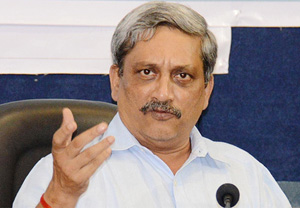
Defence Minister Manohar Parrikar

Asked at the Aaj Tak-2014 conclave about the disturbances created by Pakistan along the border, he said India was not closing any options for "harsh measures".

"We are always prepared with counter measures. Eye for eye or 'eent ka jawab pathhar se' (befitting reply) appears to be an offensive statement. But ultimately, you have to teach a lesson to those who are rouge. "How do we do it is a part of strategy, and I won't reveal it here. But I am definitely not closing any ... harsh measures," Parrikar said. He, however, added that this was not the only option and India would also try diplomatic measures like exerting political and diplomatic pressure. "I know some people will say these have failed, have not yielded results, with a state like Pakistan where there is hardly any control by the political leadership. "These might have some meaning but I think there are some effective measures that can be preventive.

"There cannot be always defensive measures. We can have preventive measures. We need not wait for someone to attack," the minister said. Parrikar said the response from India had been strong and terrorists have been neutralised. "This year the number of neutralised terrorists is 102 compared to 66 last year. You can understand the level of engagements." He was asked about the risks of a nuclear conflict between India and Pakistan."Nuclear doctrine (advocates) restraint. I don't think any state can resort to it. A full-scale war can be linked to the nuclear aspect of it, but if there are places where you get terrorists across, there are people who do it. Those people will have to be pressurised," he said. "I am not talking about going across the border. Why not use the same people who attack us, as we say 'gun ka barrel ghuma do' (turn the barrel of the gun around)," he said.

The minister added that increasing the morale of the security forces and providing them better equipment was a priority. "The soldiers who neutralise terrorists at a height of 14,000 feet... Equip them properly. If we can give good boots to soldiers in Siachen, why not to these soldiers? "When they go on vacation after two years, are you aware there is not enough space to get them back in the aircraft available? "When you expect them to fight (at the border), their battle at home should be taken care of by the ministry," he said.

Observing that blacklisting was not the only solution, the Defence Minister said Italian defence multinational Finmeccanica, which was blacklisted, has so many subsidiaries and wondered was it viable not to buy arms from any one of them.

Expressing concern over death of army personnel in various accidents, Parrikar said he will not allow any carelessness.

"Give me sometime I will establish accountability. I cannot lose soldiers while loading the gun. Definitely no."

Asked whether the last 10 years were a lost decade in terms of modernisation of armed forces, he said, "It was a lost decade for defence forces but it was gain decade for many others."

On his predecessor A K Antony, Parrikar, who is an IIT graduate, said, "There is no solution only by remaining honest.

"I agree that Antony may have a clean image that does mean the reflection of cleanliness in the actual procurement.

"To remove dirt, you have to step into it," Parrikar said, adding he reads all the files and his engineering background at times helps him in understanding technical issues.

"I do not know how many ministers read files. I read files and raise many queries. I have been habitual reader. I can isolate the good part of it. I think once you have clean intentions or proper reasoning for all judgements, there can be no question of quality of the judgement," he added.

On implementation of the 'One Rank, One Pension' policy, Parrikar said an announcement will be made within next 4-8 weeks.

"I will not drag the issue for long. I will sort it out at the earliest. If I could take the satisfaction level (of the former armed personnel) to 80-90 per cent, that should be a good enough solution," he said.

'One Rank, One Pension' has been a long-standing demand of the over two million ex-servicemen of India. It seeks to ensure that a uniform pension is paid to the defence personnel retiring at the same rank with the same length of service, irrespective of their date of retirement.


Comments

Add new comment

  • Coastaldigest.com reserves the right to delete or block any comments.
  • Coastaldigset.com is not responsible for its readers’ comments.
  • Comments that are abusive, incendiary or irrelevant are strictly prohibited.
  • Please use a genuine email ID and provide your name to avoid reject.
News Network
December 13,2025

New Delhi: School-going children are picking up drug and smoking habits and engaging in consumption of alcohol, with the average age of introduction to such harmful substances found to be around 13 years, suggesting a need for earlier interventions as early as primary school, a multi-city survey by AIIMS-Delhi said.

The findings also showed substance use increased in higher grades, with grade XI/XII students two times more likely to report use of substances when compared with grade VIII students. This emphasised the importance of continued prevention and intervention through middle and high school.

The study led by Dr Anju Dhawan of AIIMS's National Drug Dependence Treatment Centre, published in the National Medical Journal of India this month, looks at adolescent substance use across diverse regions.

The survey included 5,920 students from classes 8, 9, 11 and 12 in urban government, private and rural schools across 10 cities -- Bengaluru, Chandigarh, Delhi, Dibrugarh, Hyderabad, Imphal, Jammu, Lucknow, Mumbai, and Ranchi. The data were collected between May 2018 and June 2019.

The average age of initiation for any substance was 12.9 (2.8) years. It was lowest for inhalants (11.3 years) followed by heroin (12.3 years) and opioid pharmaceuticals (without prescription; 12.5 years).

Overall, 15.1 per cent of participants reported lifetime use, 10.3 per cent reported past year use, and 7.2 per cent reported use in the past month of any substance, the study found.

The most common substances used in the past year, after tobacco (4 per cent) and alcohol (3.8 per cent), were opioids (2.8 per cent), followed by cannabis (2 per cent) and inhalants (1.9 per cent). Use of non-prescribed pharmaceutical opioids was most common among opioid users (90.2 per cent).

On being asked, 'Do you think this substance is easily available for a person of your age' separately for each substance category, nearly half the students (46.3 per cent) endorsed that tobacco products and more than one-third of the students (36.5 per cent) agreed that a person of their age can easily procure alcohol products.

Similarly, for Bhang (21.9 per cent), ganja/charas (16.1 per cent), inhalants (15.2 per cent), sedatives (13.7 per cent), opium and heroin (10 per cent each), the students endorsed that these can be easily procured.

About 95 per cent of the children, irrespective of their grade, agreed with the statement that 'drug use is harmful'.

The rates of substance use (any) among boys were significantly higher than those of girls for substance use (ever), use in the past year and use in the past 30 days. Compared to grade VIII students, grade IX students were more likely, and grade XI/XII students were twice as likely to have used any substance (ever).

The likelihood of past-year use of any substance was also higher for grade IX students and for grade XI/XII students as compared to grade VIII students.

About 40 per cent of students mentioned that they had a family member who used tobacco or alcohol each. The use of cannabis (any product) and opioid (any product) by a family member was reported by 8.2 per cent and 3.9 per cent of students, respectively, while the use of other substances, such as inhalants/sedatives by family was 2-3 per cent, the study found.

A relatively smaller percentage of students reported use of tobacco or alcohol among peers as compared to among family members, while a higher percentage reported inhalants, sedatives, cannabis or opioid use among peers.

Children using substances (past year) compared to non-users reported significantly higher any substance use by their family members and peers.

There were 25.7 per cent students who replied 'yes' to the question 'conflicts/fights often occur in your family'. Most students also replied affirmatively to 'family members are aware of how their time is being spent' and 'damily members are aware of with whom they spend their time'.

Comments

Add new comment

  • Coastaldigest.com reserves the right to delete or block any comments.
  • Coastaldigset.com is not responsible for its readers’ comments.
  • Comments that are abusive, incendiary or irrelevant are strictly prohibited.
  • Please use a genuine email ID and provide your name to avoid reject.
News Network
December 16,2025

bengal.jpg

The deletion of over 58 lakh names from West Bengal’s draft electoral rolls following a Special Intensive Revision (SIR) has sparked widespread concern and is likely to deepen political tensions in the poll-bound state.

According to the Election Commission, the revision exercise has identified 24 lakh voters as deceased, 19 lakh as relocated, 12 lakh as missing, and 1.3 lakh as duplicate entries. The draft list, published after the completion of the first phase of SIR, aims to remove errors and duplication from the electoral rolls.

However, the scale of deletions has raised fears that a large number of eligible voters may have been wrongly excluded. The Election Commission has said that individuals whose names are missing can file objections and seek corrections. The final voter list is scheduled to be published in February next year, after which the Assembly election announcement is expected. Notably, the last Special Intensive Revision in Bengal was conducted in 2002.

The development has intensified the political row over the SIR process. Chief Minister Mamata Banerjee and her Trinamool Congress have strongly opposed the exercise, accusing the Centre and the Election Commission of attempting to disenfranchise lakhs of voters ahead of the elections.

Addressing a rally in Krishnanagar earlier this month, Banerjee urged people to protest if their names were removed from the voter list, alleging intimidation during elections and warning of serious consequences if voting rights were taken away.

The BJP, meanwhile, has defended the revision and accused the Trinamool Congress of politicising the issue to protect what it claims is an illegal voter base. Leader of the Opposition Suvendu Adhikari alleged that the ruling party fears losing power due to the removal of deceased, fake, and illegal voters.

The controversy comes amid earlier allegations by the Trinamool Congress that excessive work pressure during the SIR led to the deaths by suicide of some Booth Level Officers (BLOs), for which the party blamed the Election Commission. With the draft list now out, another round of political confrontation appears imminent.

As objections begin to be filed, the focus will be on whether the correction mechanism is accessible, transparent, and timely—critical factors in ensuring that no eligible voter is denied their democratic right ahead of a crucial election.

Comments

Add new comment

  • Coastaldigest.com reserves the right to delete or block any comments.
  • Coastaldigset.com is not responsible for its readers’ comments.
  • Comments that are abusive, incendiary or irrelevant are strictly prohibited.
  • Please use a genuine email ID and provide your name to avoid reject.