New RBI rules for debit and credit cards kick in tomorrow

Agencies
March 15, 2020

New Delhi, Mar 15: The new rules for debit and credit cards to increase security and reduce frauds kick in from Monday. In January, the Reserve Bank of India (RBI) had issued new rules to improve user convenience and increase the security of card transactions. These rules will help in curbing the misuse of debit and credit cards.

RBI has directed banks to allow only domestic card transactions at ATMs and PoS terminals in India at the time of issuance/reissuance of card. For international transactions, online transactions, card-not-present transactions and contactless transactions, customers will have to separately set up services on their card.

These rules will be applicable for new cards from March 16. Those with old cards can decide whether to disable any of these features.

As per the existing rules, these services used to come automatically with the card, but now it will start at the request of the customer.

Debit or credit card customers who have not yet done any online transaction, contactless transaction or international transaction with the card, then these services on the card will automatically stop from March 16.

The Reserve Bank has asked all banks to provide mobile banking, net banking option to enable limit and enable and disable service 24 hours a day, seven days a week.

If the customer makes any change in the status of the card, the bank will alert the customer through SMS/email and send the information.

Issuers shall provide to all cardholders facility to switch on/off and set/modify transaction limits (within the overall card limit, if any, set by the issuer) for all types of transactions -- domestic and international, at PoS/ATMs/online transactions/contactless transactions, etc.,

The provisions, however, are not mandatory for prepaid gift cards and those used at mass transit systems.

The latest instructions come in the wake of rising instances of cyber frauds and the huge increase in the use of cards.

Comments

Add new comment

  • Coastaldigest.com reserves the right to delete or block any comments.
  • Coastaldigset.com is not responsible for its readers’ comments.
  • Comments that are abusive, incendiary or irrelevant are strictly prohibited.
  • Please use a genuine email ID and provide your name to avoid reject.
News Network
December 7,2025

envoy.jpg

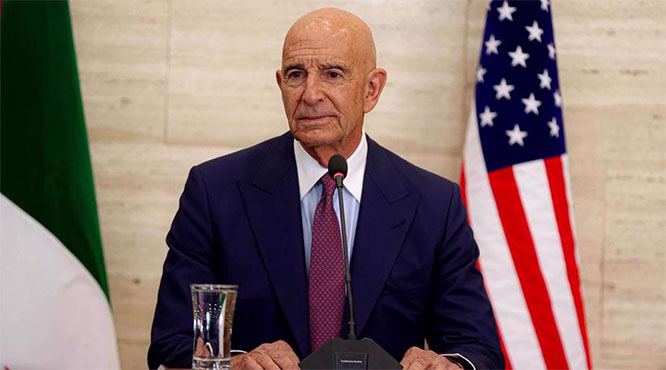
Since 1946, the United States has attempted 93 coups or “regime change” operations across the world — including two in Iran, US Special Envoy for Syria Tom Barrack has admitted.

Speaking to the UAE-based IMI Media Group, in remarks published by The National, Barrack said Washington tried twice to overthrow the Iranian government but failed both times. 

“For (Trump) then to be imputed with regime change — we had two regime changes in Iran already. Neither one worked. So I think wisely leave it to the region to solve,” said Barrack, who also serves as the US ambassador to Turkey.

His comments come six months after the US joined Israel in airstrikes against Iran during ongoing indirect nuclear negotiations between Tehran and Washington.

On June 13, Israel launched an attack on Iran that killed at least 1,064 people and hit civilian infrastructure. Days later, the United States targeted three nuclear facilities — Fordow, Natanz and Isfahan — in what Iran called a clear violation of international law. Iranian retaliation eventually forced a halt to the assault on June 24.

Barrack further claimed that US President Donald Trump and Foreign Secretary Marco Rubio are “not into regime change” and prefer a regional approach driven by Middle Eastern countries themselves. According to him, regional dialogue and non-interference by outside powers offer a more durable path forward.

He added that Washington is still open to an agreement with Tehran if Iranian authorities show “seriousness” and willingness to engage constructively.

However, Iran maintains the US has not shown readiness for meaningful talks. In an interview with Japan’s Kyodo News, Iranian Foreign Minister Abbas Araghchi said negotiations could advance only if Washington acknowledges Iran’s right to peaceful nuclear energy and lifts unilateral sanctions.

Comments

Add new comment

  • Coastaldigest.com reserves the right to delete or block any comments.
  • Coastaldigset.com is not responsible for its readers’ comments.
  • Comments that are abusive, incendiary or irrelevant are strictly prohibited.
  • Please use a genuine email ID and provide your name to avoid reject.
News Network
December 20,2025

train.jpg

At least seven elephants were killed and one calf injured after a herd collided with the Sairang-New Delhi Rajdhani Express in Assam's Hojai on Saturday morning, leading to disruption of rail services. 

The Sairang-New Delhi Rajdhani Express struck a herd of elephants, resulting in the derailment of the locomotive and five coaches. No passenger casualties or injuries were reported, officials said.

The New Delhi-bound train met with the accident around 2.17 am, PTI reported. The Sairang-New Delhi Rajdhani Express connects Mizoram's Sairang (near Aizawl) to Anand Vihar Terminal (Delhi). 

Railway has issued helpline numbers at the Guwahati Railway Station:-

•    0361-2731621
•    0361-2731622
•    0361-2731623

The accident site is located about 126 km from Guwahati. Following the incident, accident relief trains and railway officials rushed to the spot to initiate rescue operations.

Train Services Disrupted

Sources said that due to the derailment and elephant body parts scattered on the tracks, train services to Upper Assam and other parts of the Northeast were affected.

Passengers from the affected coaches were temporarily accommodated in vacant berths available in other coaches of the train. Once the train reaches Guwahati, additional coaches will be attached to accommodate all passengers, after which the train will resume its onward journey.

The incident occurred at a location that is not a designated elephant corridor. The loco pilot, upon spotting the herd on the tracks, applied emergency brakes. Despite this, the elephants dashed into the train, leading to the collision and derailment.

Last month, an elephant was killed after being hit by a train in Dhupguri in West Bengal's Jalpaiguri district. The incident took place on November 30. 

The adult elephant was killed on the spot, and a calf was discovered lying injured beside the tracks. 

Over 70 Elephants Killed In Train Collisions Over Last 5 Years

At least 79 elephants have died in train collisions across the country in the last five years, the Environment Ministry had informed Parliament in August.

In a written reply in the Lok Sabha, Minister of State for Environment Kirti Vardhan Singh had said the figure is based on reports from state governments and Union Territory administrations for the period 2020-21 to 2024-25.

He said that the ministry does not maintain consolidated data on the deaths of other wild animals on railway tracks, including in designated elephant corridors.

Singh confirmed that three elephants, including a mother and her calf, were killed on July 18 this year after being hit by a speeding express train on the Kharagpur-Tatanagar section in West Bengal's Paschim Midnapore district. The incident took place near Banstala between Jhargram and Banstala stations.

The minister said several measures have been taken jointly by the Environment Ministry and the Railways to prevent such accidents.

These include imposing speed restrictions in elephant habitats, pilot projects such as seismic sensor-based detection of elephants near tracks and construction of underpasses, ramps and fencing at vulnerable points.

The Wildlife Institute of India, in consultation with the ministry and other stakeholders, has also issued guidelines titled 'Eco-friendly Measures to Mitigate Impacts of Linear Infrastructure' to help agencies design railways and other projects in ways that reduce human-animal conflicts.

Singh added that capacity-building workshops were conducted for railway officials at the Wildlife Institute of India in 2023 and 2024 to raise awareness on elephant conservation and protection.

A detailed report titled 'Suggested Measures to Mitigate Elephant & Other Wildlife Train Collisions on Vulnerable Railway Stretches in India' had also been prepared after surveys across 127 railway stretches covering 3,452 km.

Of these, 77 stretches spanning 1,965 km in 14 states were prioritised for mitigation, with site-specific interventions suggested. 

Comments

Add new comment

  • Coastaldigest.com reserves the right to delete or block any comments.
  • Coastaldigset.com is not responsible for its readers’ comments.
  • Comments that are abusive, incendiary or irrelevant are strictly prohibited.
  • Please use a genuine email ID and provide your name to avoid reject.
News Network
December 16,2025

jordan.jpg

Prime Minister Narendra Modi on Monday held talks with Jordan’s King Abdullah II in Amman, during which the two leaders discussed ways to further strengthen bilateral relations, with the Prime Minister outlining an eight-point vision covering key areas of cooperation.

Describing the meeting as “productive”, PM Modi said he shared a roadmap focused on trade and economy, fertilisers and agriculture, information technology, healthcare, infrastructure, critical and strategic minerals, civil nuclear cooperation, and people-to-people ties.

In a post on social media platform X, the Prime Minister praised King Abdullah II’s personal commitment to advancing India–Jordan relations, particularly as both countries mark the 75th anniversary of the establishment of diplomatic ties this year.

“Held productive discussions with His Majesty King Abdullah II in Amman. His personal commitment towards vibrant India-Jordan relations is noteworthy. This year, we are celebrating the 75th anniversary of our bilateral diplomatic relations,” PM Modi said.

The meeting took place at the Al Husseiniya Palace, where the two leaders also exchanged views on regional and global issues of mutual interest. According to the Ministry of External Affairs (MEA), both sides agreed to further deepen cooperation in areas including trade and investment, defence and security, counter-terrorism and de-radicalisation, fertilisers and agriculture, infrastructure, renewable energy, tourism, and heritage.

The MEA said both leaders reaffirmed their united stand against terrorism.

PM Modi arrived in Amman earlier on Monday and was received by Jordanian Prime Minister Jafar Hassan, who accorded him a formal welcome. Following the talks, King Abdullah II hosted a banquet dinner in honour of the Prime Minister, reflecting the warmth of bilateral ties.

Jordan is the first leg of PM Modi’s three-nation tour. From Amman, the Prime Minister will travel to Ethiopia at the invitation of Prime Minister Abiy Ahmed Ali, marking his first official visit to the African nation. The tour will conclude with a visit to Oman.

Comments

Add new comment

  • Coastaldigest.com reserves the right to delete or block any comments.
  • Coastaldigset.com is not responsible for its readers’ comments.
  • Comments that are abusive, incendiary or irrelevant are strictly prohibited.
  • Please use a genuine email ID and provide your name to avoid reject.