



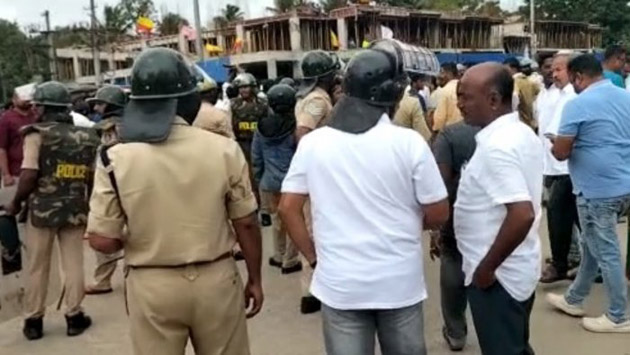
Cops shoot one suspect in leg a day after I-Day communal clash leaves 2 injured in Shivamogga

News Network
August 16, 2022

shimoga.jpg

Shivamogga, Aug 16: A man, who was suspected to be involved in clashes on Independence Day in Shivamogga, was shot in his leg by the police today morning. The police claimed that he tried to attack them when they went to detain him.

Mohammed Zabi alias Charbi (30), a resident of Marnami Bailu in this district headquarters town, is recovering in a hospital after the incident.

Two men belonging to Hindu and Muslim communities - Prem Singh (aged 20) and Saddam – were hospitalized with injuries after clashes broke out between two communities in the town over putting up banners of Hindutva ideologue Vinayak Damodar Savarkar and 18th century Mysuru ruler and India’s first freedom fighter Tipu Sultan on Monday.

Soon after the clash, prohibitory orders under section 144 of the IPC were imposed in the town.

A case of attempt to murder was also registered under section 307 of the IPC against those who allegedly stabbed Prem Singh, and, in this connection, police arrested Nadeem and Abdul Rehman.

On Tuesday morning when a police team went to detain Zabi, he allegedly tried to attack police team. In self defence, sub-inspector Manjunath S Kuki of Vinoba Nagar police station shot in his right leg, police said. He was rushed to a government hospital where he is recovering.

I-Day clash

Two people were injured on Monday as two groups clashed over displaying banners of their leaders at Amir Ahmed Circle on BH Road to mark Independence Day in the city.

Police sources said that a group of activists from Bajrang Dal and other right-wing organisations led by BJP leader Deen Dayal erected a banner of Hindutva leader Vinayak Damodar Savarkar at the circle, an area known to be communally sensitive, around 2.30 pm. The police managed to seize the banner with the help of corporation officials after a brief altercation with the group.

Meanwhile, Muslim youths gathered at the circle and insisted that they be allowed to erect a Tipu Sultan banner if Savarkar's banner is put up, superintendent of police B M Laxmi Prasad said. When the two groups started approaching the circle, the police caned and chased them away. Meanwhile, a few people were running towards the circle to hoist the tricolour. The police took away the flag and hoisted it themselves at the circle, he added. 

Enraged by this, members of right-wing groups staged flash protests demanding that the authorities permit them to display Savarkar's banner. Deputy commissioner R Selvamani pacified the protesters. The police detained the agitators as a precaution and later released them.

Amid the tension, Prem Singh was stabbed in Uppar Keri area by bike-borne youths. Prem Singh, employed at a cloth outlet on Kasturba Road, was on his way home in neighbouring Gandhi Bazaar after locking the shop when he was stabbed. SP Laxmi Prasad said that the stabbing was not related to the banner incident but a random incident after the lathi charge. He also denied reports of another stabbing incident in the city. 

Meanwhile, a youth, Saddam was attacked either with knife or stone and admitted to the District McGann general hospital. Hospital medical superintendent M S Sridhar said that Prem Singh and Saddam were both out of danger. 

On August 13, a man was arrested for obstructing corporation officials from discharging their duty at a photo exhibition of freedom fighters at the City Centre mall on Nehru Road.

Based on a complaint by the deputy commissioner of the city corporation, the police registered an FIR against unidentified youths. Later, Mohammed Sharief, spouse of a Congress corporator, was caught and produced before a court. He has been remanded in judicial custody till August 26.

Tension had prevailed at the exhibition for a while when a group of Muslims objected to Savarkar's photo along with other freedom fighters like Gandhi and Chandrashekhar Azad. They had argued that Savarkar was not a freedom fighter and the corporation had not displayed the photo of a single Muslim freedom fighter though many Muslims had sacrificed their lives during the freedom movement.


Comments

Add new comment

  • Coastaldigest.com reserves the right to delete or block any comments.
  • Coastaldigset.com is not responsible for its readers’ comments.
  • Comments that are abusive, incendiary or irrelevant are strictly prohibited.
  • Please use a genuine email ID and provide your name to avoid reject.
News Network
January 31,2026

Roy.jpg

Bengaluru: The shooting incident involving CJ Roy, founder of the Confident Group, has once again put the spotlight on a businessman whose life has swung between flamboyant global success and persistent controversy at home.

Though Roy’s business interests extended across continents, his roots lay firmly in Karnataka. An alumnus of Christ School in Bengaluru, he later moved to Tumakuru to pursue an engineering degree. Those familiar with his early years describe him as intensely ambitious, beginning his career as a salesman at a small electronics firm dealing in computers.

Roy’s entry into large-scale real estate came through the Crystal Group, where he worked closely with Latha Namboothiri and rose from manager to director. However, the launch of the Confident Group in 2005 was clouded by industry speculation. Insiders speak of a fallout involving alleged “benami” properties and claims of deception that ultimately led to his independent venture—an episode Roy spent years trying to distance himself from, according to associates.

A tale of two cities

Roy’s professional trajectory diverged sharply across geographies.

In Dubai, he built a reputation as a bold and efficient developer, completing massive luxury residential projects in record time—some reportedly within 11 months. His rapid project delivery and lavish lifestyle in the Emirates earned him admiration and visibility in the real estate sector.

In Bengaluru, however, his image remained far more fractured. Sources say Roy stayed away from the city for several years amid disputes over unpaid dues to vendors and suppliers. Several projects were allegedly stalled, with accusations of unfulfilled commitments to cement and steel suppliers continuing to follow him.

Roy’s return to Bengaluru’s business and social circles began around 2018, marked by a conscious attempt at rebranding. His appointment as Honorary Consul of the Slovak Republic added diplomatic legitimacy, which he complemented with visible CSR initiatives, including ambulance donations and high-profile charity events.

Heavy police presence in Langford Town

Following the incident, police personnel from the Central division were deployed outside the Confident Group building in Langford Town, which also houses the Slovak Honorary Consulate in Bengaluru.

The otherwise busy premises near Hosur Road wore a deserted look on Friday, reflecting the shock and uncertainty that followed the tragedy.

Comments

Add new comment

  • Coastaldigest.com reserves the right to delete or block any comments.
  • Coastaldigset.com is not responsible for its readers’ comments.
  • Comments that are abusive, incendiary or irrelevant are strictly prohibited.
  • Please use a genuine email ID and provide your name to avoid reject.
News Network
February 3,2026

Bengaluru: Following reports of fresh Nipah virus (NiV) cases in West Bengal and heightened vigilance across parts of Southeast Asia, the Karnataka Health Department has placed the state on high alert and activated emergency preparedness protocols.

Health officials said enhanced surveillance measures have been initiated after two healthcare workers in Barasat, West Bengal, tested positive for the virus earlier this month. While no cases have been reported in Karnataka so far, authorities said the state’s past exposure to Nipah outbreaks and high inter-state mobility warranted preventive action.

Officials have directed district health teams to intensify monitoring, particularly at hospitals and points of entry, and to ensure early detection and isolation of suspected cases.

High Mortality Virus with Multiple Transmission Routes

Nipah virus is a zoonotic disease that can spread from animals to humans and has a reported fatality rate ranging between 60 and 75 per cent. Fruit bats, also known as flying foxes, are the natural reservoirs of the virus and can transmit it by contaminating food sources with saliva or urine.

Known modes of transmission include:

•    Contaminated food: Consumption of fruits partially eaten by bats or raw date-palm sap
•    Animal contact: Exposure to infected pigs or other animals
•    Human-to-human transmission: Close contact with body fluids of infected persons, particularly in healthcare settings

Symptoms and Disease Progression

The incubation period typically ranges from 4 to 14 days, though delayed onset has also been reported. Early symptoms often resemble common viral infections, making prompt clinical suspicion critical.

•    Initial symptoms: Fever, headache, body aches, fatigue, sore throat
•    Progressive symptoms: Drowsiness, disorientation, altered mental state
•    Severe stage: Seizures, neck stiffness and acute encephalitis, which can rapidly progress to coma

Public Health Advisory

The Health Department has issued precautionary guidelines urging the public to adopt risk-avoidance practices to prevent any local spillover.

Do’s
•    Wash fruits thoroughly before consumption
•    Drink boiled and cooled water
•    Use protective equipment while handling livestock
•    Maintain strict hand hygiene

Don’ts
•    Avoid fruits found on the ground or showing bite marks
•    Do not consume beverages made from raw tree sap, including toddy
•    Avoid areas with dense bat populations
•    Do not handle sick or dead animals

Preparedness Measures

Officials confirmed that isolation wards are being readied in major government hospitals and that medical staff are being sensitised to identify early warning signs.

“There is no cause for panic, but there is a need for heightened vigilance,” a senior health official said, adding that there is currently no approved vaccine or specific antiviral treatment for Nipah, and care remains largely supportive.

Comments

Add new comment

  • Coastaldigest.com reserves the right to delete or block any comments.
  • Coastaldigset.com is not responsible for its readers’ comments.
  • Comments that are abusive, incendiary or irrelevant are strictly prohibited.
  • Please use a genuine email ID and provide your name to avoid reject.
News Network
January 20,2026

Mangaluru: In a major step towards strengthening rural innovation, the Office of the Principal Scientific Adviser (PSA) to the Government of India is supporting the establishment of RuTAGe Smart Village Centres (RSVCs) across the country through collaborations with academic institutions, civil society organisations and philanthropic partners.

As part of this national initiative, Nitte (Deemed to be University) will set up the first RSVCs in the region at Nitte GP in Udupi district and at the Nitte Health Centre, Sevanjali Trust, Farangipete, in Dakshina Kannada district. The centres will be inaugurated on January 21. In South India, the programme is being implemented by the Section Infin-8 Foundation (SI-8).

Speaking to reporters on Monday, SI-8 founder-director Vishwas US said experts from Nitte University and SI-8 would work closely with farmers, students, youth and local entrepreneurs to adapt and deploy technologies tailored to local needs.

Project head Prof Iddya Karunasagar, representing Nitte DU, said the RSVCs at Nitte and Farangipete would serve as demonstration hubs for a wide range of agriculture, energy, skill-development and assistive technologies. These include solar dryers for fruits, vegetables and crops; soil-testing solutions; power weeders and women-friendly farm tools; wind-powered devices for rural artisans; grain storage systems; grass-cutting and tree-climbing equipment; and liquid fertiliser production using cowshed waste.

SI-8 CEO Aravind C Kumar said the centres would also provide access to digital and knowledge-based platforms such as ISRO applications, government scheme portals, market linkage tools and gamified learning resources, along with assistive technologies for persons with visual impairments.

Highlighting the broader impact of the initiative, Principal Scientific Adviser Prof Ajay Kumar Sood said it demonstrated how applied research could bridge the rural–urban divide and help create self-reliant, technology-enabled villages.

The initiative has been made possible through philanthropic support from Dr NC Murthy of ACM Business Solutions, LLC, USA. Dr Sapna Poti, Director (Strategic Alliances) at the Office of the Principal Scientific Adviser, said the long-term objective is to build self-sufficient, technology-driven communities capable of generating sustainable livelihoods on their own.

Comments

Add new comment

  • Coastaldigest.com reserves the right to delete or block any comments.
  • Coastaldigset.com is not responsible for its readers’ comments.
  • Comments that are abusive, incendiary or irrelevant are strictly prohibited.
  • Please use a genuine email ID and provide your name to avoid reject.