



'Don't sensationalise': SC refuses to give specific date to hear plea against Karnataka HC verdict on hijab

News Network
March 24, 2022

New Delhi: The Supreme Court on Thursday declined to give any specific date to hear a plea challenging the Karnataka High Court order, which dismissed all petitions seeking direction for permission to wear hijab in classrooms.

Senior advocate Devadutt Kamat mentioned one of the cases on behalf of a petitioner, a Muslim girl student, and sought urgent listing of the matter. Kamat insisted that exams were approaching and urged the court for an urgent hearing on the matter.

A bench headed by Chief Justice N.V. Ramana said this has nothing to do with the exams. The Chief Justice told Kamat not to sensationalise the matter.

Kamat contended that the girl students were not being allowed to enter the schools, and they will lose one year. However, the bench moved on to the next item.

On March 16, the Supreme Court on Wednesday declined to grant an urgent hearing on a plea challenging the Karnataka High Court order, which held that wearing of hijab by the Muslim women does not form a part of the essential religious practice in Islamic faith.

Then, senior advocate Sanjay Hedge, representing the petitioners, mentioned the plea before a bench headed by Chief Justice N.V. Ramana. Hedge said there was urgency in the matter, as several girls have to appear in exams. The bench said others have also mentioned and the court will look into the matter.

Hedge had insisted that the exams are starting and there was urgency in the matter.

The bench said it needed time and it would post the matter for hearing. After brief submissions, the bench said the court may list it after Holi vacations. "Give us time, we'll post the matter," said the bench.

The plea filed through advocate Adeel Ahmed and Rahamathullah Kothwal said the high court order creates an unreasonable classification between the Muslim and the non-Muslim female students, and thereby is in straight violation of the concept of secularism which forms the basic structure of the Indian Constitution. The petitioners are Mohamed Arif Jameel and others.

The plea said: "The impugned order is also in sheer violation of the Article 14, 15, 19, 21 and 25 of the Indian Constitution and also violates the core principles of the International Conventions that India is a signatory to."

It further added, "Being aggrieved by the impugned Government Order, as it is in violation of Indian constitution, the petitioner had approached the Hon'ble High Court by way of a Public Interest Litigation (PIL) petition challenging the validity of the same.

"The Hon'ble High Court vide the impugned order had sought to curtail the fundamental right of Muslim student-women by upholding the impugned Government Order which bars Muslim women from wearing the hijab and pursue their education. It is hereby submitted that the right to wear hijab is an 'essential religious practice' and falls within the ambit of the right of expression guaranteed by Article 19 (1) (a), the right to privacy and also the Freedom of Conscience under Article 25 of the Constitution. The same cannot be infringed upon without a valid 'law'."

Another plea, filed by two Muslim students, Manan and Niba Naaz, through advocate Anas Tanwir, said: "The petitioners most humbly submit that the High Court has erred in creating a dichotomy of freedom of religion and freedom of conscience wherein the court has inferred that those who follow a religion cannot have the right to conscience."

Comments

Add new comment

  • Coastaldigest.com reserves the right to delete or block any comments.
  • Coastaldigset.com is not responsible for its readers’ comments.
  • Comments that are abusive, incendiary or irrelevant are strictly prohibited.
  • Please use a genuine email ID and provide your name to avoid reject.
News Network
January 19,2026

trump.jpg

Donald Trump has linked his repeated threats to seize Greenland to his failure to win the Nobel Peace Prize, in a letter to Norwegian Prime Minister Jonas Gahr Støre.

The authenticity of the letter, in which Trump says he no longer feels obligated to “think purely of peace,” was confirmed by Støre to the Norwegian newspaper VG.

“Considering your country decided not to give me the Nobel Peace Prize for having stopped eight wars plus, I no longer feel an obligation to think purely of peace,” Trump wrote, adding he can now “think about what is good and proper for the United States.”

Støre said Trump’s letter was in response to a short message he had sent earlier, on behalf of himself and Finland’s President Alexander Stubb.

Trump has escalated rhetoric toward Greenland, a self-governing Danish territory, insisting the US will take control “one way or the other.” Over the weekend, he tweeted: “Now it is time, and it will be done!!!”

On Saturday, Trump threatened a 10% tariff on imports from Denmark, Norway, Sweden, France, Germany, the UK, the Netherlands, and Finland from 1 February until the US is allowed to purchase the island. EU diplomats met for emergency talks on possible retaliatory tariffs and sanctions.

In his letter, Trump argued Denmark “cannot protect” Greenland from Russia or China, questioning Danish ownership: “There are no written documents; it’s only that a boat landed there hundreds of years ago.” He added that NATO should support the US, claiming the world is “not secure unless we have complete and total control of Greenland.”

Trump’s stance has unsettled the EU and NATO, as he refused to rule out military action to take control of the mineral-rich island.

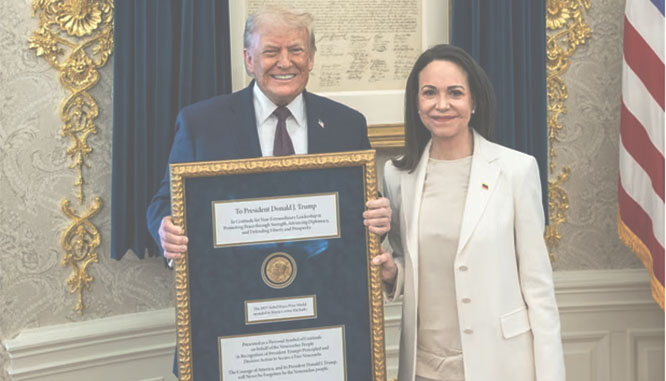
The Nobel Peace Prize is awarded by the independent Norwegian Nobel Committee, not the government. Trump had campaigned for last year’s prize, which went to Venezuelan opposition leader María Corina Machado, who dedicated her award to him.

Støre reiterated that the Nobel Prize decision rests solely with the committee.

Comments

Add new comment

  • Coastaldigest.com reserves the right to delete or block any comments.
  • Coastaldigset.com is not responsible for its readers’ comments.
  • Comments that are abusive, incendiary or irrelevant are strictly prohibited.
  • Please use a genuine email ID and provide your name to avoid reject.
News Network
January 23,2026

Karnataka Governor Thaawarchand Gehlot read only three lines from the 122-paragraph address prepared by the Congress-led state government while addressing the joint session of the Legislature on Thursday, effectively bypassing large sections critical of the BJP-led Union government.

The omitted portions of the customary Governor’s address outlined what the state government described as a “suppressive situation in economic and policy matters” under India’s federal framework. The speech also sharply criticised the Centre’s move to replace the Mahatma Gandhi National Rural Employment Guarantee Act (MGNREGA) with the Viksit Bharat–Guarantee for Rozgar and Ajeevika Mission (Gramin) Act, commonly referred to as the VB-GRAM (G) Act.

Governor Gehlot had earlier conveyed his objection to several paragraphs that were explicitly critical of the Union government. On Thursday, he confined himself to the opening lines — “I extend a warm welcome to all of you to the joint session of the State legislature. I am extremely pleased to address this august House” — before jumping directly to the concluding sentence of the final paragraph.

He ended the address by reading the last line of paragraph 122: “Overall, my government is firmly committed to doubling the pace of the State’s economic, social and physical development. Jai Hind — Jai Karnataka.”

According to the prepared speech, the Karnataka government demanded the scrapping of the VB-GRAM (G) Act, describing it as “contractor-centric” and detrimental to rural livelihoods, and called for the full restoration of MGNREGA. The state government argued that the new law undermines decentralisation, weakens labour protections, and centralises decision-making in violation of constitutional norms.

Key points from the unread sections of the speech:

•    Karnataka facing a “suppressive” economic and policy environment within the federal system

•    Repeal of MGNREGA described as a blow to rural livelihoods

•    VB-GRAM (G) Act accused of protecting corporate and contractor interests

•    New law alleged to weaken decentralised governance

•    Decision-making said to be imposed by the Centre without consulting states

•    Rights of Adivasis, women, backward classes and agrarian communities curtailed

•    Labourers allegedly placed under contractor control

•    States facing mounting fiscal stress due to central policies

•    VB-GRAM (G) Act accused of enabling large-scale corruption

Comments

Add new comment

  • Coastaldigest.com reserves the right to delete or block any comments.
  • Coastaldigset.com is not responsible for its readers’ comments.
  • Comments that are abusive, incendiary or irrelevant are strictly prohibited.
  • Please use a genuine email ID and provide your name to avoid reject.
News Network
February 1,2026

Bengaluru: Karnataka Deputy Chief Minister D K Shivakumar on Sunday criticised the Union Budget presented by Finance Minister Nirmala Sitharaman, claiming it offered no tangible benefit to the state.

Though he said he was yet to study the budget in detail, Shivakumar asserted that Karnataka had gained little from it. “There is no benefit for our state from the central budget. I was observing it. They have now named a programme after Mahatma Gandhi, after repealing the MGNREGA Act that was named after him,” he said.

Speaking to reporters here, the Deputy Chief Minister demanded the restoration of MGNREGA, and made it clear that the newly enacted rural employment scheme — VB-G RAM G — which proposes a 60:40 fund-sharing formula between the Centre and the states, would not be implemented in Karnataka.

“I don’t see any major share for our state in this budget,” he added.

Shivakumar, who also holds charge of Bengaluru development, said there were high expectations for the city from the Union Budget. “The Prime Minister calls Bengaluru a ‘global city’, but what has the Centre done for it?” he asked.

He also drew attention to the problems faced by sugar factories, particularly those in the cooperative sector, alleging a lack of timely decisions and support from the central government.

Noting that the Centre has the authority to fix the minimum support price (MSP) for agricultural produce, Shivakumar said the Union government must take concrete steps to protect farmers’ interests.

Comments

Add new comment

  • Coastaldigest.com reserves the right to delete or block any comments.
  • Coastaldigset.com is not responsible for its readers’ comments.
  • Comments that are abusive, incendiary or irrelevant are strictly prohibited.
  • Please use a genuine email ID and provide your name to avoid reject.