How ‘immoral policing’ incidents chipping away at social harmony in Mangaluru

News Network
February 25, 2023

Park.jpg

The rising incidents of moral policing in coastal Karnataka, especially in Mangaluru, in the last few years have cast a shadow over the port city, once known as a liberal society with a cosmopolitan culture. Social activists in the region reason that the deterioration in the social harmony happened after the growth of right-wing organisations, which have gained ground in the coastal belt.

They attribute the recurrence of such incidents as a result of the impunity granted to moral policing, political support to the outfits and a passive approach of the ruling BJP. Moral policing occurs mostly where the Hindutva outfits like Bajrang Dal are strong, which has affected the psyche of the young generation including students. The most glaring incident in the recent past was reported on July 25 last year when Bajrang Dal activists barged into a pub in the city protesting against women partying at the venue. Students were abused and chased away by the protestors. The attack reminded everyone of the notorious assault on girls at another pub by Sri Rama Sene members in 2009.

Observers say in most of the cases registered by the police, the accused go unpunished due to lack of evidence provided by law enforcement agencies. A top police official, on condition of anonymity, told PTI they intervene only when complaints are raised about illegal activities in pubs and public places. Right-wing organisations, including the Vishwa Hindu Parishad (VHP) and its youth wing Bajrang Dal, claim that their workers are only trying to protect the culture and tradition of the country and reminding the young generation about dignified behaviour in public spaces. "The activists carry out such protests only to protect the culture and dignity of the nation," says VHP leader Sharan Pumpwell.

He claims that people belonging to different religions partying and drinking are against the basic tenets of our culture and the activists react only when complaints are received from the public. Police said arrests are being made in many cases when a complaint is lodged. On several occasions, the victims do not wish to proceed with the cases, they contended. In 2022, there were 41 moral policing cases in Dakshina Kannada and Udupi districts, according to Suresh B Bhat, activist and member of the Karnataka Communal Harmony Forum and People's Union for Civil Liberties (PUCL), as detailed in a report titled 'Chronicle of communal incidents in coastal districts of Karnataka'.

Of the incidents, 37 were by Hindu vigilantes while four were by fringe groups of Muslim vigilantes. There was an increase in the number of instances of moral policing too, as in 2021, a total of 37 incidents were reported, while in 2020, only nine such cases were reported. In such instances of moral policing, couples who belonged to different faiths were either assaulted or handed over to the police by the vigilante groups, even if both the parties had been together wilfully. Police pointed out that the act of moral policing does not fall under any specific section of the Indian Penal Code (IPC).

However, their actions can attract charges under certain IPC sections. According to police, on moral policing incidents, they have been registering cases under IPC Sections 354 (outraging modesty of woman), 342 (wrongful confinement), 354 (molestation), 323 (voluntarily causing hurt) and 149 (unlawful assembly). DYFI leader Muneer Katipalla claims frequent incidents of moral policing occur with the tacit support of the ruling BJP in the state who prefer to remain mute spectators to such activities. These incidents are reflections of the agenda of polarisation, he asserted. Karnataka Chief Minister Basavaraj Bommai had last year stirred a controversy by his comment on moral policing. "When sentiments are hurt, there will be action and reaction," he said, inviting sharp criticism from the Opposition and social activists. 

Last year, several cases of moral policing were reported in the city including the attack on the pub. Right-wing activists had assaulted a Muslim youth for travelling with a girl of a different faith in the city on March 5. Again, on August 30, a 19-year-old Muslim student was beaten up and threatened by his college mates for befriending a Hindu girl. A 27-year-old Muslim youth was dragged out of a private bus at Naguri in the city on October 21 and beaten up for travelling with a Hindu woman. Bajrang Dal district leader Puneet Attavar had openly stated in December last that their activists will confront Muslim youth in the company of Hindu girls during New Year parties.

Police said activists of Hindutva outfits were behind the majority of attacks, while a section of Muslims were also involved in certain cases. After the infamous attack on party-goers at the pub by Sri Rama Sene activists in 2009, the court which heard the case had opined that the investigating officer had not provided sufficient evidence in the moral policing case. While acquitting the accused in the assault case in 2018, the court had observed that the officer failed to produce videos of the incident, which was shown by television channels. An indirect attempt was made by the officer to protect the real culprits, the court had remarked.

Activists in the city and the public in general feel the ugly behaviour exhibited by vigilantes must be prevented at any cost to ensure a dignified social atmosphere prevails in the city and the wider coastal region of the state. 

Comments

Add new comment

  • Coastaldigest.com reserves the right to delete or block any comments.
  • Coastaldigset.com is not responsible for its readers’ comments.
  • Comments that are abusive, incendiary or irrelevant are strictly prohibited.
  • Please use a genuine email ID and provide your name to avoid reject.
News Network
January 20,2026

DGP.jpg

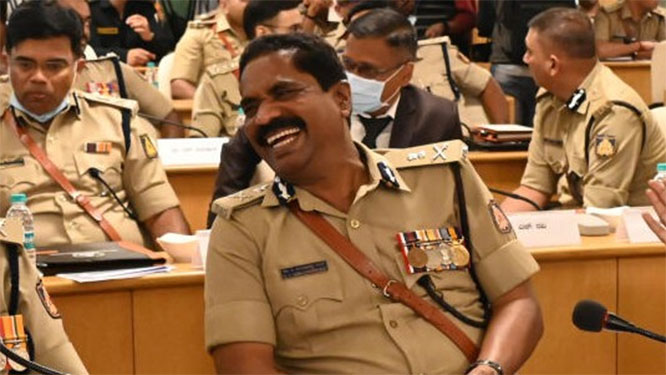
Karnataka DGP (Civil Rights Enforcement) K Ramachandra Rao was suspended with immediate effect, as per a state government order issued on Monday, 19 January. The order cited conduct unbecoming of a government servant and causing embarrassment to the state administration.

The Karnataka government suspended Rao after a purported video showed him in a compromising position with a woman inside his official chamber. The video went viral on social media. Rao rejected the videos outright, terming them "fabricated and false".

Who is K Ramachandra Rao?

Rao is a DGP-rank officer who was heading the Directorate of Civil Rights Enforcement until his suspension. He was promoted to DGP in September 2023 and assumed office in October 2023, the Sunday Guardian reported.

He also served as the Chairman and Managing Director of the Karnataka State Police Housing and Infrastructure Development Corporation Limited.

His stint as the Inspector General of Police (IGP) for the Southern Range was also marred by controversy. In 2014, during a cash seizure near Mysuru’s Yelwal, officials claimed the seized amount was ₹20 lakh, while the accused (Kerala-based merchants) claimed it was around ₹2.27 crore.

Rao, who was present during the seizure, denied all allegations. However, he was transferred soon after.

Allegations of collusion with a businessman surfaced, and a senior police officer was quoted by The Sunday Guardian as saying, “In Rao’s case, the CID has clearly mentioned that there was a great degree of lapse on the part of Rao and a deputy superintendent of police after it was brought to their notice that a few policemen, including a gunman attached to the IGP, were involved in the robbery.”

Rao had denied all wrongdoing in that incident. Despite past controversies, he rose to the state’s top police position, the Sunday Guardian reported.

Ranya Rao’s stepfather

Rao is the stepfather of Kannada actress Harshavardhini Ranya alias Ranya Rao, accused of orchestrating the illegal import of gold worth over ₹12.56 crore from Dubai to India along with two others — businessman Tarun Raju, and jewellery dealer Sahil Jain.

‘Obscene video’ controversy

A viral video showed Rao behaving inappropriately with a woman inside his office while in uniform.

The Karnataka government said in its Monday order that “vide videos and news reports widely broadcast on public news channels and media platforms, it is observed that Dr K Ramachandra Rao has acted in an obscene manner which is unbecoming of a Government Servant and also causing embarrassment to the Government.”

The order said the matter was examined by the state government, which found that the officer's conduct amounted to a violation of Rule 3 of the All India Services (Conduct) Rules, 1968.

The government said it is prima facie satisfied that "it is necessary to place Rao under suspension with immediate effect, pending inquiry".

During the suspension period, Rao will be entitled to subsistence allowance as per Rule 4 of the All India Services (Discipline and Appeal) Rules, 1969.

The order also places restrictions on his movement, stating that during the period of suspension, the officer must not leave headquarters under any circumstances without the written permission of the state government.

Comments

Add new comment

  • Coastaldigest.com reserves the right to delete or block any comments.
  • Coastaldigset.com is not responsible for its readers’ comments.
  • Comments that are abusive, incendiary or irrelevant are strictly prohibited.
  • Please use a genuine email ID and provide your name to avoid reject.
News Network
January 23,2026

Karnataka Governor Thaawarchand Gehlot read only three lines from the 122-paragraph address prepared by the Congress-led state government while addressing the joint session of the Legislature on Thursday, effectively bypassing large sections critical of the BJP-led Union government.

The omitted portions of the customary Governor’s address outlined what the state government described as a “suppressive situation in economic and policy matters” under India’s federal framework. The speech also sharply criticised the Centre’s move to replace the Mahatma Gandhi National Rural Employment Guarantee Act (MGNREGA) with the Viksit Bharat–Guarantee for Rozgar and Ajeevika Mission (Gramin) Act, commonly referred to as the VB-GRAM (G) Act.

Governor Gehlot had earlier conveyed his objection to several paragraphs that were explicitly critical of the Union government. On Thursday, he confined himself to the opening lines — “I extend a warm welcome to all of you to the joint session of the State legislature. I am extremely pleased to address this august House” — before jumping directly to the concluding sentence of the final paragraph.

He ended the address by reading the last line of paragraph 122: “Overall, my government is firmly committed to doubling the pace of the State’s economic, social and physical development. Jai Hind — Jai Karnataka.”

According to the prepared speech, the Karnataka government demanded the scrapping of the VB-GRAM (G) Act, describing it as “contractor-centric” and detrimental to rural livelihoods, and called for the full restoration of MGNREGA. The state government argued that the new law undermines decentralisation, weakens labour protections, and centralises decision-making in violation of constitutional norms.

Key points from the unread sections of the speech:

•    Karnataka facing a “suppressive” economic and policy environment within the federal system

•    Repeal of MGNREGA described as a blow to rural livelihoods

•    VB-GRAM (G) Act accused of protecting corporate and contractor interests

•    New law alleged to weaken decentralised governance

•    Decision-making said to be imposed by the Centre without consulting states

•    Rights of Adivasis, women, backward classes and agrarian communities curtailed

•    Labourers allegedly placed under contractor control

•    States facing mounting fiscal stress due to central policies

•    VB-GRAM (G) Act accused of enabling large-scale corruption

Comments

Add new comment

  • Coastaldigest.com reserves the right to delete or block any comments.
  • Coastaldigset.com is not responsible for its readers’ comments.
  • Comments that are abusive, incendiary or irrelevant are strictly prohibited.
  • Please use a genuine email ID and provide your name to avoid reject.
News Network
January 23,2026

modIKERALA.jpg

Prime Minister Narendra Modi, during his visit to Thiruvananthapuram on Friday, January 23, indicated that the Bharatiya Janata Party (BJP) is aiming to expand its political footprint in Kerala ahead of the Assembly elections scheduled in the coming months.

Speaking at a BJP-organised public meeting, Modi drew parallels between the party’s early electoral gains in Gujarat and its recent victory in the Thiruvananthapuram Municipal Corporation. The civic body win, which ended decades of Left control, was cited by the Prime Minister as a possible starting point for the party’s broader ambitions in the state.

Recalling BJP’s political trajectory in Gujarat, Modi said the party was largely insignificant before 1987 and received little media attention. He pointed out that the BJP’s first major breakthrough came with its victory in the Ahmedabad Municipal Corporation that year.

“Just as our journey in Gujarat began with one city, Kerala’s journey has also started with a single city,” Modi said, suggesting that the party’s municipal-level success could translate into wider electoral acceptance.

The Prime Minister alleged that successive governments led by the Left Democratic Front (LDF) and the United Democratic Front (UDF) had failed to adequately develop Thiruvananthapuram. He accused both fronts of corruption and neglect, claiming that basic infrastructure and facilities were denied to the capital city for decades.

According to Modi, the BJP’s control of the civic body represents a shift driven by public dissatisfaction with the existing political alternatives. He asserted that the BJP administration in Thiruvananthapuram had begun working towards development, though no specific details or timelines were outlined.

Addressing the gathering at Putharikandam Maidan, Modi said the BJP intended to project Thiruvananthapuram as a “model city,” reiterating his party’s commitment to governance-led change.

The Prime Minister’s visit to Kerala also included the inauguration of several development projects and the flagging off of new train services, as the BJP intensifies its political outreach in the poll-bound state.

Comments

Add new comment

  • Coastaldigest.com reserves the right to delete or block any comments.
  • Coastaldigset.com is not responsible for its readers’ comments.
  • Comments that are abusive, incendiary or irrelevant are strictly prohibited.
  • Please use a genuine email ID and provide your name to avoid reject.