



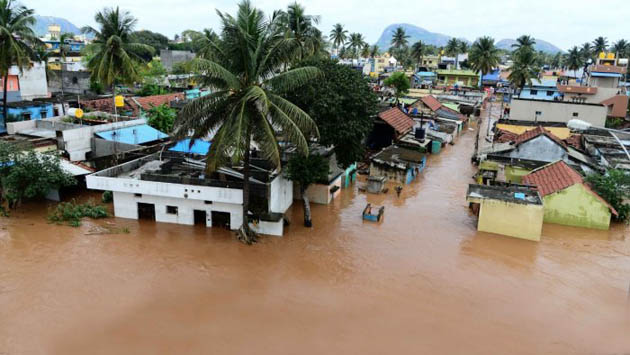
Hundreds of houses damaged, thousands of livestock killed as rains maroon cities, towns in parts of Karnataka

News Network
August 30, 2022

ramnagar.jpg

Benglauru, Aug 30: Normal life continued to affect in parts north Karnataka and of Mysuru region due to heavy rains that turned Ramanagara district into one big pool. A breach in Bakshi lake on Monday resulted in the flooding of Bengaluru-Mysuru Express Highway and railway tracks. 

Hundreds of houses were damaged, food grains and standing crops destroyed and thousands of livestock killed due to the impact of heavy rain in Ramanagara district. Motorists taking the highway had a tough time and a private bus carrying passengers was stranded on the highway.

Residents were rescued and shifted to seven relief centres. Heavy rains and floods inundated vast tracts of farm lands, destroying crops.

Rainwater gushed into the layouts of the town as the Bolappanakere overflowed. The lake has developed cracks, posing a great risk. 

Patients were shifted from the ground floor of Ramakrishna hospital as water entered the premises.

Vehicular movement came to a standstill on the 10-lane Bengaluru-Mysuru highway.

As the highway was closed at Channapatna and Ramanagara, vehicles were diverted to alternative routes.

A few cars and a bus were stuck in water as the Basavanapura underpass was flooded. Residents rescued passengers and those inside the car.

Boregowda (52), a resident of Ittamadu, was killed on the spot, while one more person was injured after a tree came crashing down on a car at Toredoddi village in Bidadi hobli.

Over 30 sheep were killed after the wall of a house fell on them at Gandhinagar in Ramanagara town.

Movement of trains was affected in the morning as water entered railway stations in Ramanagara and Channapatna.

Six houses in the quarters for fire department staff near Basavanapura on the Bengaluru-Mysuru highway were flooded with rainwater.

Water entered over 30 houses and a government school building at Palabhovidoddi village.

A cattle and a water tanker were washed away in flash floods in Arkavathi river. However, residents rescued the cattle.  

There was a flood-like situation following heavy discharge of water from Kanva dam in Channapatna. Water entered many villages and disrupted vehicular traffic.

Chamarajanagar and Yalandur taluks in Chamarajanagar district received heavy rains, believed to be the highest rainfall for a single day in the last three decades.

The downpour damaged houses, crops, public and private properties. There were floods in streams, lakes and rivers. 

Normal life was disrupted till noon. The district administration declared a holiday for schools and colleges.

Vehicular movement on the Chamarajanagar-Santhemaralli road was disrupted for hours as a bridge on the stretch was submerged. 

There was a mudslide near the 7th mile on the Madikeri-Mangaluru road. The Triveni Sangama at Bhagamandala has gone under water. Rainwater has entered the Bhagandeshwara temple.

Showers in Napoklu in Kodagu district created panic. Connectivity between Bhagamandala and Madikeri was cut off.

Bhagamandala and surrounding areas received 21.5 cm rainfall. A stretch of the Karike road caved in, affecting movement of traffic. 

North Karnataka

Kalaburagi, Bidar, Yadgir and Raichur in Kalyana Karnataka received heavy rains. Raichur and Yadgir recorded 16 mm rainfall.

It rained heavily in Haveri, Gadag, Uttara Kannada (U-K), Ballari and Vijayanagar districts.

A bridge connecting Akkur and Maradur villages across Varada river was washed away completely. 

It poured for the third consecutive day in Vijayanagar and Ballari districts, damaging houses.

Traffic came to a halt on the Adoni-Siraguppa road as the Raravi bridge was submerged. It rained for hours together in Hosapete. Sirsi and Mundgod in U-K district too recorded heavy rains.

Comments

Add new comment

  • Coastaldigest.com reserves the right to delete or block any comments.
  • Coastaldigset.com is not responsible for its readers’ comments.
  • Comments that are abusive, incendiary or irrelevant are strictly prohibited.
  • Please use a genuine email ID and provide your name to avoid reject.
News Network
January 23,2026

Karnataka Governor Thaawarchand Gehlot read only three lines from the 122-paragraph address prepared by the Congress-led state government while addressing the joint session of the Legislature on Thursday, effectively bypassing large sections critical of the BJP-led Union government.

The omitted portions of the customary Governor’s address outlined what the state government described as a “suppressive situation in economic and policy matters” under India’s federal framework. The speech also sharply criticised the Centre’s move to replace the Mahatma Gandhi National Rural Employment Guarantee Act (MGNREGA) with the Viksit Bharat–Guarantee for Rozgar and Ajeevika Mission (Gramin) Act, commonly referred to as the VB-GRAM (G) Act.

Governor Gehlot had earlier conveyed his objection to several paragraphs that were explicitly critical of the Union government. On Thursday, he confined himself to the opening lines — “I extend a warm welcome to all of you to the joint session of the State legislature. I am extremely pleased to address this august House” — before jumping directly to the concluding sentence of the final paragraph.

He ended the address by reading the last line of paragraph 122: “Overall, my government is firmly committed to doubling the pace of the State’s economic, social and physical development. Jai Hind — Jai Karnataka.”

According to the prepared speech, the Karnataka government demanded the scrapping of the VB-GRAM (G) Act, describing it as “contractor-centric” and detrimental to rural livelihoods, and called for the full restoration of MGNREGA. The state government argued that the new law undermines decentralisation, weakens labour protections, and centralises decision-making in violation of constitutional norms.

Key points from the unread sections of the speech:

•    Karnataka facing a “suppressive” economic and policy environment within the federal system

•    Repeal of MGNREGA described as a blow to rural livelihoods

•    VB-GRAM (G) Act accused of protecting corporate and contractor interests

•    New law alleged to weaken decentralised governance

•    Decision-making said to be imposed by the Centre without consulting states

•    Rights of Adivasis, women, backward classes and agrarian communities curtailed

•    Labourers allegedly placed under contractor control

•    States facing mounting fiscal stress due to central policies

•    VB-GRAM (G) Act accused of enabling large-scale corruption

Comments

Add new comment

  • Coastaldigest.com reserves the right to delete or block any comments.
  • Coastaldigset.com is not responsible for its readers’ comments.
  • Comments that are abusive, incendiary or irrelevant are strictly prohibited.
  • Please use a genuine email ID and provide your name to avoid reject.
News Network
January 20,2026

Mangaluru: In a major step towards strengthening rural innovation, the Office of the Principal Scientific Adviser (PSA) to the Government of India is supporting the establishment of RuTAGe Smart Village Centres (RSVCs) across the country through collaborations with academic institutions, civil society organisations and philanthropic partners.

As part of this national initiative, Nitte (Deemed to be University) will set up the first RSVCs in the region at Nitte GP in Udupi district and at the Nitte Health Centre, Sevanjali Trust, Farangipete, in Dakshina Kannada district. The centres will be inaugurated on January 21. In South India, the programme is being implemented by the Section Infin-8 Foundation (SI-8).

Speaking to reporters on Monday, SI-8 founder-director Vishwas US said experts from Nitte University and SI-8 would work closely with farmers, students, youth and local entrepreneurs to adapt and deploy technologies tailored to local needs.

Project head Prof Iddya Karunasagar, representing Nitte DU, said the RSVCs at Nitte and Farangipete would serve as demonstration hubs for a wide range of agriculture, energy, skill-development and assistive technologies. These include solar dryers for fruits, vegetables and crops; soil-testing solutions; power weeders and women-friendly farm tools; wind-powered devices for rural artisans; grain storage systems; grass-cutting and tree-climbing equipment; and liquid fertiliser production using cowshed waste.

SI-8 CEO Aravind C Kumar said the centres would also provide access to digital and knowledge-based platforms such as ISRO applications, government scheme portals, market linkage tools and gamified learning resources, along with assistive technologies for persons with visual impairments.

Highlighting the broader impact of the initiative, Principal Scientific Adviser Prof Ajay Kumar Sood said it demonstrated how applied research could bridge the rural–urban divide and help create self-reliant, technology-enabled villages.

The initiative has been made possible through philanthropic support from Dr NC Murthy of ACM Business Solutions, LLC, USA. Dr Sapna Poti, Director (Strategic Alliances) at the Office of the Principal Scientific Adviser, said the long-term objective is to build self-sufficient, technology-driven communities capable of generating sustainable livelihoods on their own.

Comments

Add new comment

  • Coastaldigest.com reserves the right to delete or block any comments.
  • Coastaldigset.com is not responsible for its readers’ comments.
  • Comments that are abusive, incendiary or irrelevant are strictly prohibited.
  • Please use a genuine email ID and provide your name to avoid reject.
News Network
January 20,2026

Mangaluru: In a major step towards strengthening rural innovation, the Office of the Principal Scientific Adviser (PSA) to the Government of India is supporting the establishment of RuTAGe Smart Village Centres (RSVCs) across the country through collaborations with academic institutions, civil society organisations and philanthropic partners.

As part of this national initiative, Nitte (Deemed to be University) will set up the first RSVCs in the region at Nitte GP in Udupi district and at the Nitte Health Centre, Sevanjali Trust, Farangipete, in Dakshina Kannada district. The centres will be inaugurated on January 21. In South India, the programme is being implemented by the Section Infin-8 Foundation (SI-8).

Speaking to reporters on Monday, SI-8 founder-director Vishwas US said experts from Nitte University and SI-8 would work closely with farmers, students, youth and local entrepreneurs to adapt and deploy technologies tailored to local needs.

Project head Prof Iddya Karunasagar, representing Nitte DU, said the RSVCs at Nitte and Farangipete would serve as demonstration hubs for a wide range of agriculture, energy, skill-development and assistive technologies. These include solar dryers for fruits, vegetables and crops; soil-testing solutions; power weeders and women-friendly farm tools; wind-powered devices for rural artisans; grain storage systems; grass-cutting and tree-climbing equipment; and liquid fertiliser production using cowshed waste.

SI-8 CEO Aravind C Kumar said the centres would also provide access to digital and knowledge-based platforms such as ISRO applications, government scheme portals, market linkage tools and gamified learning resources, along with assistive technologies for persons with visual impairments.

Highlighting the broader impact of the initiative, Principal Scientific Adviser Prof Ajay Kumar Sood said it demonstrated how applied research could bridge the rural–urban divide and help create self-reliant, technology-enabled villages.

The initiative has been made possible through philanthropic support from Dr NC Murthy of ACM Business Solutions, LLC, USA. Dr Sapna Poti, Director (Strategic Alliances) at the Office of the Principal Scientific Adviser, said the long-term objective is to build self-sufficient, technology-driven communities capable of generating sustainable livelihoods on their own.

Comments

Add new comment

  • Coastaldigest.com reserves the right to delete or block any comments.
  • Coastaldigset.com is not responsible for its readers’ comments.
  • Comments that are abusive, incendiary or irrelevant are strictly prohibited.
  • Please use a genuine email ID and provide your name to avoid reject.