



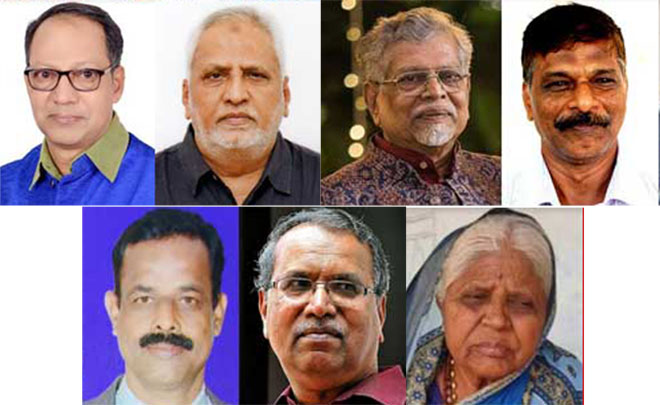
Mangaluru, Jan 20: As many as luminaries from various fields have been chosen for the Sandesha Awards 2024. The award programme will be held on February 11 at 5:30 pm at the Sandesha Institute Grounds in Mangaluru.
This year's Sandesha Awards ceremony will be presided over by Dr Peter Machado, archbishop of Bangalore and president of Karnataka Regional Bishops Conference. The chief guest for the occasion will be U T Khader, speaker of the Karnataka legislative assembly. Notable guests include Dr Henry D’Souza, the bishop of Bellary and chairman of the institute, Dr Peter Paul Saldanha, bishop of Mangalore, Dr Gerald Isaac Lobo, bishop of Udupi, Dr Sudeep Paul, MSFS, the director of Sandesha, and Roy Castelino and Fr Ivan Pinto, the trustees of the institute.
The award winners are:
• Sandesha Literature Award (Kannada): B. A. Viveka Rai
• Sandesha Literature Award (Konkani): Valerian Quadras
• Sandesha Literature Award (Tulu): Muddu Moodubele
• Sandesha Media Award: Abdussalam Puthige
• Sandesha Konkani Music Award: Alwyn D’Cunha
• Sandesha Art Award: Chandranth Acharya
• Sandesha Education Award: Hucchamma
• Sandesha Special Award: Jana Shikshana Trust
About Sandesha Awards
The 'Sandesha Awards' programme, a pivotal and much-anticipated annual event hosted by the esteemed Sandesha Foundation, serves as a distinguished platform to recognize and celebrate exceptional contributions in various domains. These include Literature, Journalism, Arts, Education, Music, Media, and Social Service, among other impactful sectors. This significant initiative not only applauds outstanding achievements but also emphasizes the importance of values in the recipients' contributions, promoting a culture of excellence and positive societal impact.
Established in 1989 and officially registered as a charitable institution in 1991, the Sandesha Foundation for Culture and Education is steadfast in its commitment to constructing a value-based society. With a focus on fostering harmony through active support for art, culture, education, and folklore-related activities, Sandesha stands as a distinguished educational institution. Offering comprehensive training programs in music, dance, art, painting, journalism, media education, public speaking, and related courses, the foundation plays a pivotal role in nurturing diverse talents.
The foundation actively organizes workshops on drama, poetry, media, and various other subjects, creating a dynamic platform that unites individuals from various walks of life. Notably, Sandesha has recently entered into a Memorandum of Understanding (MOU) with Karnataka Gangubhai Hanagal Music and Performing Arts University. This collaboration aims to broaden educational horizons by introducing certificate and diploma programs, further enriching the educational offerings of the foundation.
Bio data of the awardees:
Prof Dr B A Viveka Rai
Prof Dr B A Viveka Rai, the recipient of the Sandesha Award for Kannada Literature 2024, is a distinguished Kannada researcher, critic, folklorist, and professor with a career spanning five decades. Born on December 8, 1946, in Agrala, Puncha village, Dakshina Kannada district, Karnataka, Dr Rai's rich journey in the realms of study, teaching, and research has left an indelible mark on Kannada and Tulu literature.
A scholar deeply rooted in his Tulu heritage, Dr. Rai's linguistic prowess extends to both Kannada and Tulu, reflecting his commitment to preserving and promoting the linguistic diversity of the region. His journey into the world of language, literature, and culture was ignited at a young age when introduced to the literary works of Shivaram Karanth by his father, setting the stage for a lifelong dedication to these fields.
Prof Dr B A Viveka Rai has not only contributed significantly to the academic landscape as a professor but has also held esteemed positions, including the role of vice-chancellor at Kannada University, Hampi, and KSOU, Mysuru. His impact on Kannada literature and his tireless efforts in fostering cultural understanding have earned him the Sandesha Award, a recognition well-deserved for his exceptional contributions to the literary and cultural heritage of Karnataka.
Valerian Quadras
Valerian Alwyn Quadros, known as Valley Quadros, Ajekar, is a distinguished literary figure shaping Konkani culture. Based in Mumbai, his prolific career spans over 50 years, marked by extensive contributions to Konkani literature. As a versatile writer, editor, and scholar, Valerian's impact is evident in his diverse works, including over 350 poems, 250 short stories, six novels, and seven skits.
His anthologies like ‘Aashavadi’, ‘Khilo’ and ‘Satham aani Khotham’ showcase his deep understanding of Konkani storytelling. Valerian explores poetry analysis in books like ‘Kavitha Paath’ and ‘Daryaak Udak’ adding analytical depth to Konkani poetry appreciation. His editorial role extends to curating collections like ‘20vya shekdyaachyo konknni kaaniyio’ and ‘Suryo Udetha’.
Valerian's literary endeavors transcend scripts, with contributions in Nagari, Romi, and Kannada script Konkani. He has edited national-level compilations, conducted over 65 literary workshops, and played a pivotal role in publishing 50+ books as the editor of Aashavadi Publications. His digital engagement includes serving as the editor of poinnari.com.
Recognized with esteemed awards, including the Divo Literary Award, Karnataka Konkani Saithya Academy Award (thrice), and Mathais Family Kavita Trust Poetry Award, Valerian Alwyn Quadros's unwavering dedication has left an enduring legacy, solidifying his revered status in the Konkani literary landscape.
Muddu Moodubele
Muddu Moodubelle, a prominent figure in Tulu literature, is acclaimed as a poet, storyteller, singer, playwright, actor, folklore scholar, and Senior Announcer at All India Radio. Known by pen-names like ‘Aradhaka’, ‘Mumukshu’, ‘Shrivatsa’, and ‘Pathika’, he has made substantial contributions to literature, arts, and culture.
Muddu Moodubelle's diverse talents include fiction writing, and his noteworthy works encompass detective novels, poetry collections, and anthologies of short stories. His Tulu books 'Udhipu' and 'Osayo' won the Sahitya Academy Award, becoming prescribed texts for MA courses in Tulu language.
Delving into Tulu folk culture, Muddu Moodubelle authored 'Janapada Ineroopakolu’, exploring the rich heritage of Tulu folklore. His research work 'Mulkiseemeya Avaliveeraru Kantabare Budabare' received acclaim and underwent multiple editions.
A recipient of numerous awards, including the prestigious 'Masti Katha Puraskara' and multiple prizes in story writing competitions, Muddu Moodubelle's literary journey has left an indelible mark on Tulu literature and culture, making him a revered figure in the field.
Absussalam Puthige
Abdussalam Puthige, the editor-in-chief of Varthabharathi, a Kannada daily newspaper based in Mangaluru and Bengaluru, is a prominent figure in media. Launching Vartha Bharathi in 2003, Puthige has played a pivotal role in shaping Kannada journalism.
His notable English work, 'Towards Performing Da'wah,' was published by The International Council for Islamic Information (ICII) in the UK. Puthige's engagement with marginalized communities is evident in his widely acclaimed interview, 'The Muslim Kannadiga,' conducted by scholar Yoginder Sikand.
Puthige's significant contribution extends to literature, with the release of 'Kannadadalli Qur'an Anuvada' in 2012. This Kannada translation of the Quran has seen multiple editions, with the third edition published in Dubai by the department of Islamic affairs, government of Dubai. Available online and as an android application, 'Quran in Kannada' further demonstrates Puthige's commitment to making religious texts accessible.
Born on April 2, 1964, in Ganjimath, Dakshina Kannada district, Karnataka, Abdussalam Puthige's multifaceted contributions to media and literature have left an enduring impact on the cultural landscape.
Alwyn D’Cunha
Julian Alwyn D'Cunha, a distinguished figure in Konkani music. Renowned as a maestro in the realm of music, Julian's journey is a narrative woven with accolades and devotion to the rich traditions of Konkani music.
Guided by his parents, Walter Albuquerque and Patrick Carlo, and inspired by the teachings of A W D'Souza, Julian immersed himself in the language of music from a young age. His participation and triumphs in numerous musical competitions solidify his standing as an exceptional contributor to Konkani musical heritage.
Julian D'Cunha's commitment extends beyond personal achievements; he actively contributes to shaping the future of music by mentoring aspiring musicians. Many of his disciples have emerged as noteworthy figures in the music industry, a testament to his dedication and influence.
Having served as a training officer at the government-recognized ITI Kadri Hills, Julian exemplifies his commitment to comprehensive education and youth empowerment. His role as an excellent mentor has earned him recognition from scholars and music enthusiasts, reflecting the breadth of his impact across various musical genres. Rooted in the traditional essence of Konkani music, his distinctive musical style continues to bring forth new dimensions and perspectives.
Chandranath Acharya
Chandranath Acharya stands as a multifaceted artist with an expansive creative palette. His artistic pursuits encompass painting, printmaking, book cover design, and art direction for award-winning films.
A celebrated magazine illustrator, Chandranath has left an indelible mark by infusing a new direction and creative dimension into the fascinating world of art. For him, painting is not merely an act but a journey to delve into, explore, and express the inner world where raw human emotions—such as sex, hunger, pleasure, and the fear of death—are laid bare. His images pulsate with the excitement of realism and the magic of surrealism, capturing both external contours and internal stirrings of human relationships.
Incorporating animal forms as inspired symbols, Chandranath breathes life into his paintings, representing human sentiment, passion, and predicament. The structures and postures of these creatures mirror the vigor and verve of human behavior. Whether taming ferocious monsters, flirting with angels, or coaxing domesticated pets into mischievous pranks, Chandranath's work is alive with playfulness, teasing joviality, and warmth.
His unique ability to grasp intricate human conditions and transform them into meaningful visual statements is remarkable. Chandranath's keen scrutiny and comprehension find expression in deliberately ambiguous and mischievous images, yet there is never a dull moment or discordant note in his work. Merging fantasy with reality, dreams with desires, and concern with compassion, he fearlessly traverses artistic trails that others may shy away from.
Chandranath Acharya's contribution to the world of art extends beyond the canvas, leaving an enduring legacy that challenges and enriches the artistic landscape
Hucchamma Chowdri
In an extraordinary act of altruism, Hucchamma Chowdri, affectionately known as the ‘mother of mothers’, exemplifies the essence of selfless service. At 75, she has devoted her life to the welfare of the Kunikeri village, leaving an indelible mark on the community.
Married at an early age to Basappa Chowdri, Hucchamma found herself without children after her husband's demise three decades ago. Living a solitary life, she made a living through agriculture on the two acres of land she owned beside the village.
When the village faced the need for a new school building, Hucchamma took a bold step and donated one acre of her land. Her generosity didn't stop there; when the requirement for a playground arose, she willingly gave away her only remaining acre of land.
Today, a well-equipped school stands on the land donated by Hucchamma, catering to the education needs of the village. Despite the surge in land prices due to the establishment of steel factories in Kunikeri, she could have easily earned a substantial amount by selling her property. However, Hucchamma harbours no regrets, expressing that two square meals a day are more than sufficient for her.
Working as the chief cook in the same school, Hucchamma considers all 300 children studying there as her own. She provides them with nourishing meals every day. Even though she could have earned a considerable sum, Hucchamma prefers her role as a cook and labourer, choosing a life of humility and service over personal gain.
In a society often divided by caste and religion, Hucchamma's selflessness becomes a beacon of hope, erasing inequalities and fostering harmony. Her life's work stands as a testament to the transformative power of compassion and the impact one individual can have on an entire community. Hucchamma Chowdri, through her actions, inspires others to embrace humanity and work towards the betterment of society.
Jana Shikshana Trust
In the realm of social service, where compassion meets action, Jana Shikshana Trust (JST) stands as a beacon of selfless dedication. Founded by the dynamic duo of trained social workers, N Sheena Shetty and Krishna Moolya, JST is a not-for-profit, non-political, non-religious, and secular organization. Their journey is shaped by the knowledge acquired at ‘Ratnamanasa’, a residential life education center in Ujire, and the School of Social Work Roshni Nilaya, Mangaluru.
Driven by the spirit of knowledge, JST is on a mission to plant hopes and cultivate happiness in the lives of thousands of marginalized individuals. The trust operates with the fundamental philosophy that true development is synonymous with the development of people. This core principle manifests through:
a) Mass Mobilization: Actively engaging and mobilizing people in the fight against social inequality and injustices.
b) Grassroots Empowerment: Developing a grassroots power base at the village level and federating at higher levels to build collective strength.
c) Catalyzing Change: Providing external assistance through change agents acting as catalysts for transformation.
JST has dedicated the past 30 years to initiating and facilitating processes that empower and enhance the quality of life for tribes and all marginalized communities. The trust firmly believes in the transformative power of self-reliance and community-driven development.
JST's legacy is not merely in the services rendered but in the lives touched, uplifted, and empowered. As the recipient of the Special Recognition at the Sandesha Awards 2024, Jana Shikshana Trust exemplifies the profound impact that dedicated individuals can have when driven by the spirit of service and the unwavering belief in the collective power of communities.


Comments
Add new comment