PUC education in govt-run residential schools in Karnataka from next academic year: CM

News Network
January 27, 2023

PUC.jpg

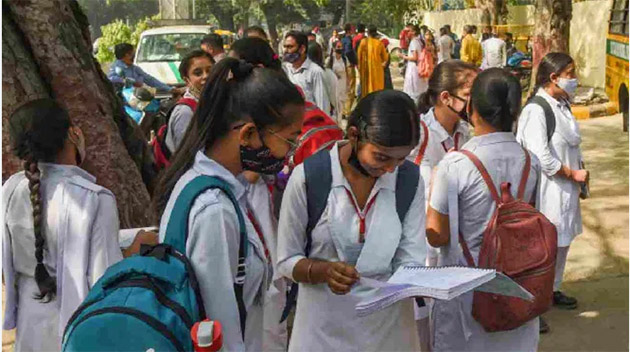
Bengaluru, Jan 27: Karnataka Chief Minister Basavaraj Bommai on Friday said the state government-run residential schools, which have completed 10 years, will have colleges offering pre-university courses (PUC) on their premises from the next academic year.

These residential schools will also have to conduct competitive examinations amongst students so that they are prepared for such challenges once they complete their education and go out in search of jobs, Bommai said.

The Chief Minister also asked the social welfare department to give up its "tendency of spending money only constructing school buildings to gratify contractors".

Instead, the focus should be on improving the quality of education. "Start the Pre-University Colleges from next year in those schools which have completed 10 years and the students are in 10th standard,” Bommai said after inaugurating 'Science Expo-2023' of the Karnataka Residential Education Institution Society (KREIS) at the Palace Grounds here.

According to Bommai, the "quality education will not continue" if the students have to go to various other schools after completing 10th standard because the competitive examinations for them start after completing their Pre-University education. Hence, the students have to continue their PUC education from the same residential school, he said.

"Conduct competitive exams in these schools among the children. We have provided them a level playing field to find out the shortcomings among the children so that it can be set right and their capacity is increased," the Chief Minister said. Bommai pointed out that the children studying in the Morarji Desai Residential Schools and similar other residential schools run by the state government are quite sharp who got admission by scoring above 60 per cent to 70 per cent.

He said the target of the government is to ensure that these students score 90 per cent by the time they complete their education.

The Chief Minister took a swipe at the tendency of spending more money on constructing buildings, which benefits contractors. "We spend thousands of crores of rupees on these institutions. We are spending more on buildings and compound walls," Bommai said and insisted that the focus should be on the "requirements" of the students studying in these residential schools.

Bommai said, "Stop giving money to the contractors. Change that model itself." According to him, the spending on building schools had started from Rs five crore, which escalated to Rs 10 crore and Rs 14 crore and now it has reached a stage where the government spends Rs 30 crore on each school. "Spend Rs 30 crore on the arrangements (facilities) for children. On the one hand government money is draining and on the other, the arrangements required for the children are not happening," the Chief Minister said.

Bommai blamed the previous governments which he alleged had been splurging money on building schools, instead of improving quality of education. "This is a legacy that has come from the past from the previous governments to take up 'contractor-based civil works' due to which we have reached this stage," he said. Stating that children belonging to the scheduled castes, scheduled tribes and other backwards castes study in these schools, Bommai said it was the duty of the government to make sure about the quality of education.

He instructed officials to give him a list of shortcomings in the schools and assured that the government will give grants. Bommai also directed officials to visit schools instead of "running administration" from Bengaluru. 

Comments

Add new comment

  • Coastaldigest.com reserves the right to delete or block any comments.
  • Coastaldigset.com is not responsible for its readers’ comments.
  • Comments that are abusive, incendiary or irrelevant are strictly prohibited.
  • Please use a genuine email ID and provide your name to avoid reject.
News Network
November 24,2025

israelsyra.jpg

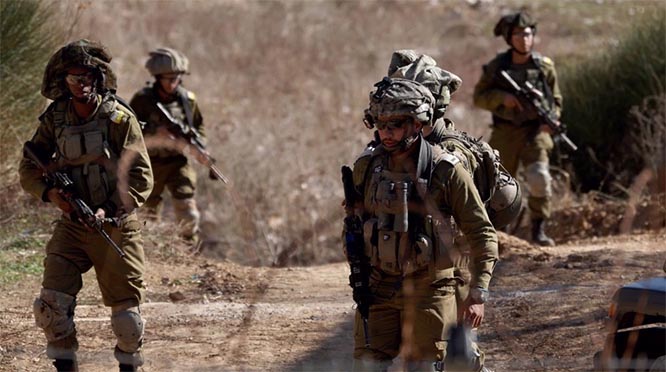
Israeli forces have pushed over the Syrian frontier, erecting a checkpoint and stopping vehicles in the southwestern city of Quneitra, in yet another breach of the Arab country’s sovereignty.

The violation took place on Sunday, when the troops made their way across the border, setting up the outpost near the Ain al-Bayda junction in northern Quneitra, Syrian outlets reported.

According to the al-Ikhbariya paper, an Israeli detachment positioned itself at the junction, halting cars and conducting searches.

The Syrian Arab News Agency (SANA) reported that three Israeli military vehicles then moved further into the northern countryside, deploying between the town of Jubata al-Khashab and the villages of Ofaniya and Ain al-Bayda. The agency added that a separate Israeli unit mounted a new incursion in the central region, approaching the villages of Umm Batina and al-Ajraf.

Residents said such activities have surged in recent months, pointing to Israeli advances onto farmland, leveling of extensive forested areas, arrests, and spread of mobile checkpoints.

The Israeli regime began markedly increasing its military aggression against Syria last year.

The escalation coincided with increasingly ferocious onslaughts throughout the country by the so-called Hay'at Tahrir al-Sham (HTS) Takfiri terrorist group, which the government of President Bashar al-Assad had confined to northwestern Syria. The HTS, however, managed to overthrow the government as the Israeli attacks would pummel the country’s civilian and defensive infrastructure.

Various reports have shown that, during the escalation, the regime conducted more than 1,000 airstrikes on the Syrian territory and over 400 ground raids into the south.

Following the collapse of the Assad government, Tel Aviv also widened its grip over the occupied Golan Heights by taking control of a demilitarized buffer zone, in defiance of a 1974 Disengagement Agreement. Earlier this month, senior Israeli officials, including Prime Minister Benjamin Netanyahu, visited the buffer zone, prompting expressions of alarm on the part of the United Nations.

The United States, the regime’s biggest ally, has, meanwhile, been fraternizing the HTS head Abu Mohammed al-Jolani amid the widely reported prospect of rapprochement with Tel Aviv.

Comments

Add new comment

  • Coastaldigest.com reserves the right to delete or block any comments.
  • Coastaldigset.com is not responsible for its readers’ comments.
  • Comments that are abusive, incendiary or irrelevant are strictly prohibited.
  • Please use a genuine email ID and provide your name to avoid reject.
Agencies
November 22,2025

indiapak.jpg

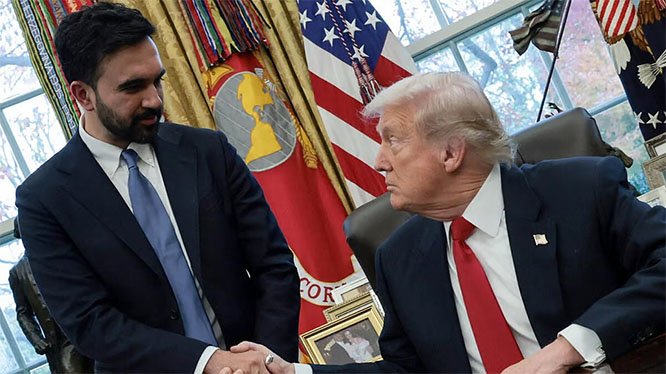
New York/Washington: US President Donald Trump has again claimed to have solved the conflict between India and Pakistan, repeating his assertion during a meeting with New York City Mayor-elect Zohran Mamdani in the Oval Office.

Mamdani flew to Washington DC for his first meeting with Trump in the White House on Friday. Trump said he “enjoyed” the meeting, which he described as “great.”

During remarks in the Oval Office, with Mamdani standing next to him, Trump repeated his claim that he solved the May conflict between India and Pakistan.

"I did eight peace deals of countries, including India and Pakistan,” he said.

On Wednesday, Trump had said he threatened to put 350 per cent tariffs on India and Pakistan if they did not end their conflict, repeating his claim that he solved the fighting between the nuclear-armed neighbours and that Prime Minister Narendra Modi had called him to say “we're not going to go to war.”

Since May 10, when Trump announced on social media that India and Pakistan had agreed to a “full and immediate” ceasefire after a “long night” of talks mediated by Washington, he has repeated his claim over 60 times that he “helped settle” the tensions between India and Pakistan.

India has consistently denied any third-party intervention. India launched Operation Sindoor on May 7, targeting terror infrastructure in Pakistan and Pakistan-occupied Kashmir in retaliation for the April 22 Pahalgam attack that killed 26 civilians. India and Pakistan reached an understanding on May 10 to end the conflict after four days of intense cross-border drone and missile strikes.

Mamdani emerged victorious in the closely-watched battle for New York City Mayor, becoming the first South Asian and Muslim to be elected to sit at the helm of the largest city in the US.

He had been the front-runner in the NYC Mayoral election for months and defeated Republican nominee Curtis Sliwa and political heavyweight former New York State Governor Andrew Cuomo, who ran as an independent candidate and was officially endorsed by Trump just hours before the elections.

Indian-descent Mamdani is the son of renowned filmmaker Mira Nair and Columbia University professor Mahmood Mamdani. He was born and raised in Kampala, Uganda and moved to New York City with his family when he was 7. Mamdani became a naturalised US citizen only recently, in 2018.

Comments

Add new comment

  • Coastaldigest.com reserves the right to delete or block any comments.
  • Coastaldigset.com is not responsible for its readers’ comments.
  • Comments that are abusive, incendiary or irrelevant are strictly prohibited.
  • Please use a genuine email ID and provide your name to avoid reject.
News Network
November 26,2025

students.jpg

Bengaluru, Nov 26: Karnataka is taking its first concrete steps towards lifting a three-decade-old ban on student elections in colleges and universities. Deputy Chief Minister D.K. Shivakumar announced Wednesday that the state government will form a small committee to study the reintroduction of campus polls, a practice halted in 1989 following incidents of violence.

Speaking at a 'Constitution Day' event organised by the Karnataka Congress, Mr. Shivakumar underscored the move's aim: nurturing new political leadership from the grassroots.

"Recently, (Leader of the Opposition in Lok Sabha) Rahul Gandhi wrote a letter to me and Chief Minister (Siddaramaiah) asking us to think about restarting student elections," Shivakumar stated. "I'm announcing today that we'll form a small committee and seek a report on this."

Student elections were banned in Karnataka in 1989, largely due to concerns over violence and the infiltration of political party affiliates into campus life. The ban effectively extinguished vibrant student bodies and the pipeline of young leaders they often produced.

Mr. Shivakumar, who also serves as the Karnataka Congress president, said that former student leaders will be consulted to "study the pros and cons" of the re-introduction.

Acknowledging the history of the ban, he added, "There were many criminal activities taking place back then. We’ll see how we can conduct (student) elections by regulating such criminal activities."

The Deputy CM reminisced about his own journey, which began on campus. He recalled his political activism at Sri Jagadguru Renukacharya College leading to his first Assembly ticket in 1985 at the age of 23. "That's how student leadership was at the time. Such leadership has gone today. College elections have stopped," he lamented, adding that for many, college elections were "like a big movement" where leaders were forged.

The move, driven by the Congress high command's push to cultivate young talent, will face scrutiny from academics and university authorities who have, in the past, expressed concern that the return of polls could disrupt the peaceful academic environment and turn campuses into political battlegrounds.

Comments

Add new comment

  • Coastaldigest.com reserves the right to delete or block any comments.
  • Coastaldigset.com is not responsible for its readers’ comments.
  • Comments that are abusive, incendiary or irrelevant are strictly prohibited.
  • Please use a genuine email ID and provide your name to avoid reject.