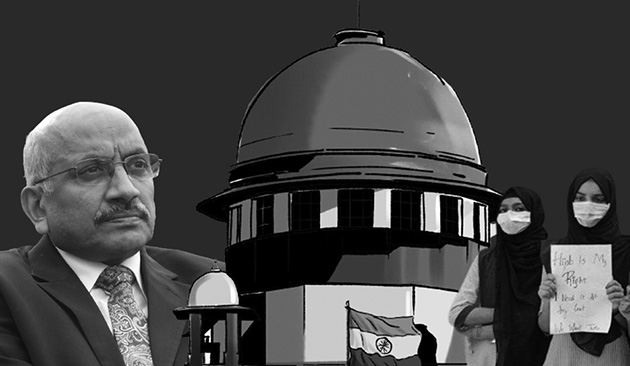
‘Sikhism engrained in India, can't compare with Islamic practices’: SC on Karnataka hijab row

News Network
September 8, 2022

gupta.jpg

New Delhi, Sept 8: It is "not very fair" to compare the practices in Sikhism as they are well engrained in the culture of the country, the Supreme Court said on Thursday while asking the petitioners in the Karnataka Hijab ban matter not to draw a parallel between Muslim and Sikh religious practices.

Hearing arguments on a batch of pleas challenging the Karnataka High Court verdict refusing to lift the ban on hijab in educational institutions of the state, the apex court observed the five Ks in Sikhism -- Kesh, Kara, Kanga, Kaccha and Kirpan -- are well established.

A bench of Justices Hemant Gupta and Sudhanshu Dhulia observed this after an advocate, appearing for one of the petitioners in the case, gave an example of Sikhism and turban.

"It is not very fair to compare the rights or the practices in Sikhism. The five Ks are well established," the bench observed.

The top court referred to Article 25 of the Constitution and said it provides for the carrying of Kirpan by Sikhs.

Article 25 of the Constitution deals with freedom of conscience and free profession, practice and propagation of religion.

"Don't compare these practices because they have been recognised for over 100 years," the bench said.

Advocate Nizam Pasha, arguing for one of the petitioners, said Article 25 mentions only Kirpan and not the other Ks.

"What we are saying is, please do not draw any parity with Sikhism. That is all. That is what we are saying," the bench said.

Observing that arguments were advanced about Kara and turban, the bench said the practices in Sikhism are well established and well engrained in the culture of the country.

During the arguments, Pasha said the high court verdict had referred to certain verses of the Holy Quran as well as some commentaries.

He said the Holy Quran, as it stands, is perfect for all times to come and to say that verses of the Quran have become obsolete, is "bordering on blasphemy".

Senior advocate Devadatt Kamat, who appeared for one of the petitioners, told the bench that the state of Karnataka has said if the students would come in a head scarf, other people will get offended but this cannot be the reason for banning it.

Kamat argued that Article 25 has three restrictions -- public order, morality and health.

"Wearing a head scarf is a part of the religious belief apart from it being a part of (Articles) 19 and 21 rights," he said.

Kamat argued that every religious practice or religious observance is not essential to the religion but that does not mean that the State will keep on restricting it because it is not essential.

"As long as I do not violate public order, I do not fall foul of morality and I do not affect the health of others, I am entitled," he said.

Giving an example that one of the senior advocates wears a 'namam' (a divine mark put on the forehead), Kamat said it may not be an integral part of the religion of the Hindu faith.

"How does it harm discipline in the court? Does it harm public order?" he asked.

The bench observed there is a particular uniform for the lawyers to appear in court.

Justice Gupta said people in Rajasthan wear Pagdi as a matter of routine because of the climatic condition and in Gujarat also people wear it.

On the arguments about public order, the bench said this issue may arise when one is on the street.

The bench observed that wearing Hijab on the street does not affect anybody.

"But once you are talking about a school building, school premises, then the question is what kind of a public order the school want to be maintained there," it said.

Kamat said public order is the responsibility of the state and the school has nothing to do with it.

He asked, "In our constitutional scheme, is heckler's veto permitted?" (Heckler's veto is suppression of speech by the government when necessary to prevent possible violent reactions).

The senior advocate said it is the duty of the State to create an atmosphere where people can exercise their rights in accordance with Article 25.

"If I wear a head scarf, whose fundamental rights am I violating?" he said.

The bench observed it is not a question of violating others' fundamental rights.

"The question is what kind of fundamental right do you have which you want to exercise," it observed during the arguments which would continue on September 12.

Kamat said the state's argument is that if it will permit the wearing of a head scarf, which the petitioners regard as a part of their faith, some other students will wear an orange shawl.

"Wearing of an orange shawl, I do not think it is an innocent display of faith. It is a belligerent display of religious jingoism," he said, adding, "Article 25 only protects an innocent display of faith".

Kamat had earlier referred to the state government's order of February 5, 2022, by which it had banned wearing clothes that disturb equality, integrity, and public order in schools and colleges which some Muslim girls had challenged in the high court.

Several pleas have been filed in the top court against the March 15 verdict of the high court holding that wearing of hijab is not a part of the essential religious practice which can be protected under Article 25 of the Constitution.

The high court had dismissed the pleas filed by a section of Muslim students from the Government Pre-University Girls College in Udupi, seeking permission to wear hijab inside the classroom.

Challenging the February 5 order of the government, the petitioners had argued before the high court that wearing the Islamic headscarf was an innocent practice of faith and an essential religious practice and not a display of religious jingoism.

Comments

Add new comment

  • Coastaldigest.com reserves the right to delete or block any comments.
  • Coastaldigset.com is not responsible for its readers’ comments.
  • Comments that are abusive, incendiary or irrelevant are strictly prohibited.
  • Please use a genuine email ID and provide your name to avoid reject.
News Network
December 2,2025

A major upgrade in safety and monitoring is planned for Haj 2026, with every Indian pilgrim set to receive a Haj Suvidha smart wristband linked to the official Haj Suvidha mobile app. The initiative aims to support pilgrims—especially senior citizens—who may struggle with smartphones during the 45-day journey.

What the Smart Wristband Will Do

Officials said the device will come with:
•    Location tracking
•    Pedometer
•    SOS emergency button
•    Qibla compass
•    Prayer timings
•    Basic health monitoring

SP Tiwari, secretary of the UP State Haj Committee, said the goal is to make the pilgrimage safer and more comfortable.

“Most Hajis are elderly and not comfortable with mobile apps,” he said. “The smartwatch will help locate pilgrims who forget their way or cannot communicate their location.”

The wristbands will be monitored by the Consulate General of India in Saudi Arabia, similar to mobile tracking via the Haj Suvidha App.

Free Distribution and Training

•    Smart wristbands will be given free of cost.
•    Training for pilgrims will be conducted between January and February 2026.
•    Sample units will reach state Haj committees soon.
•    Final devices will be distributed as pilgrims begin their journey.

New Rules for Accommodation

Two major decisions have also been finalised for Haj 2026:
1.    Separate rooms for men and women – including married couples. They may stay on the same floor but must occupy different rooms, following stricter Saudi guidelines.
2.    Cooking banned – gas cylinders will not be allowed; all meals will be provided through official catering services arranged by the Haj Committee of India.

These decisions were finalised during a meeting of the Haj Committee of India and state representatives in Mumbai.

Haj Suvidha App Launched Earlier

The government launched the Haj Suvidha App in 2024, offering:

•    Training modules
•    Accommodation and flight details
•    Baggage information
•    SOS and translation tools
•    Grievance redressal

Haj 2026 Quota and Key States

•    India’s total Haj quota for 2026: 1,75,025 pilgrims
•    70% (1,25,000) allotted to the Haj Committee of India
•    30% (around 50,000) reserved for Haj Group Organisers

Uttar Pradesh has the largest allocation (around 30,000 seats), though approximately 18,000 pilgrims are expected to go this year. States with high pilgrim numbers include Kerala, Maharashtra and Gujarat.

Dates of Haj 2026

The pilgrimage is scheduled to take place from 24 May to 29 May, 2026 (tentative).
Haj is one of the five pillars of Islam and is mandatory for Muslims who meet the required conditions.

Comments

Add new comment

  • Coastaldigest.com reserves the right to delete or block any comments.
  • Coastaldigset.com is not responsible for its readers’ comments.
  • Comments that are abusive, incendiary or irrelevant are strictly prohibited.
  • Please use a genuine email ID and provide your name to avoid reject.
News Network
December 4,2025

Mangaluru: Chaos erupted at Mangaluru International Airport (MIA) after IndiGo flight 6E 5150, bound for Mumbai, was repeatedly delayed and ultimately cancelled, leaving around 100 passengers stranded overnight. The incident highlights the ongoing country-wide operational disruptions affecting the airline, largely due to the implementation of new Flight Duty Time Limitations (FDTL) norms for crew.

The flight was initially scheduled for 9:25 PM on Tuesday but was first postponed to 11:40 PM, then midnight, before being cancelled around 3:00 AM. Passengers expressed frustration over last-minute communication and the lack of clarity, with elderly and ailing travellers particularly affected. “Though the airline arranged food, there was no proper communication, leaving us confused,” said one family member.

An IndiGo executive at MIA cited the FDTL rules, designed to prevent pilot fatigue by limiting crew working hours, as the cause of the cancellation. While alternative arrangements, including hotel stays, were offered, about 100 passengers chose to remain at the airport, creating tension. A replacement flight was arranged but also faced delays due to the same constraints, finally departing for Mumbai around 1:45 PM on Wednesday. Passengers either flew, requested refunds, or postponed their travel.

The Mangaluru delay is part of a broader crisis for IndiGo. The airline has been forced to make “calibrated schedule adjustments”—a euphemism for widespread cancellations and delays—after stricter FDTL norms came into effect on November 1.

While an IndiGo spokesperson acknowledged unavoidable flight disruptions due to technology issues, operational requirements, and the updated crew rostering rules, the DGCA has intervened, summoning senior airline officials to explain the chaos and outline corrective measures.

The ripple effect has been felt across the country, with major hubs like Bengaluru and Mumbai reporting numerous cancellations. The Mangaluru incident underscores the systemic operational strain currently confronting India’s largest carrier, leaving passengers nationwide grappling with uncertainty and delays.

Comments

Add new comment

  • Coastaldigest.com reserves the right to delete or block any comments.
  • Coastaldigset.com is not responsible for its readers’ comments.
  • Comments that are abusive, incendiary or irrelevant are strictly prohibited.
  • Please use a genuine email ID and provide your name to avoid reject.
News Network
December 15,2025

Mangaluru, Dec 15: Educational institutions in Mangaluru that rely on the popular Mangala Stadium for their annual sports events are bracing for an inconvenience as the city's key sporting venue is set to close its gates for a significant upgrade. The stadium is expected to be unavailable for approximately two months starting from January 15, 2026.

The closure is necessitated by a proposed overhaul of the stadium's facilities, with a special focus on upgrading the synthetic track. Pradeep Dsouza, Assistant Director of the District of Youth Empowerment and Sports (DYES), Dakshina Kannada, confirmed the development.

"Experts have visited the stadium, conducted a thorough inspection, and have given the go-ahead for a complete makeover," Dsouza stated. "Funds have been allocated for the project, and we are currently awaiting the final green signal from state officials to commence the work. We anticipate that the work will likely begin in the second week of January. Consequently, we have stopped renting out the stadium to colleges and other organizations in preparation for the upgrade."

The timing presents a logistical challenge for colleges, as many schools have already concluded their sports meets.

"Colleges will now be organizing their events and will need to find alternative locations to host their sports meets," Dsouza added. He suggested a few potential venues, including the Dakshina Kannada police ground, University College grounds, Panambur grounds, Swaraj Maidan in Moodbidri, and the Mangalore University sports grounds in Konaje.

However, many institutions note that finding a comparable venue will be difficult. While the DK police ground and University College grounds are closer to the city center, they do not possess the extensive facilities and infrastructure offered by Mangala Stadium.

Dr. P Dayananda Pai - P Satisha Govt First Grade College, Carstreet, is one such institution dependent on the stadium. Principal Jayakar Bhandary expressed hope for a swift completion of the work. "We expect the work to be completed at the earliest. If not, we will be forced to look for other venues to host the sports day for our students," Bhandary said, highlighting the pressing need for the city's main sporting facility.

Comments

Add new comment

  • Coastaldigest.com reserves the right to delete or block any comments.
  • Coastaldigset.com is not responsible for its readers’ comments.
  • Comments that are abusive, incendiary or irrelevant are strictly prohibited.
  • Please use a genuine email ID and provide your name to avoid reject.