



‘Sikhism engrained in India, can't compare with Islamic practices’: SC on Karnataka hijab row

News Network
September 8, 2022

gupta.jpg

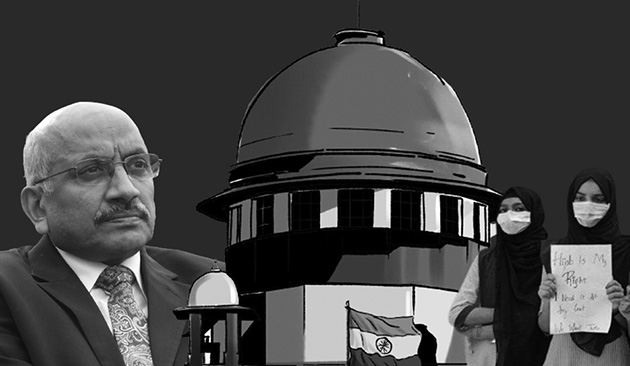
New Delhi, Sept 8: It is "not very fair" to compare the practices in Sikhism as they are well engrained in the culture of the country, the Supreme Court said on Thursday while asking the petitioners in the Karnataka Hijab ban matter not to draw a parallel between Muslim and Sikh religious practices.

Hearing arguments on a batch of pleas challenging the Karnataka High Court verdict refusing to lift the ban on hijab in educational institutions of the state, the apex court observed the five Ks in Sikhism -- Kesh, Kara, Kanga, Kaccha and Kirpan -- are well established.

A bench of Justices Hemant Gupta and Sudhanshu Dhulia observed this after an advocate, appearing for one of the petitioners in the case, gave an example of Sikhism and turban.

"It is not very fair to compare the rights or the practices in Sikhism. The five Ks are well established," the bench observed.

The top court referred to Article 25 of the Constitution and said it provides for the carrying of Kirpan by Sikhs.

Article 25 of the Constitution deals with freedom of conscience and free profession, practice and propagation of religion.

"Don't compare these practices because they have been recognised for over 100 years," the bench said.

Advocate Nizam Pasha, arguing for one of the petitioners, said Article 25 mentions only Kirpan and not the other Ks.

"What we are saying is, please do not draw any parity with Sikhism. That is all. That is what we are saying," the bench said.

Observing that arguments were advanced about Kara and turban, the bench said the practices in Sikhism are well established and well engrained in the culture of the country.

During the arguments, Pasha said the high court verdict had referred to certain verses of the Holy Quran as well as some commentaries.

He said the Holy Quran, as it stands, is perfect for all times to come and to say that verses of the Quran have become obsolete, is "bordering on blasphemy".

Senior advocate Devadatt Kamat, who appeared for one of the petitioners, told the bench that the state of Karnataka has said if the students would come in a head scarf, other people will get offended but this cannot be the reason for banning it.

Kamat argued that Article 25 has three restrictions -- public order, morality and health.

"Wearing a head scarf is a part of the religious belief apart from it being a part of (Articles) 19 and 21 rights," he said.

Kamat argued that every religious practice or religious observance is not essential to the religion but that does not mean that the State will keep on restricting it because it is not essential.

"As long as I do not violate public order, I do not fall foul of morality and I do not affect the health of others, I am entitled," he said.

Giving an example that one of the senior advocates wears a 'namam' (a divine mark put on the forehead), Kamat said it may not be an integral part of the religion of the Hindu faith.

"How does it harm discipline in the court? Does it harm public order?" he asked.

The bench observed there is a particular uniform for the lawyers to appear in court.

Justice Gupta said people in Rajasthan wear Pagdi as a matter of routine because of the climatic condition and in Gujarat also people wear it.

On the arguments about public order, the bench said this issue may arise when one is on the street.

The bench observed that wearing Hijab on the street does not affect anybody.

"But once you are talking about a school building, school premises, then the question is what kind of a public order the school want to be maintained there," it said.

Kamat said public order is the responsibility of the state and the school has nothing to do with it.

He asked, "In our constitutional scheme, is heckler's veto permitted?" (Heckler's veto is suppression of speech by the government when necessary to prevent possible violent reactions).

The senior advocate said it is the duty of the State to create an atmosphere where people can exercise their rights in accordance with Article 25.

"If I wear a head scarf, whose fundamental rights am I violating?" he said.

The bench observed it is not a question of violating others' fundamental rights.

"The question is what kind of fundamental right do you have which you want to exercise," it observed during the arguments which would continue on September 12.

Kamat said the state's argument is that if it will permit the wearing of a head scarf, which the petitioners regard as a part of their faith, some other students will wear an orange shawl.

"Wearing of an orange shawl, I do not think it is an innocent display of faith. It is a belligerent display of religious jingoism," he said, adding, "Article 25 only protects an innocent display of faith".

Kamat had earlier referred to the state government's order of February 5, 2022, by which it had banned wearing clothes that disturb equality, integrity, and public order in schools and colleges which some Muslim girls had challenged in the high court.

Several pleas have been filed in the top court against the March 15 verdict of the high court holding that wearing of hijab is not a part of the essential religious practice which can be protected under Article 25 of the Constitution.

The high court had dismissed the pleas filed by a section of Muslim students from the Government Pre-University Girls College in Udupi, seeking permission to wear hijab inside the classroom.

Challenging the February 5 order of the government, the petitioners had argued before the high court that wearing the Islamic headscarf was an innocent practice of faith and an essential religious practice and not a display of religious jingoism.

Comments

Add new comment

  • Coastaldigest.com reserves the right to delete or block any comments.
  • Coastaldigset.com is not responsible for its readers’ comments.
  • Comments that are abusive, incendiary or irrelevant are strictly prohibited.
  • Please use a genuine email ID and provide your name to avoid reject.
News Network
December 5,2025

indigoCEO.jpg

New Delhi, Dec 5: IndiGo CEO Pieter Elbers issued a public apology this evening after more than a thousand flights were cancelled today, making it the "most severely impacted day" in terms of cancellations. The biggest airline of the country cancelled "more than half" of its daily number of flights on Friday, said Elbers. He also said that even though the crisis will persist on Saturday, the airline anticipates fewer than 1,000 flight cancellations.

"Full normalisation is expected between December 10 and 15, though IndiGo cautions that recovery will take time due to the scale of operations," the IndiGo CEO said. 

IndiGo operates around 2,300 domestic and international flights daily.

Pieter Elbers, while apologising for the major inconvenience due to delays and cancellations, said the situation is a result of various causes.

The crisis at IndiGo stems from new regulations that boost pilots' weekly rest requirements by 12 hours to 48 and allow only two night-time landings per week, down from six. IndiGo has attributed the mass cancellations to "misjudgment and planning gaps".

Elbers also listed three lines of action that the airline will adopt to address the issue.

"Firstly, customer communication and addressing your needs, for this, messages have been sent on social media. And just now, a more detailed communication with information, refunds, cancellations and other customer support measures was sent," he said.

The airline has also stepped up its call centre capacity.

"Secondly, due to yesterday's situation, we had customers stranded mostly at the nation's largest airports. Our focus was for all of them to be able to travel today itself, which will be achieved. For this, we also ask customers whose flights are cancelled not to come to the airports as notifications are sent," the CEO said.

"Thirdly, cancellations were made for today to align our crew and planes to be where they need to start tomorrow morning afresh. Earlier measures of the last few days, regrettable, have proven not to be enough, but we have decided today to reboot all our systems and schedules, resulting in the highest numbers of cancellations so far, but imperative for progressive improvements starting from tomorrow," he added.

As airports witnessed chaotic scenes, the Directorate General of Civil Aviation (DGCA) stepped in to grant IndiGo a temporary exemption from stricter night duty rules for pilots. It also allowed substitution of leaves with a weekly rest period. 

Civil Aviation Minister Ram Mohan Naidu has said a high-level inquiry will be ordered and accountability will be fixed.

Comments

Add new comment

  • Coastaldigest.com reserves the right to delete or block any comments.
  • Coastaldigset.com is not responsible for its readers’ comments.
  • Comments that are abusive, incendiary or irrelevant are strictly prohibited.
  • Please use a genuine email ID and provide your name to avoid reject.
News Network
December 16,2025

bengal.jpg

The deletion of over 58 lakh names from West Bengal’s draft electoral rolls following a Special Intensive Revision (SIR) has sparked widespread concern and is likely to deepen political tensions in the poll-bound state.

According to the Election Commission, the revision exercise has identified 24 lakh voters as deceased, 19 lakh as relocated, 12 lakh as missing, and 1.3 lakh as duplicate entries. The draft list, published after the completion of the first phase of SIR, aims to remove errors and duplication from the electoral rolls.

However, the scale of deletions has raised fears that a large number of eligible voters may have been wrongly excluded. The Election Commission has said that individuals whose names are missing can file objections and seek corrections. The final voter list is scheduled to be published in February next year, after which the Assembly election announcement is expected. Notably, the last Special Intensive Revision in Bengal was conducted in 2002.

The development has intensified the political row over the SIR process. Chief Minister Mamata Banerjee and her Trinamool Congress have strongly opposed the exercise, accusing the Centre and the Election Commission of attempting to disenfranchise lakhs of voters ahead of the elections.

Addressing a rally in Krishnanagar earlier this month, Banerjee urged people to protest if their names were removed from the voter list, alleging intimidation during elections and warning of serious consequences if voting rights were taken away.

The BJP, meanwhile, has defended the revision and accused the Trinamool Congress of politicising the issue to protect what it claims is an illegal voter base. Leader of the Opposition Suvendu Adhikari alleged that the ruling party fears losing power due to the removal of deceased, fake, and illegal voters.

The controversy comes amid earlier allegations by the Trinamool Congress that excessive work pressure during the SIR led to the deaths by suicide of some Booth Level Officers (BLOs), for which the party blamed the Election Commission. With the draft list now out, another round of political confrontation appears imminent.

As objections begin to be filed, the focus will be on whether the correction mechanism is accessible, transparent, and timely—critical factors in ensuring that no eligible voter is denied their democratic right ahead of a crucial election.

Comments

Add new comment

  • Coastaldigest.com reserves the right to delete or block any comments.
  • Coastaldigset.com is not responsible for its readers’ comments.
  • Comments that are abusive, incendiary or irrelevant are strictly prohibited.
  • Please use a genuine email ID and provide your name to avoid reject.
News Network
December 7,2025

Mangaluru, Dec 7: A 34-year-old fruit and vegetable trader in Mangaluru has reportedly lost ₹33.1 lakh after falling victim to an online investment scam run through a fake mobile app.

Police said the scam began in September, when the victim received a link on Facebook. Clicking it connected him to a WhatsApp number, where an unidentified person introduced a high-return investment scheme and instructed him to download an app.

To build trust, the fraudster asked him to invest ₹30,000 on September 24. The trader soon received ₹34,000 as “profit,” convincing him the scheme was genuine. Over the next two months, he transferred money in multiple instalments via Google Pay and IMPS to different scanner codes and bank accounts shared by the scammers. Between September 24 and December 3, he ended up sending a total of ₹33.1 lakh.

When he later requested a refund of his investment and promised returns, the scammers demanded additional payments, claiming he needed to pay a “service tax” first. Even after he paid a small amount, no money was returned, and the scammers continued pressuring him for more.

A case has been registered at the CEN Crime Police Station.

Comments

Add new comment

  • Coastaldigest.com reserves the right to delete or block any comments.
  • Coastaldigset.com is not responsible for its readers’ comments.
  • Comments that are abusive, incendiary or irrelevant are strictly prohibited.
  • Please use a genuine email ID and provide your name to avoid reject.