Fishmeal units face the heat as tsunami hits Japan

[email protected] (Renuka Phadnis, The Hindu)
March 23, 2011
Mangalore, March 23: About half of the 10 manufacturers of fishmeal in and around Mangalore have suspended production owing to the changed demand scene in Japan following the earthquake-triggered tsunami. Of them, at least three exporters have sent fishmeal to Japanese ports with “no clear scene” on what has happened to what they have sent from here.

However, the suspension of production cannot be described as “closed” because fishmeal production is a seasonal activity, according to industry sources.

The tsunami has added another blow to the dull fishmeal industry already struggling with scarce and sporadic fish landing, rising prices and in recent times, a super moon-struck labour force migration that had abandoned the units to head home, they said.

The Japanese demand rises when the market here (September to January) is dull. “There is considerable exposure to Japan market, which is good and can fetch good prices for quality fishmeal. If the Japan demand is absent, units here have to suspend production,” the sources said.

A representative of a Mangalore-based company that has a turnover of Rs. 6 crore from Japan alone said that its business contacts in Japan told them that recovery could be expected in the second half of 2012. Since our fishmeal is used in aquaculture and as poultry feed and the feed companies are located in northern Japan, many must have been wiped out.

“There is no livestock, no farms, and no poultry. Infrastructure and ports have been damaged. For the time being, there are no exports,” he said.

“Mangalore's fishmeal industry has been affected by the tsunami, but the effect is yet to be felt. Units in Mangalore will find alternative uses but there is an impact. Other markets may not buy them,” said Mohammed Haris, secretary, Indian Fishmeal and Fish Oil Exporters' Association and partner of Mukka Seafood Industries, who had sent fishmeal to Japan three months ago. He said that 5,000 to 10,000 tonnes of fishmeal and 2,000 to 3,000 tonnes of fish oil per annum were exported to Japan.

Pramod Madhwaraj, proprietor of Raj Fishmeal and Oil Company, has sent 200 tonnes of fishmeal to other Japanese ports five days before the tsunami.

He said: “We have not yet felt the impact. We can't say much now as the vessel is still on its voyage”.

He had exported to Sendai two years ago but had no exports to that city now.

Fishmeal from Mangalore reaches Japan via Colombo in 20 to 25 days. It is used indirectly as the main ingredient in aquaculture and poultry feed as easily-digestible protein.

It has a shelf life of six months beyond which it turns lumpy and rancid.

Raw material availability depends on the forces of nature such as temperature, water current and wind direction. Unlike agriculture, where what is sown can be reaped, fishmeal depends on “the bounty of the sea”, said an industry expert.

The world's top three fishmeal consumers are China, U.S. and Japan. Japan buys 75 per cent of its requirements from Chile and 25 per cent from Asia, of which 15 per cent is from India.


Fish_meal_units_1

Comments

Add new comment

  • Coastaldigest.com reserves the right to delete or block any comments.
  • Coastaldigset.com is not responsible for its readers’ comments.
  • Comments that are abusive, incendiary or irrelevant are strictly prohibited.
  • Please use a genuine email ID and provide your name to avoid reject.
News Network
November 26,2025

students.jpg

Bengaluru, Nov 26: Karnataka is taking its first concrete steps towards lifting a three-decade-old ban on student elections in colleges and universities. Deputy Chief Minister D.K. Shivakumar announced Wednesday that the state government will form a small committee to study the reintroduction of campus polls, a practice halted in 1989 following incidents of violence.

Speaking at a 'Constitution Day' event organised by the Karnataka Congress, Mr. Shivakumar underscored the move's aim: nurturing new political leadership from the grassroots.

"Recently, (Leader of the Opposition in Lok Sabha) Rahul Gandhi wrote a letter to me and Chief Minister (Siddaramaiah) asking us to think about restarting student elections," Shivakumar stated. "I'm announcing today that we'll form a small committee and seek a report on this."

Student elections were banned in Karnataka in 1989, largely due to concerns over violence and the infiltration of political party affiliates into campus life. The ban effectively extinguished vibrant student bodies and the pipeline of young leaders they often produced.

Mr. Shivakumar, who also serves as the Karnataka Congress president, said that former student leaders will be consulted to "study the pros and cons" of the re-introduction.

Acknowledging the history of the ban, he added, "There were many criminal activities taking place back then. We’ll see how we can conduct (student) elections by regulating such criminal activities."

The Deputy CM reminisced about his own journey, which began on campus. He recalled his political activism at Sri Jagadguru Renukacharya College leading to his first Assembly ticket in 1985 at the age of 23. "That's how student leadership was at the time. Such leadership has gone today. College elections have stopped," he lamented, adding that for many, college elections were "like a big movement" where leaders were forged.

The move, driven by the Congress high command's push to cultivate young talent, will face scrutiny from academics and university authorities who have, in the past, expressed concern that the return of polls could disrupt the peaceful academic environment and turn campuses into political battlegrounds.

Comments

Add new comment

  • Coastaldigest.com reserves the right to delete or block any comments.
  • Coastaldigset.com is not responsible for its readers’ comments.
  • Comments that are abusive, incendiary or irrelevant are strictly prohibited.
  • Please use a genuine email ID and provide your name to avoid reject.
News Network
December 1,2025

hindutvaboy.jpg

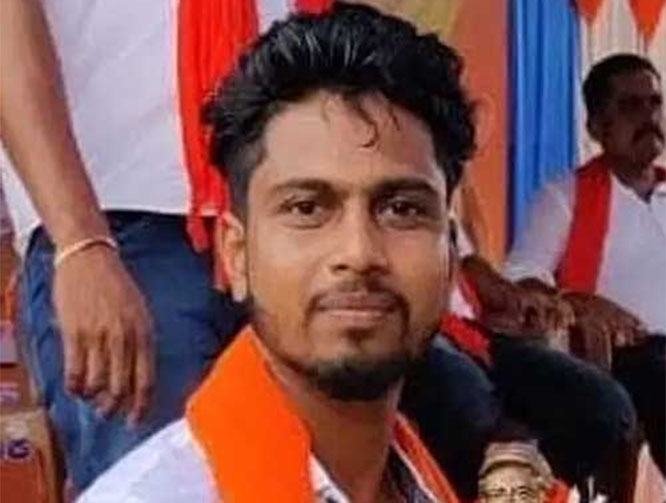
Udupi, Dec 1: A horrific case of alleged rape has unfolded in Udupi, where a worker from a Hindutva organisation, previously arrested and released on bail for harassing a young woman, is now accused of waylaying and sexually assaulting her.

The arrested individual has been identified as Pradeep Poojary (26), a member of the Hindu Jagarana Vedike's Nairkode unit in Perdur.

Poojary had allegedly been relentlessly harassing the young woman, pressuring her to marry him. When she bravely stood up to him and refused his demands, she filed a formal complaint at the Hiriyadka police station. He was subsequently arrested in that initial harassment case but was later granted bail.

According to police reports, driven by the same malicious grudge, Poojary allegedly intercepted the woman again on November 29. While she was walking through a deserted area, the accused is claimed to have threatened her by grabbing her neck. When she again refused to marry him, he allegedly proceeded to rape her.

The survivor immediately informed her family about the traumatic assault. Following this, her parents lodged a complaint at the Udupi women’s police station.

Police arrested Poojary again and produced him before the court. He has since been remanded to judicial custody.

Comments

Add new comment

  • Coastaldigest.com reserves the right to delete or block any comments.
  • Coastaldigset.com is not responsible for its readers’ comments.
  • Comments that are abusive, incendiary or irrelevant are strictly prohibited.
  • Please use a genuine email ID and provide your name to avoid reject.
News Network
November 21,2025

Bengaluru, Nov 21: The Karnataka government is facing pressure to overhaul its employment system after a high-level Cabinet sub-committee recommended the complete phase-out of job outsourcing in government offices, boards, and corporations by March 2028. The move is aimed at tackling a systemic issue that has led to the potential violation of constitutional reservation policies and the exploitation of workers.

The Call for Systemic Change

With over three lakh vacant posts currently being filled through private agencies on an outsource, insource, or daily wage basis, the sub-committee highlighted a significant lapse. "As a result, reservations are not being followed as per the Constitution and state laws. It’s an urgent need to take serious steps to change the system. It has been recommended to completely stop the system of outsourcing by March 2028," the panel stated in a document.

The practice of outsourcing involves private companies hiring workers to perform duties for a government agency. Critics argue this model results in lesser salaries, a lack of social security benefits (otherwise available to permanent government employees), and a failure to adhere to the provisions of Articles 14 and 15 of the Constitution, which guarantee equality before the law and prohibit discrimination.

The 'Bidar Model' as a Stop-Gap Solution

To regulate the current mode of employment and reduce worker exploitation until the 2028 deadline, the government plans to establish workers’ services multi-purpose cooperative societies across all districts, following the successful "Bidar Model."

The Bidar District Services of Labour Multi-purpose Cooperative Society Ltd., which operates under the District Commissioner, is cited as a successful example of providing a measure of social security to outsourced staff. Labour Department officials argue this society ensures workers receive their due wages and statutory facilities like ESI (Employees' State Insurance) and PF (Provident Fund), in exchange for a 1% service fee collected from the employees.

legislative push and Priority Insourcing

The recommendations, led by the sub-committee headed by Law and Parliamentary Affairs Minister H K Patil, are set to be discussed at the next Cabinet meeting. The committee has proposed the introduction of the Karnataka Outsourced Employees (Regulation, Placement and Welfare) Bill 2025.

In a move addressing immediate concerns, Labour Minister Santosh Lad, a member of the sub-committee, has reportedly assured that steps will be taken over the next 2-3 years to insource workers in "life-threatening services" on a priority basis. This includes essential personnel like pourakarmikas (sanitation workers), drivers, electrical staff in the Energy Department, and Health Department staff handling contagious diseases. The transition aims to grant these workers the long-term security and benefits they currently lack under the outsourcing system. 

Comments

Add new comment

  • Coastaldigest.com reserves the right to delete or block any comments.
  • Coastaldigset.com is not responsible for its readers’ comments.
  • Comments that are abusive, incendiary or irrelevant are strictly prohibited.
  • Please use a genuine email ID and provide your name to avoid reject.