Dalits and weaker sections should draw inspiration from Jagjivan Ram'

April 5, 2011

Mangalore, April 5: Rich tributes were paid to former Deputy Prime Minister and the beloved national leader Ram Babu Jagjivan Jayanthi on his 104th birth anniversary celebrated at Netravati auditorium of Zilla Panchayat here on Tuesday.

Speaking on the occasion Chairman of Coastal Development Authority B Nagaraj Shetty said that the life and struggle of the late leader should inspire one and all.

“Though he was born in a poor family, his sheer determination and efforts resulted in his rise to the coveted position of Deputy Prime Minister”, he said adding that each person from the families of Scheduled Castes and Scheduled Tribes and weaker sections should draw inspiration from Jagjivan Ram and strive to make a mark in life.

Praising the personality of the freedom fighter, Mangalore MLA U T Khader said “Jagjivan Ram was soft-spoken and implemented his plans in practice rather preach them. He organised poor feeding on a regular basis and financially helped students pursue college education.”

MCC Commissioner K N Vijayaprakash, Assistant Commissioner Prabhuling Kavalkatti, and former ZP President Mamatha Gatti were among those present.

Great achiever

Babu Jagjivan Ram, known popularly as Babuji was a freedom fighter and a social reformer hailing from the backward classes of Bihar in India. He was instrumental in foundation of the 'All-India Depressed Classes League', an organization dedicated to attaining equality for untouchables, in 1935 and was elected to Bihar Legislative Assembly in 1937, that is when he organized, rural labour movement.

In 1946, he became the youngest minister in Jawaharlal Nehru's provisional government, the First Union Cabinet of India as a Labour minister, and also a member of Constituent Assembly of India, where he ensured that social justice was enshrined in the Constitution. He went on serve as a minister in the Indian parliament with various portfolios for more than forty years as a member of Indian National Congress (INC), most importantly he was the Defence Minister of India during the Indo-Pak war of 1971, which resulted in formation of Bangladesh. His contribution to the Green Revolution in India and modernising Indian agriculture, during his two tenures as Union Agriculture Minister are still remembered, especial during 1974 drought when he was asked to hold the additional portfolio to tide over the food crisis. Though he supported Indira Gandhi during the Emergency in India (1975–1977), he left Congress in 1977 and joined Janata Party alliance in 1977, along with his Congress for Democracy, he later served as the Deputy Prime Minister of India (1977–1979), then in 1980, he formed Congress (J).

BJ1

BJ2

BJ3

BJ4

BJ5

BJ6

BJ7

BJ8

BJ9

Comments

Add new comment

  • Coastaldigest.com reserves the right to delete or block any comments.
  • Coastaldigset.com is not responsible for its readers’ comments.
  • Comments that are abusive, incendiary or irrelevant are strictly prohibited.
  • Please use a genuine email ID and provide your name to avoid reject.
News Network
January 23,2026

Mangaluru: The Karnataka Government Polytechnic (KPT), Mangaluru, has achieved autonomous status from the All India Council for Technical Education (AICTE), becoming the first government polytechnic in the country to receive such recognition in its 78-year history. The status was granted by AICTE, New Delhi, and subsequently approved by the Karnataka Board of Technical Education in October last year.

Officials said the autonomy was conferred a few months ago. Until recently, AICTE extended autonomous status only to engineering colleges, excluding diploma institutions. However, with a renewed national focus on skill development, several government polytechnics across India have now been granted autonomy.

KPT, the second-largest polytechnic in Karnataka, was established in 1946 with four branches and has since expanded to offer eight diploma programmes, including computer science and polymer technology. The institution is spread across a 19-acre campus.

Ravindra M Keni, the first dean of the institution, told The Times of India that AICTE had proposed autonomous status for polytechnic institutions that are over 25 years old. “Many colleges applied. In the first round, 100 institutions were shortlisted, which was further narrowed down to 15 in the second round. We have already completed one semester after becoming an autonomous institution,” he said. He added that nearly 500 students are admitted annually across eight three-year diploma courses.

Explaining the factors that helped KPT secure autonomy, Keni said the institution has consistently recorded 100 per cent admissions and placements for its graduates. He also noted its strong performance in sports, with the college emerging champions for 12 consecutive years, along with active student participation in NCC and NSS activities.

Autonomous status allows KPT to design industry-oriented curricula, conduct examinations, prepare question papers, and manage academic documentation independently. The institution can also directly collaborate with industries and receive priority funding from AICTE or the Ministry of Education. While academic autonomy has been granted, financial control will continue to rest with the state government.

“There will be separate committees for examinations, question paper setting, boards of studies, and boards of examiners. The institution will now have the freedom to conduct admissions without government notifications and issue its own marks cards,” Keni said, adding that new academic initiatives would be planned after a year of functioning under the autonomous framework.

Comments

Add new comment

  • Coastaldigest.com reserves the right to delete or block any comments.
  • Coastaldigset.com is not responsible for its readers’ comments.
  • Comments that are abusive, incendiary or irrelevant are strictly prohibited.
  • Please use a genuine email ID and provide your name to avoid reject.
News Network
February 1,2026

Bengaluru: Karnataka Deputy Chief Minister D K Shivakumar on Sunday criticised the Union Budget presented by Finance Minister Nirmala Sitharaman, claiming it offered no tangible benefit to the state.

Though he said he was yet to study the budget in detail, Shivakumar asserted that Karnataka had gained little from it. “There is no benefit for our state from the central budget. I was observing it. They have now named a programme after Mahatma Gandhi, after repealing the MGNREGA Act that was named after him,” he said.

Speaking to reporters here, the Deputy Chief Minister demanded the restoration of MGNREGA, and made it clear that the newly enacted rural employment scheme — VB-G RAM G — which proposes a 60:40 fund-sharing formula between the Centre and the states, would not be implemented in Karnataka.

“I don’t see any major share for our state in this budget,” he added.

Shivakumar, who also holds charge of Bengaluru development, said there were high expectations for the city from the Union Budget. “The Prime Minister calls Bengaluru a ‘global city’, but what has the Centre done for it?” he asked.

He also drew attention to the problems faced by sugar factories, particularly those in the cooperative sector, alleging a lack of timely decisions and support from the central government.

Noting that the Centre has the authority to fix the minimum support price (MSP) for agricultural produce, Shivakumar said the Union government must take concrete steps to protect farmers’ interests.

Comments

Add new comment

  • Coastaldigest.com reserves the right to delete or block any comments.
  • Coastaldigset.com is not responsible for its readers’ comments.
  • Comments that are abusive, incendiary or irrelevant are strictly prohibited.
  • Please use a genuine email ID and provide your name to avoid reject.
coastaldigest.com news network
January 19,2026

badriya.jpg

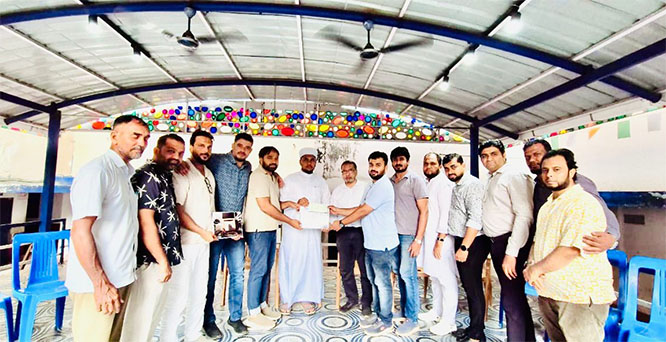
Mangaluru: The Phase I project of Badria Vision 2028 was formally launched at a ceremony held at the Badria Campus on January 17, marking an important step in the institution’s long-term development roadmap.

The programme was attended by P.B. Abdul Hameed, Secretary of the MEA, and P.C. Hasir, Correspondent of the MEA, who presided over the event and underscored the institution’s commitment to growth and academic excellence.

Office-bearers of the Badria Alumni Association were present in large numbers, including A.K. Sajid (President), Shamsuddin and S.M. Farooq (Vice-Presidents), Shaheed (General Secretary), and Khaleel (Treasurer), reflecting strong alumni engagement in the initiative.

The gathering was blessed by Sayyid Shamsuddeen Basith Thangal Kukkaje, Qateeb of Zeenat Yatheem Bakshi, who led a special dua seeking divine guidance and success for the project.

The ceremony also witnessed the participation of prominent alumnus and local corporate professional Abdul Latheef, along with alumni members Naushad, Kalandar, Safwan, members of the core committee, and several other former students.

A key moment of the event was the formal handover of a cheque to Ameen Woodland Architect, signalling the immediate commencement of construction work under Phase I of the project.

Organisers said the launch of Phase I reflects a shared vision, institutional unity, and collective resolve to realise the objectives of Badria Vision 2028.

Comments

Add new comment

  • Coastaldigest.com reserves the right to delete or block any comments.
  • Coastaldigset.com is not responsible for its readers’ comments.
  • Comments that are abusive, incendiary or irrelevant are strictly prohibited.
  • Please use a genuine email ID and provide your name to avoid reject.