Faculty development programme gets underway at AIMIT

July 13, 2011

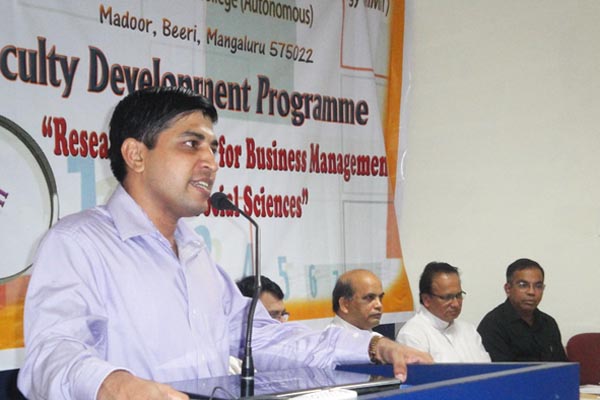
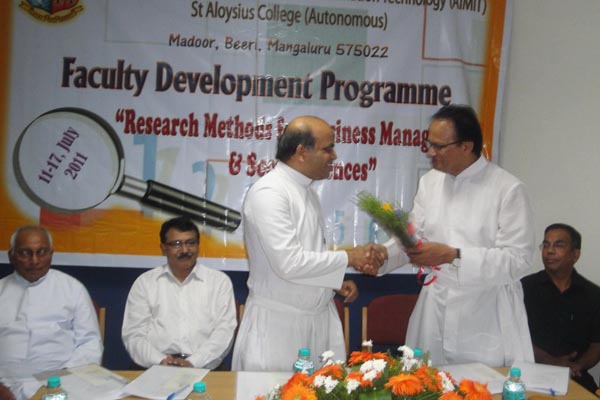
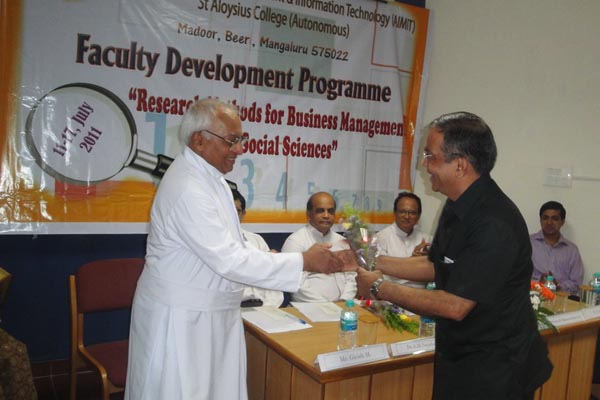
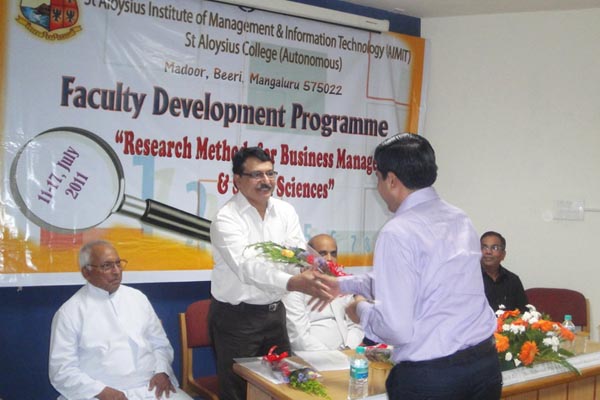
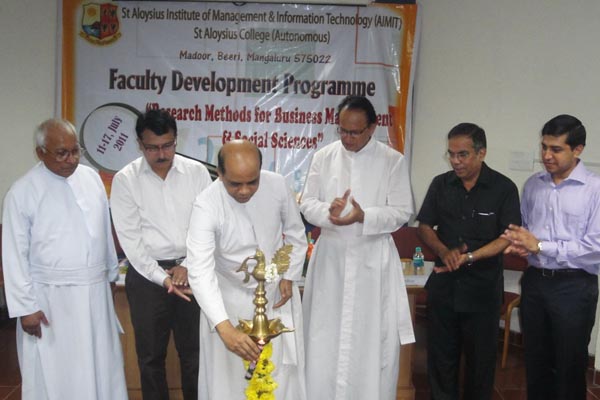
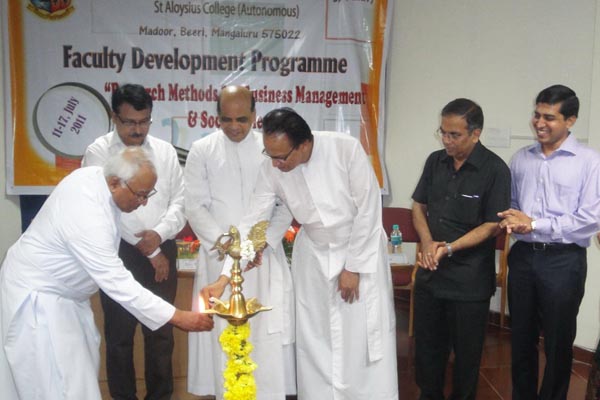
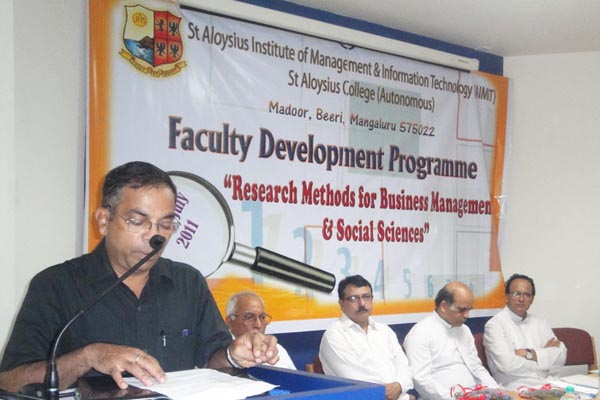
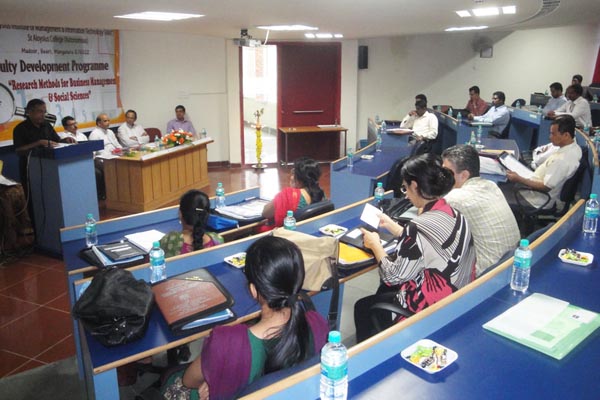
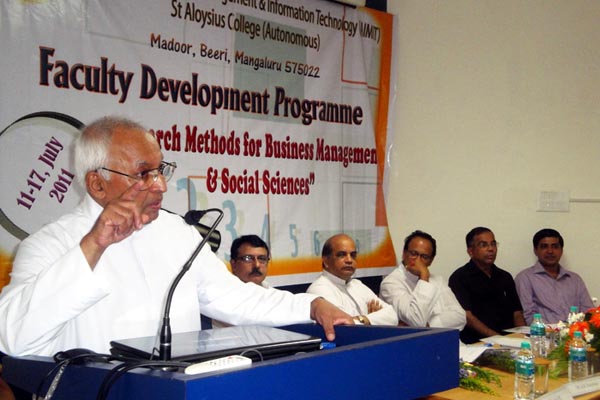
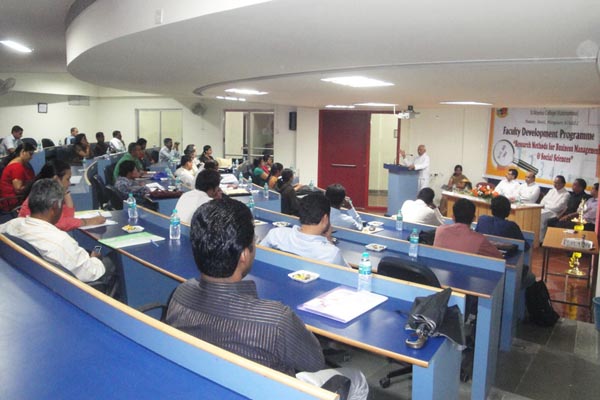
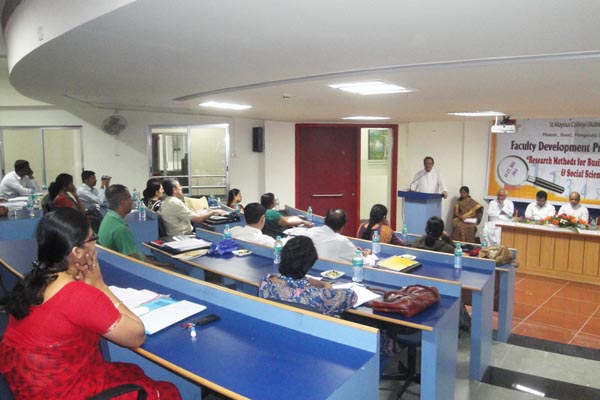
Mangalore, July 13: The inauguration ceremony of the one week Faculty Development Programme on Research Methods for Business Management and Social Sciences organised by the St Aloysius Institution of Management and Information technology, St Aloysius College began on Monday, July 11.

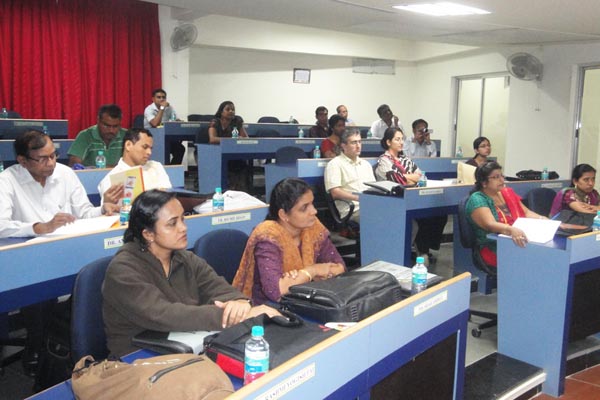
Rev. Fr. Swebert D'silva S.J. -Principal, St Aloysius College, Dr A.M. Narahari- Registrar, St Aloysius College, Rev. Fr. Denzil Lobo S.J- Director AMIT , Rev. Dr. Oswald Mascarenhas S.J- Chairman, AIMIT (MBA ), Dr Sridhar Dean (Research), Dr Rowena Wright, Dean(Academics) and Mr Girish -Faculty Coordinator of the FDP were present at the programme. The programme was attended by more than 30 participants from various institutions around the country. Dr Rowena Wright compered the programme.

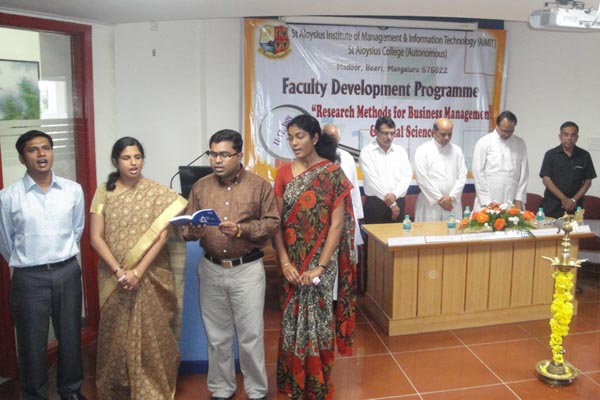
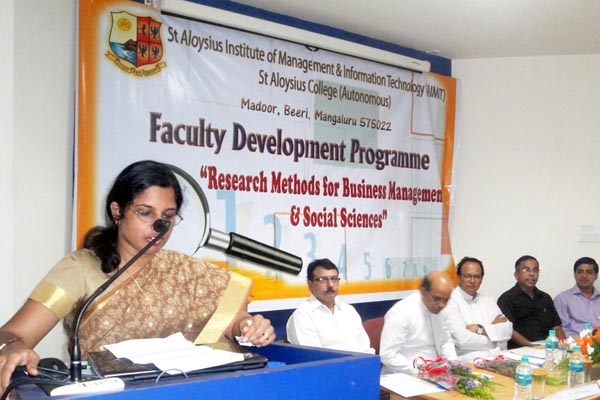
The Inauguration Ceremony began with a prayer sung by the Faculty members of the MBA Department followed by a welcome address by MS. Sumitha Achar – Joint Coordinator of the FDP Programme.

Dr Sridhar then gave an overview to the participants on the preparation for such a programme and explained in brief the topics to be covered in this one week FDP in a nutshell. He also invited suggestions from the participants for organising such programmes and workshops in the future.

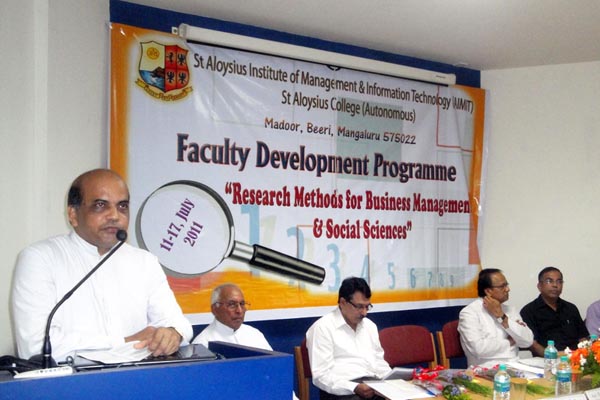
Rev. Fr. Swebert D'silva S.J congratulated the Department of MBA for its tremendous growth from its inception and for organising several such programmes which are indeed contributing toward academic growth. He also stressed on how the college has been imparting quality education with a strong base of ethical and moral values among students for over a century.

Dr A.M. Narahari gave his best wishes to the organisers of the programme and made it clear through his speech as on how research would contribute towards increased Industry – Academic integration.

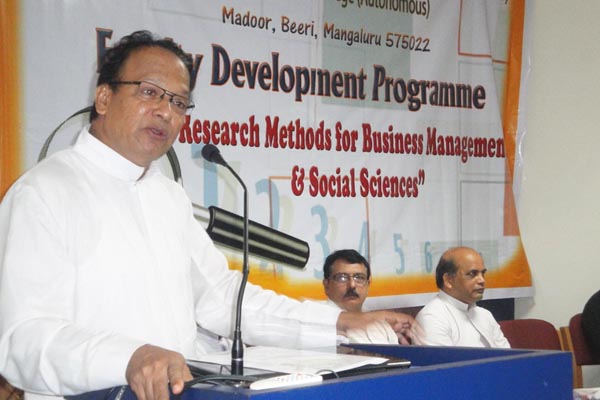
The programme then continued with a brief introduction given by Rev. Dr. Oswald Mascarenhas S.J on “growth of research.” He highlighted the fact that research today has not just remained merely a number crunching activity but has grown from Quantitative Data Analysis to Qualitative one over the past few decades.

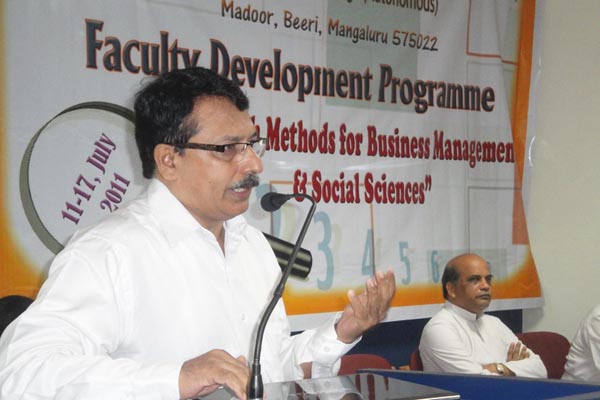
The Presidential remarks were made by Rev. Fr. Denzil Lobo S.J. who stated on how Jesuit Education which has been managing Educational Institutions over four hundred years has been key promoters of research. He also put forth the idea of how the Institution is working hard towards organising many more programmes of academic and research importance.

The Inauguration ceremony concluded with a vote of thanks speech by Mr. Girish M who thanked the guest, participants, teaching and non- teaching staff for their contributions toward making this programme a success reality.

This FDP programme will include deliberations on various research topics like Research Methods, Ethics in Research, Research Design and Sampling, Literature review: types, process , Identifying Research Gap, Framing Research Questions, What Statistics can and cannot do?, validating the research Study, Research tools and Scales of Measurement, overview of descriptive Statistics, Theory of Probability, overview of inferential Statistics and Practical sessions on Statistical Techniques, Non- Parametric Tests, Multivariate Data Analysis, Conjoint Analysis, Basis of Qualitative Research, Qualitative Data Analysis, Basis of Data Envelopment Analysis and many more interactive sessions.
FD_1

FD_2

FD_3

FD_4

FD_5

FD_6

FD_7

FD_8

FD_9

FD_10

FD_11

FD_12

FD_13

FD_14

FD_15

FD_16

FD_17

Comments

Add new comment

  • Coastaldigest.com reserves the right to delete or block any comments.
  • Coastaldigset.com is not responsible for its readers’ comments.
  • Comments that are abusive, incendiary or irrelevant are strictly prohibited.
  • Please use a genuine email ID and provide your name to avoid reject.
coastaldigest.com news network
January 19,2026

badriya.jpg

Mangaluru: The Phase I project of Badria Vision 2028 was formally launched at a ceremony held at the Badria Campus on January 17, marking an important step in the institution’s long-term development roadmap.

The programme was attended by P.B. Abdul Hameed, Secretary of the MEA, and P.C. Hasir, Correspondent of the MEA, who presided over the event and underscored the institution’s commitment to growth and academic excellence.

Office-bearers of the Badria Alumni Association were present in large numbers, including A.K. Sajid (President), Shamsuddin and S.M. Farooq (Vice-Presidents), Shaheed (General Secretary), and Khaleel (Treasurer), reflecting strong alumni engagement in the initiative.

The gathering was blessed by Sayyid Shamsuddeen Basith Thangal Kukkaje, Qateeb of Zeenat Yatheem Bakshi, who led a special dua seeking divine guidance and success for the project.

The ceremony also witnessed the participation of prominent alumnus and local corporate professional Abdul Latheef, along with alumni members Naushad, Kalandar, Safwan, members of the core committee, and several other former students.

A key moment of the event was the formal handover of a cheque to Ameen Woodland Architect, signalling the immediate commencement of construction work under Phase I of the project.

Organisers said the launch of Phase I reflects a shared vision, institutional unity, and collective resolve to realise the objectives of Badria Vision 2028.

Comments

Add new comment

  • Coastaldigest.com reserves the right to delete or block any comments.
  • Coastaldigset.com is not responsible for its readers’ comments.
  • Comments that are abusive, incendiary or irrelevant are strictly prohibited.
  • Please use a genuine email ID and provide your name to avoid reject.
News Network
January 23,2026

Karnataka Governor Thaawarchand Gehlot read only three lines from the 122-paragraph address prepared by the Congress-led state government while addressing the joint session of the Legislature on Thursday, effectively bypassing large sections critical of the BJP-led Union government.

The omitted portions of the customary Governor’s address outlined what the state government described as a “suppressive situation in economic and policy matters” under India’s federal framework. The speech also sharply criticised the Centre’s move to replace the Mahatma Gandhi National Rural Employment Guarantee Act (MGNREGA) with the Viksit Bharat–Guarantee for Rozgar and Ajeevika Mission (Gramin) Act, commonly referred to as the VB-GRAM (G) Act.

Governor Gehlot had earlier conveyed his objection to several paragraphs that were explicitly critical of the Union government. On Thursday, he confined himself to the opening lines — “I extend a warm welcome to all of you to the joint session of the State legislature. I am extremely pleased to address this august House” — before jumping directly to the concluding sentence of the final paragraph.

He ended the address by reading the last line of paragraph 122: “Overall, my government is firmly committed to doubling the pace of the State’s economic, social and physical development. Jai Hind — Jai Karnataka.”

According to the prepared speech, the Karnataka government demanded the scrapping of the VB-GRAM (G) Act, describing it as “contractor-centric” and detrimental to rural livelihoods, and called for the full restoration of MGNREGA. The state government argued that the new law undermines decentralisation, weakens labour protections, and centralises decision-making in violation of constitutional norms.

Key points from the unread sections of the speech:

•    Karnataka facing a “suppressive” economic and policy environment within the federal system

•    Repeal of MGNREGA described as a blow to rural livelihoods

•    VB-GRAM (G) Act accused of protecting corporate and contractor interests

•    New law alleged to weaken decentralised governance

•    Decision-making said to be imposed by the Centre without consulting states

•    Rights of Adivasis, women, backward classes and agrarian communities curtailed

•    Labourers allegedly placed under contractor control

•    States facing mounting fiscal stress due to central policies

•    VB-GRAM (G) Act accused of enabling large-scale corruption

Comments

Add new comment

  • Coastaldigest.com reserves the right to delete or block any comments.
  • Coastaldigset.com is not responsible for its readers’ comments.
  • Comments that are abusive, incendiary or irrelevant are strictly prohibited.
  • Please use a genuine email ID and provide your name to avoid reject.
News Network
January 23,2026

Mangaluru: The Karnataka Government Polytechnic (KPT), Mangaluru, has achieved autonomous status from the All India Council for Technical Education (AICTE), becoming the first government polytechnic in the country to receive such recognition in its 78-year history. The status was granted by AICTE, New Delhi, and subsequently approved by the Karnataka Board of Technical Education in October last year.

Officials said the autonomy was conferred a few months ago. Until recently, AICTE extended autonomous status only to engineering colleges, excluding diploma institutions. However, with a renewed national focus on skill development, several government polytechnics across India have now been granted autonomy.

KPT, the second-largest polytechnic in Karnataka, was established in 1946 with four branches and has since expanded to offer eight diploma programmes, including computer science and polymer technology. The institution is spread across a 19-acre campus.

Ravindra M Keni, the first dean of the institution, told The Times of India that AICTE had proposed autonomous status for polytechnic institutions that are over 25 years old. “Many colleges applied. In the first round, 100 institutions were shortlisted, which was further narrowed down to 15 in the second round. We have already completed one semester after becoming an autonomous institution,” he said. He added that nearly 500 students are admitted annually across eight three-year diploma courses.

Explaining the factors that helped KPT secure autonomy, Keni said the institution has consistently recorded 100 per cent admissions and placements for its graduates. He also noted its strong performance in sports, with the college emerging champions for 12 consecutive years, along with active student participation in NCC and NSS activities.

Autonomous status allows KPT to design industry-oriented curricula, conduct examinations, prepare question papers, and manage academic documentation independently. The institution can also directly collaborate with industries and receive priority funding from AICTE or the Ministry of Education. While academic autonomy has been granted, financial control will continue to rest with the state government.

“There will be separate committees for examinations, question paper setting, boards of studies, and boards of examiners. The institution will now have the freedom to conduct admissions without government notifications and issue its own marks cards,” Keni said, adding that new academic initiatives would be planned after a year of functioning under the autonomous framework.

Comments

Add new comment

  • Coastaldigest.com reserves the right to delete or block any comments.
  • Coastaldigset.com is not responsible for its readers’ comments.
  • Comments that are abusive, incendiary or irrelevant are strictly prohibited.
  • Please use a genuine email ID and provide your name to avoid reject.