Mangalore Bishop visits Maasai tribes of Africa

[email protected] (CD Network)
July 27, 2013

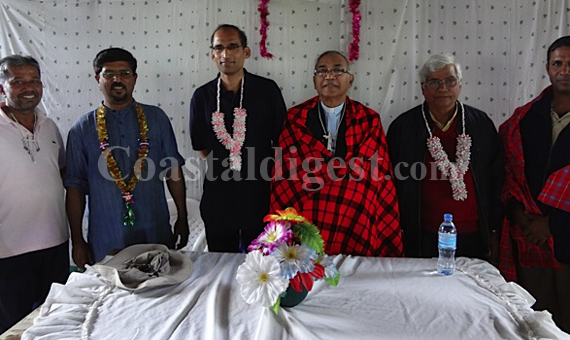
Simanjiro, Jul 27: Bishop of Mangalore visited SVD Fathers mission in Africa and appreciated the work done by the Mission in the remote Samanjiro area of the desert, which is inhabited by the Maasai tribes.

Bishop Alousius Paul D'Souza was given a warm welcome by the people of Simanjiro. Colourful Maasai dance and songs were staged by the community who later presented him with the traditional 'Shuka', a Maasai blanket, 'Rungu', which is presented to the chief of the tribe recognising him as the head of the tribe and a Maasai Cross.

Simanjiro is a remote place in the Region of Manyara of Tanzania, East Africa.  From the City of Arusha the nearest main town one has to travel a long distance of hundred kilometers in the dessert on the bush roads to reach Simanjiro.

The inhabitants of the place belong to Maasai Tribe the main occupation is to grazing Cattle and Sheep.  That's their main source of income.

In 1952 the Holy Ghost Fathers' came as missionaries to work among Maasai tribe.   Rome of the east Mangalore also has connection with Simanjiro mission.  Fr. Fredric Castillino of Belvai parish worked here from 2002 to 2007.  Presently Fr. Peter Pinto of Shirthady Parish is the mission superior.  The mission has 18 substations of Maasai Tribe and two substations of non-Maasai tribe having a Catholic population of four thousand.

The Mission runs 45 bed hospital to take care of the health needs of the people of Simanjiro.  But for this hospital Simanjiro people would have had to travel, hundred kilometers to reach the nearest health center.

One in fifteen days 'flying medical services' land at Simanjiro making Simanjiro as the base and visit near by villages to administer vaccine to pregnant women and children below 5 years each.  They take the assistance of Simanjiro Hospital.

In addition to this Simanjiro hospital on its own provides similar kind of service to another five villages along with a twenty four hours Ambulance service to the people in the bush which saves precious lives.

Bishop_Visits_SVD_mission_in_Africa_6

Bishop_Visits_SVD_mission_in_Africa_3

Bishop_Visits_SVD_mission_in_Africa_4

Bishop_Visits_SVD_mission_in_Africa_5

Bishop_Visits_SVD_mission_in_Africa_7

Bishop_Visits_SVD_mission_in_Africa_8

Bishop_Visits_SVD_mission_in_Africa_10

Bishop_Visits_SVD_mission_in_Africa_11

Bishop_Visits_SVD_mission_in_Africa_15

Comments

Add new comment

  • Coastaldigest.com reserves the right to delete or block any comments.
  • Coastaldigset.com is not responsible for its readers’ comments.
  • Comments that are abusive, incendiary or irrelevant are strictly prohibited.
  • Please use a genuine email ID and provide your name to avoid reject.
News Network
December 7,2025

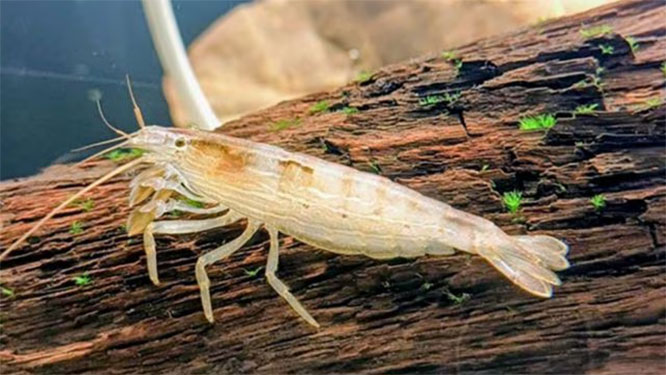
SHRIMP.jpg

Mangaluru, Dec 7: A rare bamboo shrimp has been rediscovered on mainland India more than 70 years after it was last reported, confirming for the first time the presence of Atyopsis spinipes in the country. The find was made by researchers from the Centre for Climate Change Studies at Sathyabama Institute of Science and Technology, Chennai, during surveys in Karnataka and Odisha.

The team — shrimp expert Dr S Prakash, PhD scholar K Kunjulakshmi, and Mangaluru-based researcher Maclean Antony Santos — combined field surveys, ecological assessments and DNA analysis to identify the elusive species. Their findings, published in Zootaxa, resolve decades of taxonomic confusion stemming from a 1951 report that misidentified the species as Atyopsis moluccensis without strong evidence.

The shrimp has now been confirmed at two locations: the Mulki–Pavanje estuary near Mangaluru and the Kuakhai River in Bhubaneswar. Historical specimens from the Andaman Islands, previously labelled as A. moluccensis, were also found to be misidentified and actually belong to A. spinipes.

The rediscovery began after an aquarium hobbyist in Odisha spotted a shrimp in 2022, prompting systematic surveys across Udupi, Karwar and Mangaluru. Four female specimens were collected in Mulki and one in Odisha, all genetically matching.

Researchers warn the species may exist in very small, vulnerable populations as freshwater habitats face increasing pressure from pollution, sand mining and infrastructure development. All verified specimens have been deposited with the Zoological Survey of India for future reference.

Comments

Add new comment

  • Coastaldigest.com reserves the right to delete or block any comments.
  • Coastaldigset.com is not responsible for its readers’ comments.
  • Comments that are abusive, incendiary or irrelevant are strictly prohibited.
  • Please use a genuine email ID and provide your name to avoid reject.