



E-Jama'ath: A Creative Step by Creative Foundation

[email protected] (CD Network)
June 11, 2010

ejamath
.
Mangalore, June 11: With the establishment of Information and Empowerment Centre (IEC) in the city and declaring of three isolated Masjid bodies as e-jama'aths, the decade old dream of a small group of awakened people of Dakshina Kannada district is on it's road to realisation.

The initiative can be described as the first step towards empowering a neglected, downtrodden, opportunity-less, marginalised and unorganised community of the region.

One of the salient characteristics of the Muslim community of this country in general and rural areas in particular is the lack of information and awareness. Realising this fact, the Creative Foundation, which came into existence 10 years ago, recently put forward a step to establish an information-sharing unit, maintaining constant internet link with all the members of Muslim community of Dakshina Kannada district through Masjid bodies.

The IEC which can be rightly called as the brain child of Creative Foundation is committed to maintain constant contact with all e-jama'aths of the district. Further, it will always keep a track on all the development schemes and programmes of both the state and central governments and provide information to all the e-jama'aths of the district via internet.

According to Anwar Sadath, the president of Creative Foundation, his organisation is striving hard to declare the entire district as e-jama'ath zone by the end of 2015, so that the data of each Muslim individual can be accumulated and reviewed by an accountable and responsible centre.

An e-jama'ath would collect the data of each and every individual who comes under its jurisdiction, feed them into the computer and share them with the IEC. How many homes and families are there in a particular jama'ath? Who is the head of a particular family? How many male and female members are there in a family? What are their qualifications and abilities? How many of them are employed and what kind of job are they doing? How many are graduates and how many of them are unemployed? Are they beneficiaries of the development schemes and programmes of government meant for minorities? How many of them own a house and how many families are leading their lives as tenants? If a particular family owns a house, does it have proper records and documents? Whether all the members of above 18 year age posses voter identity card or not? How many of them are pan card holders? ...all these details would be updated by an e-jama'ath.

The IEC would peruse all these details and guide the jama'ath to overcome its shortcomings and problems. It also would inform and explain the members of the jama'ath in time about the new development schemes of the government and guide them how to derive benefits from them.

“The work-sphere of a governing body of a jama'ath should not be confined to the development of mosque and madrasa buildings. It should exert all its efforts for the cause of overall progress of the community”, says Sadath.

In order to make community members realise their responsibilities, Sadath says, his foundation will organise education guidance camps, information camps, and the like, to explain about the community development plans of the state and union government.

Creative foundation believes that the jama'ath of a Masjid is the right place for the sharing of information. And, if a jama'ath becomes an e-jama'ath, it can easily share all the information through internet.

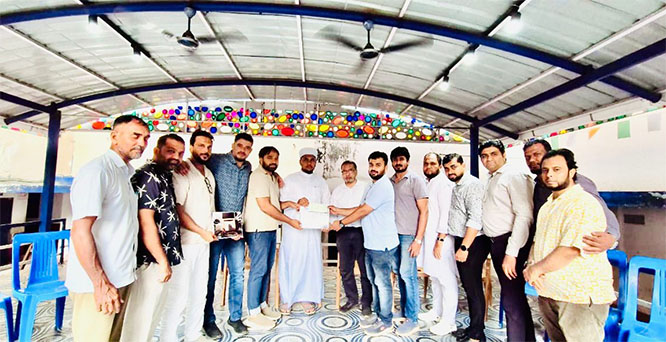
Currently three independent jama'aths of the district, namely Muhiyuddeen Jama'ath of Idya, Shekhmaley Jama'ath of Puttur and Bolar Jama'ath of Mangalore have been declared as e-jama'aths. These 3 jama'aths have already been provided with computers and internet facility and the preparations for data compilation have also begun. The imams of the mosques and office bearers of the jama'ath are being trained to handle the information sharing system.

K P Sadiq, the Vice-President of Shekhmale jama'ath says that there are more than 700 members residing over 90 homes, which come under the jurisdiction of his jama'ath. The jama'ath is planning to set up a team to collect the data from the members and feed it into the computer. The imam of the mosque also appears to be enthusiastic about the plan.

The Muhiyuddeen jama'ath of Idya, near Suratkal has more than 900 homes under its limits. It has two computers presently, which can be used for multipurpose activities such as data storage, information sharing and training of the madrasa students. Abdul Azeez, the secretary of the jama'ath says that the concept of e-jama'ath has stimulated many people. According to him, the jama'ath will be able to pile up all the expected details from the members within 4 months.

The Bolar Muslim jama'ath has over 600 homes in its limits. Haneef Haji, the secretary of the jama'ath says that the governing body of the mosque is currently discussing the finalization of the framework to launch a data collection campaign.

With the aim of bringing the entire Muslim community onto the platform of e-jama'ath, the Creative Foundation is eager to declare at least 100 mosque-bodies as e-jama'aths in the next few months.

“Lack of creativity and information is one of the main reasons for the backwardness of this community. It is our responsibility to awaken it. If everything goes according to the plan, we hope e-jama'ath would change the picture of this community,” says an office bearer of IEC. Meanwhile, several Muslim organisations of the region such as Jamiyathul Falah and Talent Research Foundation have come forward to encourage IEC.

Comments

Add new comment

  • Coastaldigest.com reserves the right to delete or block any comments.
  • Coastaldigset.com is not responsible for its readers’ comments.
  • Comments that are abusive, incendiary or irrelevant are strictly prohibited.
  • Please use a genuine email ID and provide your name to avoid reject.
News Network
January 20,2026

Mangaluru: In a major step towards strengthening rural innovation, the Office of the Principal Scientific Adviser (PSA) to the Government of India is supporting the establishment of RuTAGe Smart Village Centres (RSVCs) across the country through collaborations with academic institutions, civil society organisations and philanthropic partners.

As part of this national initiative, Nitte (Deemed to be University) will set up the first RSVCs in the region at Nitte GP in Udupi district and at the Nitte Health Centre, Sevanjali Trust, Farangipete, in Dakshina Kannada district. The centres will be inaugurated on January 21. In South India, the programme is being implemented by the Section Infin-8 Foundation (SI-8).

Speaking to reporters on Monday, SI-8 founder-director Vishwas US said experts from Nitte University and SI-8 would work closely with farmers, students, youth and local entrepreneurs to adapt and deploy technologies tailored to local needs.

Project head Prof Iddya Karunasagar, representing Nitte DU, said the RSVCs at Nitte and Farangipete would serve as demonstration hubs for a wide range of agriculture, energy, skill-development and assistive technologies. These include solar dryers for fruits, vegetables and crops; soil-testing solutions; power weeders and women-friendly farm tools; wind-powered devices for rural artisans; grain storage systems; grass-cutting and tree-climbing equipment; and liquid fertiliser production using cowshed waste.

SI-8 CEO Aravind C Kumar said the centres would also provide access to digital and knowledge-based platforms such as ISRO applications, government scheme portals, market linkage tools and gamified learning resources, along with assistive technologies for persons with visual impairments.

Highlighting the broader impact of the initiative, Principal Scientific Adviser Prof Ajay Kumar Sood said it demonstrated how applied research could bridge the rural–urban divide and help create self-reliant, technology-enabled villages.

The initiative has been made possible through philanthropic support from Dr NC Murthy of ACM Business Solutions, LLC, USA. Dr Sapna Poti, Director (Strategic Alliances) at the Office of the Principal Scientific Adviser, said the long-term objective is to build self-sufficient, technology-driven communities capable of generating sustainable livelihoods on their own.

Comments

Add new comment

  • Coastaldigest.com reserves the right to delete or block any comments.
  • Coastaldigset.com is not responsible for its readers’ comments.
  • Comments that are abusive, incendiary or irrelevant are strictly prohibited.
  • Please use a genuine email ID and provide your name to avoid reject.
coastaldigest.com news network
January 19,2026

badriya.jpg

Mangaluru: The Phase I project of Badria Vision 2028 was formally launched at a ceremony held at the Badria Campus on January 17, marking an important step in the institution’s long-term development roadmap.

The programme was attended by P.B. Abdul Hameed, Secretary of the MEA, and P.C. Hasir, Correspondent of the MEA, who presided over the event and underscored the institution’s commitment to growth and academic excellence.

Office-bearers of the Badria Alumni Association were present in large numbers, including A.K. Sajid (President), Shamsuddin and S.M. Farooq (Vice-Presidents), Shaheed (General Secretary), and Khaleel (Treasurer), reflecting strong alumni engagement in the initiative.

The gathering was blessed by Sayyid Shamsuddeen Basith Thangal Kukkaje, Qateeb of Zeenat Yatheem Bakshi, who led a special dua seeking divine guidance and success for the project.

The ceremony also witnessed the participation of prominent alumnus and local corporate professional Abdul Latheef, along with alumni members Naushad, Kalandar, Safwan, members of the core committee, and several other former students.

A key moment of the event was the formal handover of a cheque to Ameen Woodland Architect, signalling the immediate commencement of construction work under Phase I of the project.

Organisers said the launch of Phase I reflects a shared vision, institutional unity, and collective resolve to realise the objectives of Badria Vision 2028.

Comments

Add new comment

  • Coastaldigest.com reserves the right to delete or block any comments.
  • Coastaldigset.com is not responsible for its readers’ comments.
  • Comments that are abusive, incendiary or irrelevant are strictly prohibited.
  • Please use a genuine email ID and provide your name to avoid reject.
News Network
January 23,2026

Mangaluru: The Karnataka Government Polytechnic (KPT), Mangaluru, has achieved autonomous status from the All India Council for Technical Education (AICTE), becoming the first government polytechnic in the country to receive such recognition in its 78-year history. The status was granted by AICTE, New Delhi, and subsequently approved by the Karnataka Board of Technical Education in October last year.

Officials said the autonomy was conferred a few months ago. Until recently, AICTE extended autonomous status only to engineering colleges, excluding diploma institutions. However, with a renewed national focus on skill development, several government polytechnics across India have now been granted autonomy.

KPT, the second-largest polytechnic in Karnataka, was established in 1946 with four branches and has since expanded to offer eight diploma programmes, including computer science and polymer technology. The institution is spread across a 19-acre campus.

Ravindra M Keni, the first dean of the institution, told The Times of India that AICTE had proposed autonomous status for polytechnic institutions that are over 25 years old. “Many colleges applied. In the first round, 100 institutions were shortlisted, which was further narrowed down to 15 in the second round. We have already completed one semester after becoming an autonomous institution,” he said. He added that nearly 500 students are admitted annually across eight three-year diploma courses.

Explaining the factors that helped KPT secure autonomy, Keni said the institution has consistently recorded 100 per cent admissions and placements for its graduates. He also noted its strong performance in sports, with the college emerging champions for 12 consecutive years, along with active student participation in NCC and NSS activities.

Autonomous status allows KPT to design industry-oriented curricula, conduct examinations, prepare question papers, and manage academic documentation independently. The institution can also directly collaborate with industries and receive priority funding from AICTE or the Ministry of Education. While academic autonomy has been granted, financial control will continue to rest with the state government.

“There will be separate committees for examinations, question paper setting, boards of studies, and boards of examiners. The institution will now have the freedom to conduct admissions without government notifications and issue its own marks cards,” Keni said, adding that new academic initiatives would be planned after a year of functioning under the autonomous framework.

Comments

Add new comment

  • Coastaldigest.com reserves the right to delete or block any comments.
  • Coastaldigset.com is not responsible for its readers’ comments.
  • Comments that are abusive, incendiary or irrelevant are strictly prohibited.
  • Please use a genuine email ID and provide your name to avoid reject.