



Nine Killed as Massive Storm Hits Delhi; Flights, Metro Services Hit

May 31, 2014

New Delhi, May 31: At least nine people were killed in the NCR region, including six in Delhi, as a massive thunder storm lashed the region crippling road traffic, metro services and flight operations and hitting power supply.
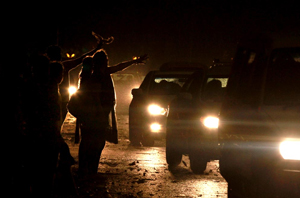
Storm Hits Delhi
Delhi Police said six people died and 13 were injured in various areas of the city in accidents like felling of trees, collapse of walls and electrocution following the storm which was accompanied by winds at a speed of over 90 kmph.

he storm struck Delhi at 4:58 pm immediately throwing normal life out of gear.

Thousands of people were stranded outside Metro stations and on roads as traffic almost came to a halt due the storm which darkened the sky.

Most areas in city plunged into darkness immediately after the storm as uprooted trees snapped power lines. Metro train services were disrupted on almost all lines for about an hour due to power failure during the evening rush time.

Met department termed the storm as "cumulonimbus" andattributed it to western disturbance over Pakistan. NCR areas of east Delhi, Noida and Ghaziabad were most affected by the storm.

Met office said similar weather conditions are likely to persist for over the next two days. At least 12 flights werediverted due to the storm, an IGI official said.

Areas in South, East and North Delhi faced long power cuts ranging from one to four hours. Supply of power could not be restored till late in the evening in several areas in North and North West Delhi.

The city saw massive traffic jams as the storm uprooted trees snapping power lines in many areas and affecting traffic lights leading to chaos on the streets.

"The cumulonimbus brings tall thunderstorms and dusty winds with a speed of over 92 kmph and are caused because of western disturbance, which is currently over Pakistan."

"The meeting of cold air and hot air on the Indo-Gangetic plains causes low pressure area and also lot of instability. This results in severe thunderstorm," IMD Director General L S Rathore said.

The storm affected northeast Haryana and the NCR. But parts of east Delhi, Noida and Ghaziabad were affected the most, he said.

Police in Ghaziabad said the storm claimed three lives and injured more than a 12 people besides causing heavy loss to property in different parts of the city.

"This phenomena is likely to continue for the next two days," Rathore said.

The maximum temperature recorded today was 42.8 degree Celsius while the minimum was 29.1 degree.

At some locations including Janakpuri and Inderlok, material like tin sheet and pipes got entangled into the overhead electrification wire due to the dust storm, making train movement impossible.

The storm affected many transmission lines and power generation plants in Delhi.

"A maximum load up to around 3000 MW was affected. The lines which tripped included lines of both northern grid as well as of Delhi Transco," said a senior Power department official.

Power generation plants Rajghat power house, Pragati Power Station and three units of BTPS also tripped.

Delhi Police said a 17-year-old youth, identified as Anu died when a tin sheet slit his neck and then hit his 51-year-old mother's on her head leaving her critically injured in Vivek Vihar area in east Delhi.

Five people were injured in East Delhi in a wall collapse.

In South West Delhi, two people including an 18-year-old girl were killed. The Class XII student lost her life after a portion of a boundary wall fell on her around 5.15 pm.

The girl was identified as Aasha Malik and she was returning home after tuition classes. She was shifted to Rao Tula Ram Hospital where doctors declared her dead on arrival.

Three people were injured in North East Delhi while another trio were injured in Nizamuddin area in South East Delhi.

In Central Delhi, a 24-year-old cab driver, identified as Chattarpal died after a tree fell on his car in I.P. Estate area around 5.30 pm.

In North Delhi, a man identified as Younis was killed after a tree fell on him. A 20 year-old-youth was killed when a tree fell on him in Uttam Nagar are of West Delhi, police said.

The MeT department has also predicted bad air quality in the city for the next three days.

System of Air quality Forecasting And Research (SAFAR), a constituent of Indian Institute of Tropical Meteorology, said the air quality was found "poor" following the storm.

Parked cars were damaged in some areas due to felling of trees.

In North Delhi, at least nine complaints of tree or its branches falling were received by the North Corporation from its various zones, NDMC Public Relations Officer Yogendra Singh Mann said.

"The control room of North Delhi Municipal Corporation received nine complaints of falling of trees or branches. While three complaints each were received from Civil Lines Zone and City Zone areas, two complaints came from Rohini Zone and one from Narela Zone," he said.

East Delhi Municipal Corporation received the maximum complaint of 20 such cases. While six complaints were received from Shahdara (North) Zone area, the remaining 14 complaints came from Shahdara (South) Zone, Mann said.

However, no casualty has been reported so far, he said, adding, couple of complaints of water logging were also reported.

In South Delhi, a total of 11 cases of fallen trees were reported.

"Four trees fell in South Zone, three each in Central and West Zones while one in Najafgarh Zone," SDMC Public Relations Officer Mukesh Yadav said.


Comments

Add new comment

  • Coastaldigest.com reserves the right to delete or block any comments.
  • Coastaldigset.com is not responsible for its readers’ comments.
  • Comments that are abusive, incendiary or irrelevant are strictly prohibited.
  • Please use a genuine email ID and provide your name to avoid reject.
News Network
December 6,2025

pilot.jpg

New Delhi: IndiGo, India’s largest airline, faced major operational turbulence this week after failing to prepare for new pilot-fatigue regulations issued by the Directorate General of Civil Aviation (DGCA). The stricter rules—designed to improve flight safety—took effect in phases through 2024, with the latest implementation on November 1. IndiGo has acknowledged that inadequate roster planning led to widespread cancellations and delays.

Below are the key DGCA rules that affected IndiGo’s operations:

1. Longer Mandatory Weekly Rest

Weekly rest for pilots has been increased from 36 hours to 48 hours.

The government says the extended break is essential to curb cumulative fatigue. This rule remains in force despite the current crisis.

2. Cap on Night Landings

Pilots can now perform only two night landings per week—a steep reduction from the earlier limit of six.

Night hours, defined as midnight to early morning, are considered the least alert period for pilots.

Given the disruptions, this rule has been temporarily relaxed for IndiGo until February 10.

3. Reduced Maximum Night Flight Duty

Flight duty that stretches into the night is now capped at 10 hours.

This measure has also been kept on hold for IndiGo until February 10 to stabilize operations.

4. Weekly Rest Cannot Be Replaced With Personal Leave

Airlines can no longer count a pilot’s personal leave as part of the mandatory 48-hour rest.

Pilots say this closes a loophole that previously reduced actual rest time.

Currently, all airlines are exempt from this rule to normalise travel.

5. Mandatory Fatigue Monitoring

Airlines must submit quarterly fatigue reports along with corrective actions to DGCA.

This system aims to create a transparent fatigue-tracking framework across the industry.

The DGCA has stressed that these rules were crafted to strengthen flight safety and align India with global fatigue-management standards. The temporary relaxations are expected to remain until February 2025, giving IndiGo time to stabilise its schedules and restore normal air travel.

Comments

Add new comment

  • Coastaldigest.com reserves the right to delete or block any comments.
  • Coastaldigset.com is not responsible for its readers’ comments.
  • Comments that are abusive, incendiary or irrelevant are strictly prohibited.
  • Please use a genuine email ID and provide your name to avoid reject.
News Network
December 16,2025

bengal.jpg

The deletion of over 58 lakh names from West Bengal’s draft electoral rolls following a Special Intensive Revision (SIR) has sparked widespread concern and is likely to deepen political tensions in the poll-bound state.

According to the Election Commission, the revision exercise has identified 24 lakh voters as deceased, 19 lakh as relocated, 12 lakh as missing, and 1.3 lakh as duplicate entries. The draft list, published after the completion of the first phase of SIR, aims to remove errors and duplication from the electoral rolls.

However, the scale of deletions has raised fears that a large number of eligible voters may have been wrongly excluded. The Election Commission has said that individuals whose names are missing can file objections and seek corrections. The final voter list is scheduled to be published in February next year, after which the Assembly election announcement is expected. Notably, the last Special Intensive Revision in Bengal was conducted in 2002.

The development has intensified the political row over the SIR process. Chief Minister Mamata Banerjee and her Trinamool Congress have strongly opposed the exercise, accusing the Centre and the Election Commission of attempting to disenfranchise lakhs of voters ahead of the elections.

Addressing a rally in Krishnanagar earlier this month, Banerjee urged people to protest if their names were removed from the voter list, alleging intimidation during elections and warning of serious consequences if voting rights were taken away.

The BJP, meanwhile, has defended the revision and accused the Trinamool Congress of politicising the issue to protect what it claims is an illegal voter base. Leader of the Opposition Suvendu Adhikari alleged that the ruling party fears losing power due to the removal of deceased, fake, and illegal voters.

The controversy comes amid earlier allegations by the Trinamool Congress that excessive work pressure during the SIR led to the deaths by suicide of some Booth Level Officers (BLOs), for which the party blamed the Election Commission. With the draft list now out, another round of political confrontation appears imminent.

As objections begin to be filed, the focus will be on whether the correction mechanism is accessible, transparent, and timely—critical factors in ensuring that no eligible voter is denied their democratic right ahead of a crucial election.

Comments

Add new comment

  • Coastaldigest.com reserves the right to delete or block any comments.
  • Coastaldigset.com is not responsible for its readers’ comments.
  • Comments that are abusive, incendiary or irrelevant are strictly prohibited.
  • Please use a genuine email ID and provide your name to avoid reject.
