



Normalcy in J&K, internet to be restored in due time: Amit Shah

News Network
November 20, 2019

New Delhi, Nov 20: Home Minister Amit Shah on Wednesday said in Rajya Sabha that total normalcy prevails in Kashmir with government offices and educational institutions functioning fully, but Internet connection will be restored after the local administration feels it is fit to do so.
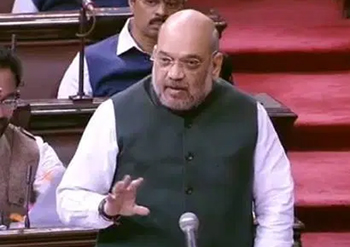
He also asserted that not a single person has died in police firing since August 5 when the Centre abrogated special status of the state although many feared there would be bloodshed and more killings.

Prohibitory orders under Section 144 are prevalent only in certain areas from 8 pm to 6 am in the valley, he said.

Responding to a series of questions on the situation in Jammu and Kashmir during Question Hour, Shah said government offices, educational institutes, courts, health centres, banks and media outlets are functioning fully.

"As far as Internet service is concerned, an appropriate action will be taken on the recommendation of the local administration. Neighbouring country is still doing some mischief and we will restore the connection as soon as the local administration says it is fit to do so," he said. Internet is important in the present day world and it should be restored as early as possible. It is an effective means of communication, he said. "However when it comes to the security of Jammu and Kashmir and for waging war against terrorism, we have to fix our priorities," he said.

The Home Minister recalled that it was the BJP government which began Internet service in Kashmir way back in 2002 and the mobile service in 2003. To a supplementary on how much more time would be needed to bring normalcy in Kashmir, Shah said, "The situation there was always normal. There were many notions spread all over the world. There is total normalcy prevailing. After August 5, not a single person has died in police firing although many feared there would be bloodshed and more number of killings."

All restrictions imposed in Kashmir have been successful. Stone pelting incidents have come down to 544 so far in 2019 from 802 incidents in 2018, he said.

Highlighting the normal functioning of life in Kashmir, Shah said Urdu and English dailies and all TV channels are functioning and circulation of newspapers has increased. Courts are also functioning fully. They have heard 36,192 cases and delivered orders in as many as 500 cases, he said, adding that even the Block Development Council elections were held peacefully and successfully.

He further said as many as 20,114 schools have opened. Out of 50,537 students, 50,272 students comprising 99.48 per cent appeared for exams.

About 99.7 per cent of students have given Class 9 and 10 exams.

Hospitals are also functioning and the number of people visiting the Out Patient Department (OPD) has increased in Srinagar, he said, adding good quantity of medicines are being made available in the valley and there is no shortage.

Mobile vans and vending machines were also made available. "If any one has information that a particular person in a remote area is not getting medical facility, they can contact me directly. I will get it done in 24 hours," Shah told the House.

The sale of LPG, kerosene and rice has also gone up by by 8-16 per cent in the last ten years, he added.

To protect apple growers, Shah said the government has made all arrangements for sale of the fruit.

Cooperative NAFED has so far procured about 6,000 tonnes of apples from Kashmir. Apple production is estimated to be 22.58 lakh tonnes this year and the government is facilitating traders for sale of the fruit, he added.

As the Home Minister gave out figures supporting normalcy in the Valley, Leader of Opposition in the Upper House, Ghulam Nabi Azad said, "It looks like the Home Minister is referring to the report of some other state."

When Opposition members objected to the Chair giving more time to the Home Minister to reply on Kashmir during the Question Hour, Chairman Venkaiah Naidu said, "It is a national security issue".

The Home Minister said, "there can be a discussion on this matter for an hour."

The Opposition insisted that there should a debate on the matter, to which Naidu said, "It will be done".  

Comments

Add new comment

  • Coastaldigest.com reserves the right to delete or block any comments.
  • Coastaldigset.com is not responsible for its readers’ comments.
  • Comments that are abusive, incendiary or irrelevant are strictly prohibited.
  • Please use a genuine email ID and provide your name to avoid reject.
News Network
December 15,2025

Mangaluru police have arrested a 27-year-old NRI on his return from Saudi Arabia in connection with an Instagram post allegedly containing derogatory and provocative remarks about the Hindu religion, officials said on Monday.

The accused, Abdul Khader Nehad, a resident of Ulaibettu in Mangaluru, was working in Saudi Arabia when the post was uploaded, police said.

A suo motu case was registered at the Bajpe police station on October 11 after an allegedly offensive post circulated from the Instagram account ‘team_sdpi_2025’. Police said the content was flagged for being provocative and derogatory in nature.

During the investigation, technical analysis traced the Instagram post to Nehad, who was residing abroad at the time, a senior police officer said. Based on these findings, a Look Out Circular (LOC) was issued against him.

On December 14, Nehad arrived from Saudi Arabia at Calicut International Airport in Kerala, where he was taken into custody on arrival. Police said further investigation is underway.

Comments

Add new comment

  • Coastaldigest.com reserves the right to delete or block any comments.
  • Coastaldigset.com is not responsible for its readers’ comments.
  • Comments that are abusive, incendiary or irrelevant are strictly prohibited.
  • Please use a genuine email ID and provide your name to avoid reject.
News Network
December 13,2025

New Delhi: School-going children are picking up drug and smoking habits and engaging in consumption of alcohol, with the average age of introduction to such harmful substances found to be around 13 years, suggesting a need for earlier interventions as early as primary school, a multi-city survey by AIIMS-Delhi said.

The findings also showed substance use increased in higher grades, with grade XI/XII students two times more likely to report use of substances when compared with grade VIII students. This emphasised the importance of continued prevention and intervention through middle and high school.

The study led by Dr Anju Dhawan of AIIMS's National Drug Dependence Treatment Centre, published in the National Medical Journal of India this month, looks at adolescent substance use across diverse regions.

The survey included 5,920 students from classes 8, 9, 11 and 12 in urban government, private and rural schools across 10 cities -- Bengaluru, Chandigarh, Delhi, Dibrugarh, Hyderabad, Imphal, Jammu, Lucknow, Mumbai, and Ranchi. The data were collected between May 2018 and June 2019.

The average age of initiation for any substance was 12.9 (2.8) years. It was lowest for inhalants (11.3 years) followed by heroin (12.3 years) and opioid pharmaceuticals (without prescription; 12.5 years).

Overall, 15.1 per cent of participants reported lifetime use, 10.3 per cent reported past year use, and 7.2 per cent reported use in the past month of any substance, the study found.

The most common substances used in the past year, after tobacco (4 per cent) and alcohol (3.8 per cent), were opioids (2.8 per cent), followed by cannabis (2 per cent) and inhalants (1.9 per cent). Use of non-prescribed pharmaceutical opioids was most common among opioid users (90.2 per cent).

On being asked, 'Do you think this substance is easily available for a person of your age' separately for each substance category, nearly half the students (46.3 per cent) endorsed that tobacco products and more than one-third of the students (36.5 per cent) agreed that a person of their age can easily procure alcohol products.

Similarly, for Bhang (21.9 per cent), ganja/charas (16.1 per cent), inhalants (15.2 per cent), sedatives (13.7 per cent), opium and heroin (10 per cent each), the students endorsed that these can be easily procured.

About 95 per cent of the children, irrespective of their grade, agreed with the statement that 'drug use is harmful'.

The rates of substance use (any) among boys were significantly higher than those of girls for substance use (ever), use in the past year and use in the past 30 days. Compared to grade VIII students, grade IX students were more likely, and grade XI/XII students were twice as likely to have used any substance (ever).

The likelihood of past-year use of any substance was also higher for grade IX students and for grade XI/XII students as compared to grade VIII students.

About 40 per cent of students mentioned that they had a family member who used tobacco or alcohol each. The use of cannabis (any product) and opioid (any product) by a family member was reported by 8.2 per cent and 3.9 per cent of students, respectively, while the use of other substances, such as inhalants/sedatives by family was 2-3 per cent, the study found.

A relatively smaller percentage of students reported use of tobacco or alcohol among peers as compared to among family members, while a higher percentage reported inhalants, sedatives, cannabis or opioid use among peers.

Children using substances (past year) compared to non-users reported significantly higher any substance use by their family members and peers.

There were 25.7 per cent students who replied 'yes' to the question 'conflicts/fights often occur in your family'. Most students also replied affirmatively to 'family members are aware of how their time is being spent' and 'damily members are aware of with whom they spend their time'.

Comments

Add new comment

  • Coastaldigest.com reserves the right to delete or block any comments.
  • Coastaldigset.com is not responsible for its readers’ comments.
  • Comments that are abusive, incendiary or irrelevant are strictly prohibited.
  • Please use a genuine email ID and provide your name to avoid reject.
News Network
December 19,2025

Saudi Arabia has abolished fees on expatriate workers employed in licensed industrial establishments, signaling a strong push to empower national factories and enhance the Kingdom’s global industrial competitiveness. The move reflects the leadership’s commitment to building a sustainable and resilient industrial economy under Saudi Vision 2030.

The decision was approved by the Council of Ministers, chaired by Crown Prince and Prime Minister Mohammed bin Salman, following a recommendation from the Council of Economic and Development Affairs (CEDA). It forms part of a broader strategy to support, modernize, and strengthen the industrial sector.

By removing fees on foreign workers, industrial establishments gain greater operational flexibility and relief from financial pressures. This is expected to help factories expand production, improve efficiency, and compete more effectively in international markets, while reinforcing long-term sustainability.

The initiative aligns closely with Saudi Vision 2030, which identifies industry as a key pillar of economic diversification. A competitive and resilient industrial base is viewed as essential for driving innovation, attracting investment, and sustaining long-term economic growth.

Overall, the fee exemption underscores the Kingdom’s commitment to creating a supportive environment for industrial development and ensuring that Saudi factories remain globally competitive and capable of leading the nation’s economic transformation.

Comments

Add new comment

  • Coastaldigest.com reserves the right to delete or block any comments.
  • Coastaldigset.com is not responsible for its readers’ comments.
  • Comments that are abusive, incendiary or irrelevant are strictly prohibited.
  • Please use a genuine email ID and provide your name to avoid reject.