



Now high-end SUVs for ITBP troops on Sino-India border

May 15, 2016

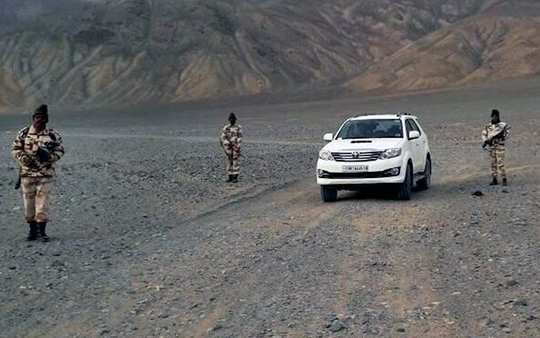
New Delhi, May 15: Expensive SUVs, usually found zipping across roads in urban locations, have for the first time been deployed at high-altitude border posts of the ITBP along the Sino-India border to transport troopers.
itbp

Four white-coloured Sports Utility Vehicles (SUVs), two Toyota Fortuner and as many Ford Endeavour, with a price tag of around Rs 25 lakh each, have been deployed by the border guarding force at some of its forward locations over 13,000 ft above the sea level at Burtse and Dungti in the Ladakh sector and Menchuka, over 6,000 ft, in Arunachal Pradesh.

No other border guarding force or army formations in forward areas have ever used high-end SUVs for troops.

The Indo-Tibetan Border Police (ITBP) headquarters here has issued a directive that the troopers and officers will use these vehicles only for operational tasks to prevent their misuse.

ITBP Director General Krishna Chaudhary said while the force has several types of four-wheelers, including those with 4x4 drive facility for high-altitude driving at its border locations, SUV platforms, which are powered by diesel-run heavy-duty engines were required for quick movement in these mountainous areas.

"We were looking for some good high-power vehicles at those heights where regular vehicles are not as adept as an SUV. The Ministry of Home Affairs sometime back approved our proposal and we purchased four such four-wheelers in the first batch.

"I can tell you that none of the senior officers in the force including me have such smart and powerful vehicles for their movement as compared to what our men have now," he told PTI.

In order to make sure they are utilised for the task they have been sent for, the ITBP boss said, strict instructions have been issued that these vehicles will carry troops while on duty and during patrol, officers can utilise them only when leading such tasks, in order to prevent their misuse.

"It's not that my men will misuse the asset but what has to be ensured and kept in mind is that these vehicles have been sent for a special purpose and there should be no dilution in that task," he added.

The force, before deploying these SUVs at border posts, trained a special batch of drivers at the ITBP training centre in Chandigarh, after which they were driven uphill, to their places of deployment.

The interiors of the SUVs, a senior official said, have been slightly modified to fix radio communication sets and to seat 6-7 troops with their firearms.

The force is tasked with guarding the 3,488 km Sino-India border. Its posts are in some of the harshest areas with locations ranging from 9,000 ft to 18,000 ft where mercury often plunges below zero degree Celsius.


Comments

Add new comment

  • Coastaldigest.com reserves the right to delete or block any comments.
  • Coastaldigset.com is not responsible for its readers’ comments.
  • Comments that are abusive, incendiary or irrelevant are strictly prohibited.
  • Please use a genuine email ID and provide your name to avoid reject.
News Network
December 16,2025

bengal.jpg

The deletion of over 58 lakh names from West Bengal’s draft electoral rolls following a Special Intensive Revision (SIR) has sparked widespread concern and is likely to deepen political tensions in the poll-bound state.

According to the Election Commission, the revision exercise has identified 24 lakh voters as deceased, 19 lakh as relocated, 12 lakh as missing, and 1.3 lakh as duplicate entries. The draft list, published after the completion of the first phase of SIR, aims to remove errors and duplication from the electoral rolls.

However, the scale of deletions has raised fears that a large number of eligible voters may have been wrongly excluded. The Election Commission has said that individuals whose names are missing can file objections and seek corrections. The final voter list is scheduled to be published in February next year, after which the Assembly election announcement is expected. Notably, the last Special Intensive Revision in Bengal was conducted in 2002.

The development has intensified the political row over the SIR process. Chief Minister Mamata Banerjee and her Trinamool Congress have strongly opposed the exercise, accusing the Centre and the Election Commission of attempting to disenfranchise lakhs of voters ahead of the elections.

Addressing a rally in Krishnanagar earlier this month, Banerjee urged people to protest if their names were removed from the voter list, alleging intimidation during elections and warning of serious consequences if voting rights were taken away.

The BJP, meanwhile, has defended the revision and accused the Trinamool Congress of politicising the issue to protect what it claims is an illegal voter base. Leader of the Opposition Suvendu Adhikari alleged that the ruling party fears losing power due to the removal of deceased, fake, and illegal voters.

The controversy comes amid earlier allegations by the Trinamool Congress that excessive work pressure during the SIR led to the deaths by suicide of some Booth Level Officers (BLOs), for which the party blamed the Election Commission. With the draft list now out, another round of political confrontation appears imminent.

As objections begin to be filed, the focus will be on whether the correction mechanism is accessible, transparent, and timely—critical factors in ensuring that no eligible voter is denied their democratic right ahead of a crucial election.

Comments

Add new comment

  • Coastaldigest.com reserves the right to delete or block any comments.
  • Coastaldigset.com is not responsible for its readers’ comments.
  • Comments that are abusive, incendiary or irrelevant are strictly prohibited.
  • Please use a genuine email ID and provide your name to avoid reject.