



Oppn targets govt over JNU, Vemula issue; BJP targets Rahul

February 24, 2016

New Delhi, Feb 24: Sparks flew in the Lok Sabha today as the raging JNU row and suicide of Dalit student Rohith Vemula was taken up for discussion, with opposition accusing the government of muzzling the voice of the youth and "mercilessly crushing" the principles of democracy.
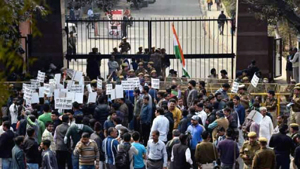
jnu-protest

To counter the opposition onslaught, BJP targeted Congress Vice President Rahul Gandhi for his "support" to those standing with hanged Parliament attack convict Afzal Guru and said the House has to decide if it stands with those who attacked Parliament or those who laid down their lives defending it.

The debate, on the first working day of Budget session, saw accusations and counter-accusations, with both ruling and opposition sides underlining their credentials as "nationalists".

Initiating the debate, Congress' Chief Whip Jyotiraditya Scindia alleged "undue interference" by Union HRD Minister Smriti Irani and Labour Minister Bandaru Dattatreya in Vemula's case.

"Bandaru Dattaterya in his letter had called Rohith a castiest and an anti-national. Where in the world can you see a HRD minister writing five letters in any case," he said.

Scindia also raised the issue of FTII, IIT Madras and JNU and said, "the government was trying to muzzle the voice of the youth."

Lambasting the government, Scindia attacked External Affairs Minister Sushma Swaraj, Tribal Affairs Minister Jual Oram and Irani for emphasising that Vemula was not a Dalit.

Criticising the role of Hyderabad University administration, he said protests and fights are the part of academic institutions but in this case the Vice-Chancellor should have tackled this issue in a better way.

However, he instead suspended the Dalit students and compelled them to stay in an open tent because of the the "politics of the RSS and BJP," Scindia said.

"What is the duty of the government? It is to protect the democratic institutions and work for the betterment of the people. But since last two years, with the atmosphere of intolerance, no one feels secured. It is mercilessly crushing the democratic principles," the Congress leader said.

"The Prime Minister speaks of demographic dividend of the youth. But what do we see in the country? In Madhya Pradesh, we see Vyapam in Madhya Pradesh, the problem of drugs in Punjab, the way the voice of students in FTII was muzzled. The government machinery is being misused and is trying to crush the voice of the dissident and those having the contrary view," he said.

He also questioned the silence of Prime Minister Narendra Modi, saying "He tweets on every other thing, but it took five days for him to speak on this matter, only after a worldwide uproar. There is no reference on in the Mann Ki Baat."

Scindia said while the government was celebrating 125th century of Dr Babasaheb Ambedkar, it was not following its path. "There is huge gap between the talk and the act of the government."

Comments

Add new comment

  • Coastaldigest.com reserves the right to delete or block any comments.
  • Coastaldigset.com is not responsible for its readers’ comments.
  • Comments that are abusive, incendiary or irrelevant are strictly prohibited.
  • Please use a genuine email ID and provide your name to avoid reject.
News Network
December 13,2025

New Delhi: School-going children are picking up drug and smoking habits and engaging in consumption of alcohol, with the average age of introduction to such harmful substances found to be around 13 years, suggesting a need for earlier interventions as early as primary school, a multi-city survey by AIIMS-Delhi said.

The findings also showed substance use increased in higher grades, with grade XI/XII students two times more likely to report use of substances when compared with grade VIII students. This emphasised the importance of continued prevention and intervention through middle and high school.

The study led by Dr Anju Dhawan of AIIMS's National Drug Dependence Treatment Centre, published in the National Medical Journal of India this month, looks at adolescent substance use across diverse regions.

The survey included 5,920 students from classes 8, 9, 11 and 12 in urban government, private and rural schools across 10 cities -- Bengaluru, Chandigarh, Delhi, Dibrugarh, Hyderabad, Imphal, Jammu, Lucknow, Mumbai, and Ranchi. The data were collected between May 2018 and June 2019.

The average age of initiation for any substance was 12.9 (2.8) years. It was lowest for inhalants (11.3 years) followed by heroin (12.3 years) and opioid pharmaceuticals (without prescription; 12.5 years).

Overall, 15.1 per cent of participants reported lifetime use, 10.3 per cent reported past year use, and 7.2 per cent reported use in the past month of any substance, the study found.

The most common substances used in the past year, after tobacco (4 per cent) and alcohol (3.8 per cent), were opioids (2.8 per cent), followed by cannabis (2 per cent) and inhalants (1.9 per cent). Use of non-prescribed pharmaceutical opioids was most common among opioid users (90.2 per cent).

On being asked, 'Do you think this substance is easily available for a person of your age' separately for each substance category, nearly half the students (46.3 per cent) endorsed that tobacco products and more than one-third of the students (36.5 per cent) agreed that a person of their age can easily procure alcohol products.

Similarly, for Bhang (21.9 per cent), ganja/charas (16.1 per cent), inhalants (15.2 per cent), sedatives (13.7 per cent), opium and heroin (10 per cent each), the students endorsed that these can be easily procured.

About 95 per cent of the children, irrespective of their grade, agreed with the statement that 'drug use is harmful'.

The rates of substance use (any) among boys were significantly higher than those of girls for substance use (ever), use in the past year and use in the past 30 days. Compared to grade VIII students, grade IX students were more likely, and grade XI/XII students were twice as likely to have used any substance (ever).

The likelihood of past-year use of any substance was also higher for grade IX students and for grade XI/XII students as compared to grade VIII students.

About 40 per cent of students mentioned that they had a family member who used tobacco or alcohol each. The use of cannabis (any product) and opioid (any product) by a family member was reported by 8.2 per cent and 3.9 per cent of students, respectively, while the use of other substances, such as inhalants/sedatives by family was 2-3 per cent, the study found.

A relatively smaller percentage of students reported use of tobacco or alcohol among peers as compared to among family members, while a higher percentage reported inhalants, sedatives, cannabis or opioid use among peers.

Children using substances (past year) compared to non-users reported significantly higher any substance use by their family members and peers.

There were 25.7 per cent students who replied 'yes' to the question 'conflicts/fights often occur in your family'. Most students also replied affirmatively to 'family members are aware of how their time is being spent' and 'damily members are aware of with whom they spend their time'.

Comments

Add new comment

  • Coastaldigest.com reserves the right to delete or block any comments.
  • Coastaldigset.com is not responsible for its readers’ comments.
  • Comments that are abusive, incendiary or irrelevant are strictly prohibited.
  • Please use a genuine email ID and provide your name to avoid reject.