



Outsource govt services; bring in pvt sector talent: Niti Aayog

April 30, 2017

New Delhi, Apr 30: Policy think-tank Niti Aayog has suggested outsourcing of public services to private hands in order to reduce dependence on the government administrative machinery. It has also recommended induction of specialists into the governance system through lateral entry, a move which, it says, will bring "competition to the established career bureaucracy".
niti

In its draft report on a three-year action agenda made public recently, the Niti Aayog has set a target of full- digitisation of governance-related works by the end of 2018- 19. Civil service is the backbone of the government and it needs to be empowered to make quick decisions and implement them. Sustained high levels of performance can only be achieved if it is objectively measured with high performance rewarded and poor reprimanded, it said.

"Today, rising complexity of the economy has meant that policy-making is a specialised activity. Therefore, it is essential that specialists be inducted into the system through lateral entry. "Such entry will also have the beneficial side effect of bringing competition to the established career bureaucracy," as per the draft three-year action agenda for 2017-18 to 2019- 20.

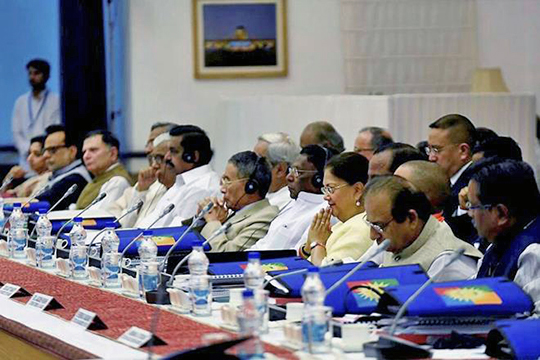
The draft was circulated among the Governing Council (consisting of chief ministers of all states and others) members of the Niti Aayog on April 23. The recommendation may come under criticism from Indian Administrative Service (IAS) officers, who are part of top- level management in government departments. The Niti Aayog said the dependence on the government administrative machinery for the delivery of services needs to be reduced wherever possible.

"We can make use of the power of Aadhaar-based identity verification to allow private channels to provide services wherever possible. Identification of such services should be taken up and public-private-partnership model to provide those services should be explored," the draft report said. It also favoured longer tenure for Secretary-rank officer in government departments. Currently, by the time officers are promoted from Additional Secretary to Secretary level, usually they have two years or less left before retirement.

This feature creates two important inefficiencies, the report said. One: with a time horizon shorter than two years, the officer is hesitant to take any major initiatives; and two: the officer is reluctant to take decisions on any major project fearing any mis-step may become the cause for charges of favouritism or corruption post retirement.

"This causes inordinate amount of delay in decision- making," it said, adding that one possible solution is early promotion to the Secretary position and introduction of lateral entry. The report said officers may be encouraged to gain expertise in specific areas in the early stages of their careers and the current system of rapid rotation of officers across ministries may be replaced by a system of longer postings according to specialisation.

"Officers should also be encouraged to enhance their knowledge and skills in the chosen area of specialisation through intensive training. This specialisation by the internal staff needs to be complemented by lateral entry of highly specialised staff on fixed-term contracts," it said.

Specialists could be brought on three to five year contracts as such a system will bring top talent and energy into the government system and lend new dynamism to ministries, the report said.

"The NITI Aayog performs many tasks requiring specialised knowledge and skills. Therefore, it has recently proposed changes to its rules of recruitment, which if approved would open the door to lateral entry. This initiative could serve as a pilot for other ministries," it said.

Comments

Add new comment

  • Coastaldigest.com reserves the right to delete or block any comments.
  • Coastaldigset.com is not responsible for its readers’ comments.
  • Comments that are abusive, incendiary or irrelevant are strictly prohibited.
  • Please use a genuine email ID and provide your name to avoid reject.
News Network
December 13,2025

New Delhi: School-going children are picking up drug and smoking habits and engaging in consumption of alcohol, with the average age of introduction to such harmful substances found to be around 13 years, suggesting a need for earlier interventions as early as primary school, a multi-city survey by AIIMS-Delhi said.

The findings also showed substance use increased in higher grades, with grade XI/XII students two times more likely to report use of substances when compared with grade VIII students. This emphasised the importance of continued prevention and intervention through middle and high school.

The study led by Dr Anju Dhawan of AIIMS's National Drug Dependence Treatment Centre, published in the National Medical Journal of India this month, looks at adolescent substance use across diverse regions.

The survey included 5,920 students from classes 8, 9, 11 and 12 in urban government, private and rural schools across 10 cities -- Bengaluru, Chandigarh, Delhi, Dibrugarh, Hyderabad, Imphal, Jammu, Lucknow, Mumbai, and Ranchi. The data were collected between May 2018 and June 2019.

The average age of initiation for any substance was 12.9 (2.8) years. It was lowest for inhalants (11.3 years) followed by heroin (12.3 years) and opioid pharmaceuticals (without prescription; 12.5 years).

Overall, 15.1 per cent of participants reported lifetime use, 10.3 per cent reported past year use, and 7.2 per cent reported use in the past month of any substance, the study found.

The most common substances used in the past year, after tobacco (4 per cent) and alcohol (3.8 per cent), were opioids (2.8 per cent), followed by cannabis (2 per cent) and inhalants (1.9 per cent). Use of non-prescribed pharmaceutical opioids was most common among opioid users (90.2 per cent).

On being asked, 'Do you think this substance is easily available for a person of your age' separately for each substance category, nearly half the students (46.3 per cent) endorsed that tobacco products and more than one-third of the students (36.5 per cent) agreed that a person of their age can easily procure alcohol products.

Similarly, for Bhang (21.9 per cent), ganja/charas (16.1 per cent), inhalants (15.2 per cent), sedatives (13.7 per cent), opium and heroin (10 per cent each), the students endorsed that these can be easily procured.

About 95 per cent of the children, irrespective of their grade, agreed with the statement that 'drug use is harmful'.

The rates of substance use (any) among boys were significantly higher than those of girls for substance use (ever), use in the past year and use in the past 30 days. Compared to grade VIII students, grade IX students were more likely, and grade XI/XII students were twice as likely to have used any substance (ever).

The likelihood of past-year use of any substance was also higher for grade IX students and for grade XI/XII students as compared to grade VIII students.

About 40 per cent of students mentioned that they had a family member who used tobacco or alcohol each. The use of cannabis (any product) and opioid (any product) by a family member was reported by 8.2 per cent and 3.9 per cent of students, respectively, while the use of other substances, such as inhalants/sedatives by family was 2-3 per cent, the study found.

A relatively smaller percentage of students reported use of tobacco or alcohol among peers as compared to among family members, while a higher percentage reported inhalants, sedatives, cannabis or opioid use among peers.

Children using substances (past year) compared to non-users reported significantly higher any substance use by their family members and peers.

There were 25.7 per cent students who replied 'yes' to the question 'conflicts/fights often occur in your family'. Most students also replied affirmatively to 'family members are aware of how their time is being spent' and 'damily members are aware of with whom they spend their time'.

Comments

Add new comment

  • Coastaldigest.com reserves the right to delete or block any comments.
  • Coastaldigset.com is not responsible for its readers’ comments.
  • Comments that are abusive, incendiary or irrelevant are strictly prohibited.
  • Please use a genuine email ID and provide your name to avoid reject.