



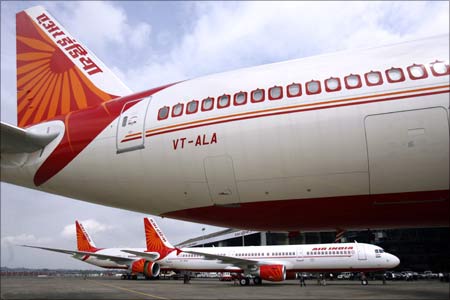
Oxygen cylinder empty, Air India’s Frankfurt-Delhi flight delayed by 24 hours

April 27, 2014

Air_Indias_Frankfurt

New Delhi, Apr 27 : An unserviceable oxygen bottle on an aircraft has cost Air India dearly and led to a delay of over 24 hours for the 245 passengers who were to fly from Frankfurt to Delhi on Friday night. Since the Dreamliner (VT-AOG) could not take off without this vital emergency equipment, all the flyers were put up in an expensive Frankfurt hotel.

"Oxygen bottles are critical emergency equipment meant to supply oxygen to pilots in the cockpit in the event of a drop in cabin pressure. Passengers and cabin crew have to breathe through overhead masks that are supplied oxygen through another O2 generator located in overhead panel. Pilots are supplied through separate bottles so that in case of cabin depressurisation or smoke, they do not suffer hypoxia (pass out due to O2 deficiency) which is an insidious killer — one of the worst possible scenarios for any aircraft and its passengers," said a source.

An AI official said the airline despatched another oxygen bottle on a flight to Frankfurt on Saturday morning. "Oxygen bottle does not come under minimum equipment list (that is it can be allowed to operate without an item that is on this list being operational). So the plane had to be grounded. This aircraft is now expected to take off late on Saturday night (India time)," said an AI official.

Oxygen bottles are meant to supply O2 to people inside an aircraft that has suffered cabin pressurization failure for about 15 minutes — the time in which the pilots declare an emergency and descend to 10,000 feet. Once at this level, the ram air valves of the aircraft are opened to allow outside fresh air to flow in.

"Two days back, another of our Boeing 787 suffered a wing spoiler trouble in Sydney. The flight was delayed by some time as this issue had to be sorted out first," said a source.

Cabin crew deported

An Air India cabin crew was deported from London for allegedly smuggling 100 to 200 cartons of cigarettes from India. The flight attendant had flown into London on a schedule flight to UK caught with the cigarettes. "He came back on a flight on which he was scheduled to operate as crew. DGCA rules mandate that there should be a cabin crew member for each aircraft door. With a crew short, one door was declared unserviceable," said an AI official.

Comments

Add new comment

  • Coastaldigest.com reserves the right to delete or block any comments.
  • Coastaldigset.com is not responsible for its readers’ comments.
  • Comments that are abusive, incendiary or irrelevant are strictly prohibited.
  • Please use a genuine email ID and provide your name to avoid reject.
News Network
December 13,2025

New Delhi: School-going children are picking up drug and smoking habits and engaging in consumption of alcohol, with the average age of introduction to such harmful substances found to be around 13 years, suggesting a need for earlier interventions as early as primary school, a multi-city survey by AIIMS-Delhi said.

The findings also showed substance use increased in higher grades, with grade XI/XII students two times more likely to report use of substances when compared with grade VIII students. This emphasised the importance of continued prevention and intervention through middle and high school.

The study led by Dr Anju Dhawan of AIIMS's National Drug Dependence Treatment Centre, published in the National Medical Journal of India this month, looks at adolescent substance use across diverse regions.

The survey included 5,920 students from classes 8, 9, 11 and 12 in urban government, private and rural schools across 10 cities -- Bengaluru, Chandigarh, Delhi, Dibrugarh, Hyderabad, Imphal, Jammu, Lucknow, Mumbai, and Ranchi. The data were collected between May 2018 and June 2019.

The average age of initiation for any substance was 12.9 (2.8) years. It was lowest for inhalants (11.3 years) followed by heroin (12.3 years) and opioid pharmaceuticals (without prescription; 12.5 years).

Overall, 15.1 per cent of participants reported lifetime use, 10.3 per cent reported past year use, and 7.2 per cent reported use in the past month of any substance, the study found.

The most common substances used in the past year, after tobacco (4 per cent) and alcohol (3.8 per cent), were opioids (2.8 per cent), followed by cannabis (2 per cent) and inhalants (1.9 per cent). Use of non-prescribed pharmaceutical opioids was most common among opioid users (90.2 per cent).

On being asked, 'Do you think this substance is easily available for a person of your age' separately for each substance category, nearly half the students (46.3 per cent) endorsed that tobacco products and more than one-third of the students (36.5 per cent) agreed that a person of their age can easily procure alcohol products.

Similarly, for Bhang (21.9 per cent), ganja/charas (16.1 per cent), inhalants (15.2 per cent), sedatives (13.7 per cent), opium and heroin (10 per cent each), the students endorsed that these can be easily procured.

About 95 per cent of the children, irrespective of their grade, agreed with the statement that 'drug use is harmful'.

The rates of substance use (any) among boys were significantly higher than those of girls for substance use (ever), use in the past year and use in the past 30 days. Compared to grade VIII students, grade IX students were more likely, and grade XI/XII students were twice as likely to have used any substance (ever).

The likelihood of past-year use of any substance was also higher for grade IX students and for grade XI/XII students as compared to grade VIII students.

About 40 per cent of students mentioned that they had a family member who used tobacco or alcohol each. The use of cannabis (any product) and opioid (any product) by a family member was reported by 8.2 per cent and 3.9 per cent of students, respectively, while the use of other substances, such as inhalants/sedatives by family was 2-3 per cent, the study found.

A relatively smaller percentage of students reported use of tobacco or alcohol among peers as compared to among family members, while a higher percentage reported inhalants, sedatives, cannabis or opioid use among peers.

Children using substances (past year) compared to non-users reported significantly higher any substance use by their family members and peers.

There were 25.7 per cent students who replied 'yes' to the question 'conflicts/fights often occur in your family'. Most students also replied affirmatively to 'family members are aware of how their time is being spent' and 'damily members are aware of with whom they spend their time'.

Comments

Add new comment

  • Coastaldigest.com reserves the right to delete or block any comments.
  • Coastaldigset.com is not responsible for its readers’ comments.
  • Comments that are abusive, incendiary or irrelevant are strictly prohibited.
  • Please use a genuine email ID and provide your name to avoid reject.