



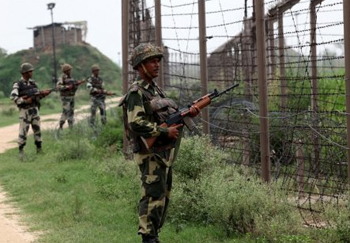
Pak shells 25 BoPs, 19 hamlets along Jammu Border

August 24, 2014

Pak shells
Jammu, Aug 24: Pakistani troops continued to violate the ceasefire by shelling and firing upon 25 Border Out Posts (BoPs) and 19 villages along the International Border in Jammu sector throughout the night, prompting the BSF to retaliate.

"Pak Rangers resorted to heavy firing of small and automatic weapons and shelling of mortars bombs on 25 BoPs and civilian areas along IB in Arnia and R S Pura sub-sectors of Jammu district from 2030 hours last night" a BSF officer said today.

BSF troops gave a befitting reply by responding strongly and the heavy exchanges continued till 0730 hours today, he said.

As per the official reports, Pakistan troops also targeted 19 Border villages throughout the night.

"Although there was no loss of human life or injury to anyone, three cows were killed in Treva border village in the shelling", Sub-Divisional Police Officer, R S Pura, Devender Singh said.

Civilian casualties have been avoided due to evacuation of villagers or night migration from over 20 border hamlets along IB in R S Pura and Arnia sub-sectors of Jammu district, he said.

There have been 18 ceasefire violations in less then a fortnight and 20 in the month of August.

In a major escalation, Pakistani troops resorted to heavy shelling and firing on 22 BoPs and 13 villages, killing 2 civilians and injuring 6 others including a BSF jawan along International Border in Arnia and R S Pura Sub-sectors of Jammu sector yesterday. Pak troops also fired during the day yesterday in Shahpur sub-sector of Poonch violating ceasefire.

In the firing and shelling, 2 people were killed and 6 others including a BSF jawan were injured and 5 houses suffered damaged, security officials had said.

At least 3000 people from 7 to 8 border villages, were evacuated by the district administration in view of their safety and shifted to safe shelters, Divisional Commissioner, Jammu Zone, Shant Manu said.

They were housed in safe shelters in the Government High School, Rangpur in Basspur Bungalow and Government Industrial Training Institute (ITI), RS Pura.

These two Government buildings have been identified by the district administration for the civilians to protect them from Pakistan firing as a part of contingency plan put in place after fresh round of heavy shelling and firing in RS Pura sector.

Civil and police administration was camping in RS Pura and have made arrangements for accommodating the border villagers.

Comments

Add new comment

  • Coastaldigest.com reserves the right to delete or block any comments.
  • Coastaldigset.com is not responsible for its readers’ comments.
  • Comments that are abusive, incendiary or irrelevant are strictly prohibited.
  • Please use a genuine email ID and provide your name to avoid reject.
News Network
December 13,2025

New Delhi: School-going children are picking up drug and smoking habits and engaging in consumption of alcohol, with the average age of introduction to such harmful substances found to be around 13 years, suggesting a need for earlier interventions as early as primary school, a multi-city survey by AIIMS-Delhi said.

The findings also showed substance use increased in higher grades, with grade XI/XII students two times more likely to report use of substances when compared with grade VIII students. This emphasised the importance of continued prevention and intervention through middle and high school.

The study led by Dr Anju Dhawan of AIIMS's National Drug Dependence Treatment Centre, published in the National Medical Journal of India this month, looks at adolescent substance use across diverse regions.

The survey included 5,920 students from classes 8, 9, 11 and 12 in urban government, private and rural schools across 10 cities -- Bengaluru, Chandigarh, Delhi, Dibrugarh, Hyderabad, Imphal, Jammu, Lucknow, Mumbai, and Ranchi. The data were collected between May 2018 and June 2019.

The average age of initiation for any substance was 12.9 (2.8) years. It was lowest for inhalants (11.3 years) followed by heroin (12.3 years) and opioid pharmaceuticals (without prescription; 12.5 years).

Overall, 15.1 per cent of participants reported lifetime use, 10.3 per cent reported past year use, and 7.2 per cent reported use in the past month of any substance, the study found.

The most common substances used in the past year, after tobacco (4 per cent) and alcohol (3.8 per cent), were opioids (2.8 per cent), followed by cannabis (2 per cent) and inhalants (1.9 per cent). Use of non-prescribed pharmaceutical opioids was most common among opioid users (90.2 per cent).

On being asked, 'Do you think this substance is easily available for a person of your age' separately for each substance category, nearly half the students (46.3 per cent) endorsed that tobacco products and more than one-third of the students (36.5 per cent) agreed that a person of their age can easily procure alcohol products.

Similarly, for Bhang (21.9 per cent), ganja/charas (16.1 per cent), inhalants (15.2 per cent), sedatives (13.7 per cent), opium and heroin (10 per cent each), the students endorsed that these can be easily procured.

About 95 per cent of the children, irrespective of their grade, agreed with the statement that 'drug use is harmful'.

The rates of substance use (any) among boys were significantly higher than those of girls for substance use (ever), use in the past year and use in the past 30 days. Compared to grade VIII students, grade IX students were more likely, and grade XI/XII students were twice as likely to have used any substance (ever).

The likelihood of past-year use of any substance was also higher for grade IX students and for grade XI/XII students as compared to grade VIII students.

About 40 per cent of students mentioned that they had a family member who used tobacco or alcohol each. The use of cannabis (any product) and opioid (any product) by a family member was reported by 8.2 per cent and 3.9 per cent of students, respectively, while the use of other substances, such as inhalants/sedatives by family was 2-3 per cent, the study found.

A relatively smaller percentage of students reported use of tobacco or alcohol among peers as compared to among family members, while a higher percentage reported inhalants, sedatives, cannabis or opioid use among peers.

Children using substances (past year) compared to non-users reported significantly higher any substance use by their family members and peers.

There were 25.7 per cent students who replied 'yes' to the question 'conflicts/fights often occur in your family'. Most students also replied affirmatively to 'family members are aware of how their time is being spent' and 'damily members are aware of with whom they spend their time'.

Comments

Add new comment

  • Coastaldigest.com reserves the right to delete or block any comments.
  • Coastaldigset.com is not responsible for its readers’ comments.
  • Comments that are abusive, incendiary or irrelevant are strictly prohibited.
  • Please use a genuine email ID and provide your name to avoid reject.