



Pakistan must explain why they have been persecuting minorities: Modi

News Network
January 12, 2020

Kolkata, Jan 12: Strongly defending the new citizenship law, Prime Minister Narendra Modi said on Sunday the dispute that has arisen over it has made the world aware of persecution of religious minorities in Pakistan.
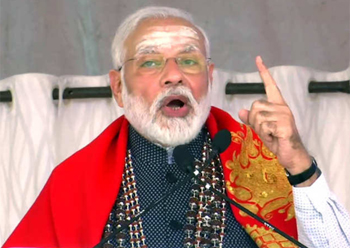
He, however, deplored that a section of the youth is being “misguided” over the Citizenship (Amendment) Act, which is aimed at giving and not taking away anybody's citizenship rights.

“CAA is not about taking away citizenship, it is about giving citizenship. Today, on National Youth Day, I would like to tell this to the youngsters of India, West Bengal, North East that this is not an overnight law for giving citizenship.

“We must all know that any person of any religion from any country of the world who believes in India and its Constitution can apply for Indian citizenship through due process. There's no problem in that,” he told a gathering at Belur Math, the headquarters of Ramkrishna Mission.

Modi said even Mahatma Gandhi had favoured Indian citizenship to those fleeing religious persecution and that his government has only delivered on the wishes of the freedom fighters.

Referring to anti-CAA protests in the North-East, Modi vowed to protect the distinct identity and culture of the people of the region, and asserted the new law will not hurt their interests.

“We've only done what Mahatma Gandhi had said decades ago. Should we send these refugees back to die? Are they our responsibility or not? Should we make them our citizens or not?” he said, evoking a thunderous applause by the gathering.

Modi said some people with political interests are deliberately spreading rumours about the new citizenship law, despite “complete clarity” over the CAA.

“Our initiative to amend the citizenship act has created a dispute. It is the result of our initiative that Pakistan will now have to answer why they have been persecuting minorities for the last 70 years. Human rights have been demolished in Pakistan,” he said.

Seeking to assuage the concerns of the people of the North-East, Modi called the region “our pride”. “Their culture, traditions and demography remains untouched by this amended law,” he said.

He said the citizenship law was only “changed a little” for those who were ill-treated in Pakisan after Partition.

“They were having a bitter time living there. Women were in danger of losing their pride,” he said.

“Young people have understood the whole thing but those who want to indulge in politics over it will not,” he said.

Modi said five years ago, there was disappointment among the youth of the country, but the situation has changed now.

“Not just India, the entire world has a lot of expectations from the youth of the country. The youth are not afraid of challenges....they challenge the challenges,” he said at the Belur Math, the abode of Swami Vivekananda for several years until his death in 1902, aged 39 years.

Modi, an ardent devotee of Vivekananda, spent the night at the Math.

He has a long association with the Ramkrishna Mission order founded by Vivekananda in 1897. Inspired by the teachings of Vivekananda, Modi had arrived at the Mission Ashram in Gujarat's Rajkot and expressed desire to join the order.

Swami Atmasthananda, who later went on to become the 15th president of the Ramakrishna Math and the Ramakrishna Mission, then headed the Rajkot branch and had advised him that sanyas was not for him and that he should work among people.

During those days, Modi used to regularly meet Atmasthananda and sought his spiritual guidance.

Although Modi went back after spending some time there his the relationship with Swami Atmasthananda and the Ramkrishna Mission continued.

Whenever Modi used to visit Kolkata, even during his days as Gujarat chief minister, he would travel to the Math.

In 2013, during his Kolkata visit, he had gone to Belur and sought the blessings from Atmasthananda.

He had in 2015 called on ailing Swami Atmasthananda at Ramakrishna Mission Seva Pratisthan, a hospital run by the Mission in south Kolkata and enquired about his health.

After Atmasthananda's death in 2017, Prime Minister Modi had termed it as a “personal loss”.

On Sunday, the prime minister paid tributes to Swami Vivekananda on his birth anniversary, which is celebrated as the National Youth Day, and spent some time in the spiritual leader's room in quietude.


Comments

Add new comment

  • Coastaldigest.com reserves the right to delete or block any comments.
  • Coastaldigset.com is not responsible for its readers’ comments.
  • Comments that are abusive, incendiary or irrelevant are strictly prohibited.
  • Please use a genuine email ID and provide your name to avoid reject.
News Network
December 20,2025

train.jpg

At least seven elephants were killed and one calf injured after a herd collided with the Sairang-New Delhi Rajdhani Express in Assam's Hojai on Saturday morning, leading to disruption of rail services. 

The Sairang-New Delhi Rajdhani Express struck a herd of elephants, resulting in the derailment of the locomotive and five coaches. No passenger casualties or injuries were reported, officials said.

The New Delhi-bound train met with the accident around 2.17 am, PTI reported. The Sairang-New Delhi Rajdhani Express connects Mizoram's Sairang (near Aizawl) to Anand Vihar Terminal (Delhi). 

Railway has issued helpline numbers at the Guwahati Railway Station:-

•    0361-2731621
•    0361-2731622
•    0361-2731623

The accident site is located about 126 km from Guwahati. Following the incident, accident relief trains and railway officials rushed to the spot to initiate rescue operations.

Train Services Disrupted

Sources said that due to the derailment and elephant body parts scattered on the tracks, train services to Upper Assam and other parts of the Northeast were affected.

Passengers from the affected coaches were temporarily accommodated in vacant berths available in other coaches of the train. Once the train reaches Guwahati, additional coaches will be attached to accommodate all passengers, after which the train will resume its onward journey.

The incident occurred at a location that is not a designated elephant corridor. The loco pilot, upon spotting the herd on the tracks, applied emergency brakes. Despite this, the elephants dashed into the train, leading to the collision and derailment.

Last month, an elephant was killed after being hit by a train in Dhupguri in West Bengal's Jalpaiguri district. The incident took place on November 30. 

The adult elephant was killed on the spot, and a calf was discovered lying injured beside the tracks. 

Over 70 Elephants Killed In Train Collisions Over Last 5 Years

At least 79 elephants have died in train collisions across the country in the last five years, the Environment Ministry had informed Parliament in August.

In a written reply in the Lok Sabha, Minister of State for Environment Kirti Vardhan Singh had said the figure is based on reports from state governments and Union Territory administrations for the period 2020-21 to 2024-25.

He said that the ministry does not maintain consolidated data on the deaths of other wild animals on railway tracks, including in designated elephant corridors.

Singh confirmed that three elephants, including a mother and her calf, were killed on July 18 this year after being hit by a speeding express train on the Kharagpur-Tatanagar section in West Bengal's Paschim Midnapore district. The incident took place near Banstala between Jhargram and Banstala stations.

The minister said several measures have been taken jointly by the Environment Ministry and the Railways to prevent such accidents.

These include imposing speed restrictions in elephant habitats, pilot projects such as seismic sensor-based detection of elephants near tracks and construction of underpasses, ramps and fencing at vulnerable points.

The Wildlife Institute of India, in consultation with the ministry and other stakeholders, has also issued guidelines titled 'Eco-friendly Measures to Mitigate Impacts of Linear Infrastructure' to help agencies design railways and other projects in ways that reduce human-animal conflicts.

Singh added that capacity-building workshops were conducted for railway officials at the Wildlife Institute of India in 2023 and 2024 to raise awareness on elephant conservation and protection.

A detailed report titled 'Suggested Measures to Mitigate Elephant & Other Wildlife Train Collisions on Vulnerable Railway Stretches in India' had also been prepared after surveys across 127 railway stretches covering 3,452 km.

Of these, 77 stretches spanning 1,965 km in 14 states were prioritised for mitigation, with site-specific interventions suggested. 

Comments

Add new comment

  • Coastaldigest.com reserves the right to delete or block any comments.
  • Coastaldigset.com is not responsible for its readers’ comments.
  • Comments that are abusive, incendiary or irrelevant are strictly prohibited.
  • Please use a genuine email ID and provide your name to avoid reject.
News Network
December 19,2025

Saudi Arabia has abolished fees on expatriate workers employed in licensed industrial establishments, signaling a strong push to empower national factories and enhance the Kingdom’s global industrial competitiveness. The move reflects the leadership’s commitment to building a sustainable and resilient industrial economy under Saudi Vision 2030.

The decision was approved by the Council of Ministers, chaired by Crown Prince and Prime Minister Mohammed bin Salman, following a recommendation from the Council of Economic and Development Affairs (CEDA). It forms part of a broader strategy to support, modernize, and strengthen the industrial sector.

By removing fees on foreign workers, industrial establishments gain greater operational flexibility and relief from financial pressures. This is expected to help factories expand production, improve efficiency, and compete more effectively in international markets, while reinforcing long-term sustainability.

The initiative aligns closely with Saudi Vision 2030, which identifies industry as a key pillar of economic diversification. A competitive and resilient industrial base is viewed as essential for driving innovation, attracting investment, and sustaining long-term economic growth.

Overall, the fee exemption underscores the Kingdom’s commitment to creating a supportive environment for industrial development and ensuring that Saudi factories remain globally competitive and capable of leading the nation’s economic transformation.

Comments

Add new comment

  • Coastaldigest.com reserves the right to delete or block any comments.
  • Coastaldigset.com is not responsible for its readers’ comments.
  • Comments that are abusive, incendiary or irrelevant are strictly prohibited.
  • Please use a genuine email ID and provide your name to avoid reject.