



Parliament approves historic law to overturn collegium system

August 14, 2014

New Delhi, Aug 14: Overcoming resistance by the judiciary, Parliament today took the much-delayed historic step of clearing two bills to have a new mechanism to appoint judges to higher courts and scrap the collegium system which has been under severe criticism.
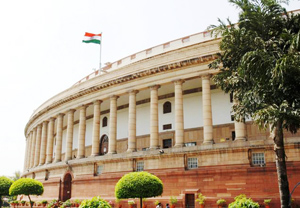
Parliament

Rajya Sabha approved with overwhelming majority the 121st Constitution Amendment Bill along with the National Judicial Appointments Commission Bill, 2014, a day after Lok Sabha gave its nod to the measure with a crucial amendment of the opposition Congress being accepted by the government.

The Constitution Amendment Bill was passed with 179 votes in favour among 180 votes polled while noted lawyer Ram Jethmalani abstained. The Appointments Commission Bill was approved by voice vote.

Approval of the 245-member Upper House to the measure is significant as ruling NDA is in a minority there. The two measures were taken up separately after questions were raised by members over legislative competence of the House amid apprehensions that it could be struck down by the judiciary as 'ultra vires'.

A determined government asserted that Parliament is supreme and competent enough to enact laws and that it has no intention of transgressing on independence of the judiciary through the new law.

Law Minister Ravi Shankar Prasad underlined that the new measure of appointing judges to Supreme Court and High Courts will come into effect only after ratification of the Constitution Amendment Bill by 50 per cent state assemblies. The process could take up to eight months. After ratification, government will send it to the President for his approval.

With this step, the collegium system of judges appointing judges will be changed with a six-member Commission headed by Chief Justice of India making the appointments and transfers.

There have been several attempts to overturn the 20-year-old collegium system in the past, including by the previous NDA and UPA governments. The effort finally fructified on the last day of the first working session of Parliament under the new government.

To bring Opposition on board, government had yesterday dropped a controversial provision that required unanimity in recommendation if President seeks reconsideration.

The amendment dropped the provision requiring unanimity in the Commission's recommendation if President had referred the earlier recommendation back to the collegium for reconsideration.

The Constitution amendment bill will grant Constitutional status to the NJAC and its composition. The NJAC Bill, passed along with the statute amendment bill, lays down the procedure to be adopted by the commission for elevation of Supreme Court judges and transfer and posting of Chief Justices and other judges of the 24 High Courts.

Under the statute amendment bill, Chief Justice of India will head the NJAC. Besides the CJI, the judiciary would be represented by two senior judges of the Supreme Court. Two eminent personalities and the Law Minister will be the other members of the proposed body.

In his intervention, Finance Minister Arun Jaitley, a noted lawyer, said since there is a marginal role of the executive in the current system, "the effort is now to restore what is the spirit of the original Constitution" with checks and balances in place.

Prasad rejected the opposition charge that the measure was being brought in haste, saying the exercise has been going on for two decades during which several committees have recommended for changing the collegium system.

"Why is Parliament wary of using its powers? Parliament must have full trust in the ability of Parliament to pass the law," he said. Prasad said the power of appointing a judge rests with the President of India. "This House respects the independence of the judiciary and this House also respects the power of Parliament," he said.

Comments

Add new comment

  • Coastaldigest.com reserves the right to delete or block any comments.
  • Coastaldigset.com is not responsible for its readers’ comments.
  • Comments that are abusive, incendiary or irrelevant are strictly prohibited.
  • Please use a genuine email ID and provide your name to avoid reject.
News Network
December 13,2025

New Delhi: School-going children are picking up drug and smoking habits and engaging in consumption of alcohol, with the average age of introduction to such harmful substances found to be around 13 years, suggesting a need for earlier interventions as early as primary school, a multi-city survey by AIIMS-Delhi said.

The findings also showed substance use increased in higher grades, with grade XI/XII students two times more likely to report use of substances when compared with grade VIII students. This emphasised the importance of continued prevention and intervention through middle and high school.

The study led by Dr Anju Dhawan of AIIMS's National Drug Dependence Treatment Centre, published in the National Medical Journal of India this month, looks at adolescent substance use across diverse regions.

The survey included 5,920 students from classes 8, 9, 11 and 12 in urban government, private and rural schools across 10 cities -- Bengaluru, Chandigarh, Delhi, Dibrugarh, Hyderabad, Imphal, Jammu, Lucknow, Mumbai, and Ranchi. The data were collected between May 2018 and June 2019.

The average age of initiation for any substance was 12.9 (2.8) years. It was lowest for inhalants (11.3 years) followed by heroin (12.3 years) and opioid pharmaceuticals (without prescription; 12.5 years).

Overall, 15.1 per cent of participants reported lifetime use, 10.3 per cent reported past year use, and 7.2 per cent reported use in the past month of any substance, the study found.

The most common substances used in the past year, after tobacco (4 per cent) and alcohol (3.8 per cent), were opioids (2.8 per cent), followed by cannabis (2 per cent) and inhalants (1.9 per cent). Use of non-prescribed pharmaceutical opioids was most common among opioid users (90.2 per cent).

On being asked, 'Do you think this substance is easily available for a person of your age' separately for each substance category, nearly half the students (46.3 per cent) endorsed that tobacco products and more than one-third of the students (36.5 per cent) agreed that a person of their age can easily procure alcohol products.

Similarly, for Bhang (21.9 per cent), ganja/charas (16.1 per cent), inhalants (15.2 per cent), sedatives (13.7 per cent), opium and heroin (10 per cent each), the students endorsed that these can be easily procured.

About 95 per cent of the children, irrespective of their grade, agreed with the statement that 'drug use is harmful'.

The rates of substance use (any) among boys were significantly higher than those of girls for substance use (ever), use in the past year and use in the past 30 days. Compared to grade VIII students, grade IX students were more likely, and grade XI/XII students were twice as likely to have used any substance (ever).

The likelihood of past-year use of any substance was also higher for grade IX students and for grade XI/XII students as compared to grade VIII students.

About 40 per cent of students mentioned that they had a family member who used tobacco or alcohol each. The use of cannabis (any product) and opioid (any product) by a family member was reported by 8.2 per cent and 3.9 per cent of students, respectively, while the use of other substances, such as inhalants/sedatives by family was 2-3 per cent, the study found.

A relatively smaller percentage of students reported use of tobacco or alcohol among peers as compared to among family members, while a higher percentage reported inhalants, sedatives, cannabis or opioid use among peers.

Children using substances (past year) compared to non-users reported significantly higher any substance use by their family members and peers.

There were 25.7 per cent students who replied 'yes' to the question 'conflicts/fights often occur in your family'. Most students also replied affirmatively to 'family members are aware of how their time is being spent' and 'damily members are aware of with whom they spend their time'.

Comments

Add new comment

  • Coastaldigest.com reserves the right to delete or block any comments.
  • Coastaldigset.com is not responsible for its readers’ comments.
  • Comments that are abusive, incendiary or irrelevant are strictly prohibited.
  • Please use a genuine email ID and provide your name to avoid reject.