PM asks officials to double taxpayer base to 10 crore

June 16, 2016

New Delhi, Jun 16: Prime Minister Narendra Modi today set a target for the taxmen to double the taxpayer base to 10 crore and warned "the long arm of the law" will catch up with those evading taxes.
pm

At the same time, he asked tax officers to be "soft and sober" in their approach and not treat everyone as tax evaders.

Addressing the inaugural session of the two-day annual conference of tax administrators, Prime Minister said the foundation of administration should be on five pillars of Revenue, Accountability, Probity, Information and Digitisation (RAPID).

"There should be respect for law among all citizens and even fear of the long arm of the law for those who evade taxes," Modi said.

Stating that people should not fear tax administrators, Prime Minister said Indians inherently are honest and asked the taxmen to build a "bridge of trust" so as to achieve tax collection targets without coercion.

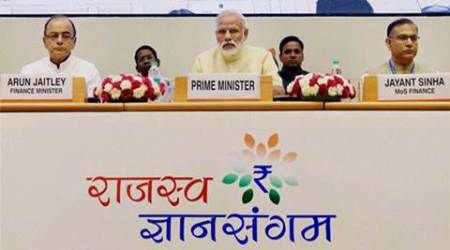
At the conference titled 'Rajasva Gyan Sangam' (Knowledge Conference on Revenue), Modi asked the officials to "move towards digitisation" to make tax administration efficient and work towards bridging the "trust deficit".

Taxpayers should not face any problem in paying taxes, he said, adding administrators should have a cooperative approach.

"You should behave like mentors to people, rather than invaders. Don't presume that every one is tax evader," Revenue Secretary Hasmukh Adhia quoted Modi as saying in the conference.

Asking taxmen to set sights higher, Modi said we should legitimately aspire to have 10 crore taxpayers within our tax bases as against 5.43 crore tax payers currently.

Prime Minister, who at the beginning asked the officials to give their opinions and suggestions on the issues facing administration in the country, wanted the 'Gyan Sangam' to be turned into "Karma Sangam" by translating ideas into action.

On generation of black money in the economy, Modi was of the opinion that holders of illegal wealth are few in number and tax will automatically come if the regime is taxpayer friendly.

Highlighting shortcomings in the system, Modi said a query on search engine Google on 'How to pay taxes in India' throws up 7 crore answers, but a query on 'How not to pay taxes in India' gives out 12 crore results.

The Income Tax Department has 42,000 officers, yet only 8 per cent of the revenue come from scrutiny of returns, he said.

As much as 92 per cent of direct tax revenue come from tax deducted at source (TDS) of mostly salaried people, advance taxes and self assessment taxes.

Prodded by Modi during an hour-long interaction, officers of the direct and indirect taxes wing (CBDT and CBEC) asked if they should act as law enforcement agencies or taxpayer friendly departments while collecting due taxes from people.

Another suggestion was to bring a "tax facilitation act" that would frame rules for dealing with tax payers. The rules should also be in regional languages.

They also raised the issue of voluntary tax compliance, increasing tax base, upgradation of digital and physical infrastructure for tax administrators.

They also suggested how to streamline internal communication within the department and make it paperless.

Stating that the country is filled with "aspirational people", Modi urged taxmen to take steps so that people find it easier to pay taxes here.

Asked on whether Modi wanted officers to be law enforcement agency or tax payer friendly, Minister of State for Finance Jayant Sinha said we need not necessarily think about it in terms of a trade off between Enforcement and taxpayers services.

"If you trust the taxpayer, if you build that bridge of trust between the taxpayer and the system... because people of India are inherently honest, then we will find it very easy to be able to achieve the target and ensure that the trust deficit is fully bridged," Sinha told reporters.

"People within the country are not dishonest. People have no problem in paying taxes, but somewhere they have some problem. Understand that problem and try to remove it," Modi told the taxmen.

Adhia said Prime Minister stressed on being cooperative when dealing with people. "If you become taxpayer friendly, then taxes will automatically come to you."

Addressing the officers, Finance Minister Arun Jaitley suggested the departments should move towards digitisation.

When asked if achieving tax base of 10 crore is an aspirational target, Sinha said: "What we have to do is to continue to increase the tax base in the country, to continue to move the tax to GDP ratio upwards."

Sinha said of 25 crore households in the country, 15 crore are agriculturalists and hence the remaining 10 crore should come under the tax net.

He said 90 per cent of 5.43 crore taxpayers e-file their returns and 60 per cent of the refunds are issued within 30 days.

"Prime Minister said we should raise our sights higher. We should make it very easy for people to file taxes and that we should legitimately aspire to 10 crore taxpayers within our tax base," Sinha said.

Explaining the five pillars of tax administration RAPID, Adhia said it means the revenue collection with accountability and probity, and then using the information available for non- intrusive tax assessment and collection and using digitation to record them.

"We will work in such a manner that we use the information available as well as put to use the digitisation to achieve our goal of increasing tax base," Sinha said.

Prime Minister wanted the taxmen to remove the fear of harassment from the mind of people.

"Our country is aspiring and people want to move forward," Modi said asking the taxmen to make it easier for people to pay taxes in India.

Prime Minister also said tax officials should focus on simplification so the two-day brainstorming sessions could lead to better outcome with regard to tax payer services.
CBDT Chairman Atulesh Jindal said the department will take steps to bridge the trust deficit with taxpayers.


Comments

Add new comment

  • Coastaldigest.com reserves the right to delete or block any comments.
  • Coastaldigset.com is not responsible for its readers’ comments.
  • Comments that are abusive, incendiary or irrelevant are strictly prohibited.
  • Please use a genuine email ID and provide your name to avoid reject.
News Network
December 16,2025

jordan.jpg

Prime Minister Narendra Modi on Monday held talks with Jordan’s King Abdullah II in Amman, during which the two leaders discussed ways to further strengthen bilateral relations, with the Prime Minister outlining an eight-point vision covering key areas of cooperation.

Describing the meeting as “productive”, PM Modi said he shared a roadmap focused on trade and economy, fertilisers and agriculture, information technology, healthcare, infrastructure, critical and strategic minerals, civil nuclear cooperation, and people-to-people ties.

In a post on social media platform X, the Prime Minister praised King Abdullah II’s personal commitment to advancing India–Jordan relations, particularly as both countries mark the 75th anniversary of the establishment of diplomatic ties this year.

“Held productive discussions with His Majesty King Abdullah II in Amman. His personal commitment towards vibrant India-Jordan relations is noteworthy. This year, we are celebrating the 75th anniversary of our bilateral diplomatic relations,” PM Modi said.

The meeting took place at the Al Husseiniya Palace, where the two leaders also exchanged views on regional and global issues of mutual interest. According to the Ministry of External Affairs (MEA), both sides agreed to further deepen cooperation in areas including trade and investment, defence and security, counter-terrorism and de-radicalisation, fertilisers and agriculture, infrastructure, renewable energy, tourism, and heritage.

The MEA said both leaders reaffirmed their united stand against terrorism.

PM Modi arrived in Amman earlier on Monday and was received by Jordanian Prime Minister Jafar Hassan, who accorded him a formal welcome. Following the talks, King Abdullah II hosted a banquet dinner in honour of the Prime Minister, reflecting the warmth of bilateral ties.

Jordan is the first leg of PM Modi’s three-nation tour. From Amman, the Prime Minister will travel to Ethiopia at the invitation of Prime Minister Abiy Ahmed Ali, marking his first official visit to the African nation. The tour will conclude with a visit to Oman.

Comments

Add new comment

  • Coastaldigest.com reserves the right to delete or block any comments.
  • Coastaldigset.com is not responsible for its readers’ comments.
  • Comments that are abusive, incendiary or irrelevant are strictly prohibited.
  • Please use a genuine email ID and provide your name to avoid reject.
News Network
December 16,2025

bengal.jpg

The deletion of over 58 lakh names from West Bengal’s draft electoral rolls following a Special Intensive Revision (SIR) has sparked widespread concern and is likely to deepen political tensions in the poll-bound state.

According to the Election Commission, the revision exercise has identified 24 lakh voters as deceased, 19 lakh as relocated, 12 lakh as missing, and 1.3 lakh as duplicate entries. The draft list, published after the completion of the first phase of SIR, aims to remove errors and duplication from the electoral rolls.

However, the scale of deletions has raised fears that a large number of eligible voters may have been wrongly excluded. The Election Commission has said that individuals whose names are missing can file objections and seek corrections. The final voter list is scheduled to be published in February next year, after which the Assembly election announcement is expected. Notably, the last Special Intensive Revision in Bengal was conducted in 2002.

The development has intensified the political row over the SIR process. Chief Minister Mamata Banerjee and her Trinamool Congress have strongly opposed the exercise, accusing the Centre and the Election Commission of attempting to disenfranchise lakhs of voters ahead of the elections.

Addressing a rally in Krishnanagar earlier this month, Banerjee urged people to protest if their names were removed from the voter list, alleging intimidation during elections and warning of serious consequences if voting rights were taken away.

The BJP, meanwhile, has defended the revision and accused the Trinamool Congress of politicising the issue to protect what it claims is an illegal voter base. Leader of the Opposition Suvendu Adhikari alleged that the ruling party fears losing power due to the removal of deceased, fake, and illegal voters.

The controversy comes amid earlier allegations by the Trinamool Congress that excessive work pressure during the SIR led to the deaths by suicide of some Booth Level Officers (BLOs), for which the party blamed the Election Commission. With the draft list now out, another round of political confrontation appears imminent.

As objections begin to be filed, the focus will be on whether the correction mechanism is accessible, transparent, and timely—critical factors in ensuring that no eligible voter is denied their democratic right ahead of a crucial election.

Comments

Add new comment

  • Coastaldigest.com reserves the right to delete or block any comments.
  • Coastaldigset.com is not responsible for its readers’ comments.
  • Comments that are abusive, incendiary or irrelevant are strictly prohibited.
  • Please use a genuine email ID and provide your name to avoid reject.
News Network
December 22,2025

The Bharatiya Janata Party (BJP) received ₹6,654.93 crore in donations during the 2024-25 financial year — a Lok Sabha election year — registering a 68 per cent increase over the previous fiscal.

In its annual contribution report submitted to the Election Commission on December 8, two days ahead of the deadline, the BJP disclosed all donations exceeding ₹20,000. The report, now available on the Commission’s website, covers contributions received between April 1, 2024 and March 30, 2025 — a period marked by the general election and Assembly polls in Arunachal Pradesh, Sikkim, Andhra Pradesh, Odisha, Jammu and Kashmir, Haryana, Jharkhand, Maharashtra and Delhi.

The BJP, the world’s largest political party by membership, had reported donations of ₹3,967 crore in 2023-24. The latest figures represent the party’s highest donation receipts in the last five years.

Electoral trusts accounted for around 40 per cent of the BJP’s total donations. The Prudent Electoral Trust contributed ₹2,180 crore, followed by the Progressive Electoral Trust with ₹757 crore and the New Democratic Electoral Trust with ₹150 crore. Contributions from other electoral trusts together amounted to ₹3,112.5 crore. The remaining funds came from corporate donors and individuals. Electoral trusts are entities set up by companies to channel donations to political parties.

Among major corporate contributors, Serum Institute of India donated ₹100 crore, Rungta Sons Private Limited ₹95 crore, Vedanta ₹67 crore, and Macrotech Developers (formerly Lodha Developers) ₹65 crore. Three Bajaj Group companies together contributed ₹65 crore, while Derive Investments donated ₹50 crore.

Other notable donors included Malabar Gold (₹10 crore), Kalyan Jewellers (₹15.1 crore), Hero Group (₹23.65 crore), Dilip Buildcon Group (₹29 crore), ITC Limited (₹35 crore), Wave Industries (₹5.25 crore) and Zerodha’s investment firm, promoted by Nikhil Kamath, which contributed ₹1.5 crore.

Several BJP leaders also made individual donations. Assam Chief Minister Himanta Biswa Sarma donated ₹3 lakh, Assam minister Pijush Hazarika ₹2.75 lakh, Union Education Minister Dharmendra Pradhan ₹1 lakh, Odisha Chief Minister Mohan Charan Majhi ₹5 lakh, Indore Mayor Pushyamitra Bhargava ₹1 lakh, and Akash Vijayvargiya, son of senior BJP leader Kailash Vijayvargiya, also donated ₹1 lakh, among others.

In contrast, most opposition parties reported a sharp decline in donations. The Congress received ₹522.13 crore in 2024-25, a fall of about 43 per cent from ₹1,129 crore in the previous year. The Trinamool Congress saw donations drop to ₹184.08 crore from ₹618.8 crore, while the Bharat Rashtra Samithi reported just ₹15.09 crore, down from ₹580 crore.

The Aam Aadmi Party, however, recorded an increase, collecting ₹39.2 crore compared to ₹22.1 crore last year. The Telugu Desam Party received ₹85.2 crore in donations, down from ₹274 crore, but also earned ₹102 crore through fees and subscriptions. The Biju Janata Dal reported ₹60 crore in donations, compared to ₹246 crore in the previous fiscal.

The 2024-25 financial year is also the first without electoral bonds, after the Supreme Court struck down the scheme as unconstitutional in February 2024. Since its introduction in 2018, the electoral bond scheme had enabled political parties to receive over ₹16,000 crore in anonymous donations, with the BJP receiving the largest share. 

Comments

Add new comment

  • Coastaldigest.com reserves the right to delete or block any comments.
  • Coastaldigset.com is not responsible for its readers’ comments.
  • Comments that are abusive, incendiary or irrelevant are strictly prohibited.
  • Please use a genuine email ID and provide your name to avoid reject.