



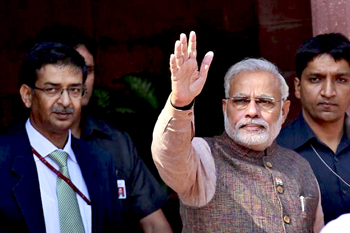
PM embarks on 10-day tour to attend key summits

November 11, 2014

PM key summits
New Delhi, Nov 11: Asserting that ASEAN is at the core of India's 'Act East' policy, Prime Minister Narendra Modi today headed to Myanmar to attend the Summit with the ten-nation grouping and the East Asia Summit.

Modi left by a special Air India plane for Nay Pyi Taw on the first leg of his 10-day, three-nation tour that will also take him to Australia, where he will attend the G-20 meet, and Fiji.

"ASEAN is at the core of our Act East Policy and at the centre of our dream of an Asian century, characterised by cooperation and integration," the Prime Minister said before his departure.

Modi said he was looking forward to discussing with ASEAN leaders how to take "our relationship to a new level, which will supplement our deepening bilateral ties with each member".

The Prime Minister will meet over 40 leaders from countries in Asia, Africa, Europe, North America, South America and Pacific Region during the India-ASEAN and East Asia summits on November 12-13 in Myanmar's capital Nay Pyi Taw, the G 20 Summit in Brisbane and the visit to Fiji Islands.

Noting that no other region in the world embodies so much dynamism or faces so many challenges as the region spanning the Indian Ocean, continental Asia and Pacific Ocean, he said the East Asia Summit has the potential to shape this region and the world's future.

"At the East Asia Summit, I look forward to discussing with ASEAN and seven global leaders how we can strengthen regional institutions, international norms and regional cooperation in pursuit of peace, stability and prosperity," the Prime Minister said in a statement.

On the sidelines of the international summits in Myanmar, Modi is slated to meet Russian Prime Minister Dmitry Medvedev, South Korean President Park Geun-hye and Singapore President Tony Tan, besides the host President Thein Sein.

The ASEAN members are Brunei, Cambodia, Indonesia, Laos, Malaysia, Myanmar, Singapore, Thailand, Philippines and Vietnam, while the EAS members 10 ASEAN nations and Australia, China, Japan, New Zealand, South Korea, Russia and the US.

At the G-20 Summit, the Prime Minister said, highlighting the importance of international cooperation against black money would be a key issue.

He will also discuss with other leaders ways to accelerate the creation of next generation infrastructure, which also includes digital infrastructure, and ensure access to clean and affordable energy.

The Prime Minister noted that G-20 countries account for 85 per cent of the world's economic output and it is a key forum to coordinate activities and pursue collective action to support global economic growth and stability, stable financial markets and global trading regimes and employment generation.

Modi will also have bilateral talks with Australian Prime Minister Tony Abbott in Canberra after the G20 summit. He will be the first Indian Prime Minister to visit Australia in 28 years since Rajiv Gandhi in 1986.

"While we have much in common with Australia, our political, strategic and economic relations have been below potential," he said.

Pitching for closer strategic partnership with Australia, he said it will support India's economic goals, "promote our security interests, including maritime security, and reinforce our efforts to foster a climate of peace and stability in our extended continental and maritime neighbourhood."

The four-city, three-day visit from November 16 covers Melbourne and Sydney besides Melbourne and Canberra.

Referring to his day-long visit to Fiji on November 19, Modi said it will be his privilege to visit that country, with which India shares "historical and ethnic links', soon after the return of democracy in September this year.

"We also owe them a debt of gratitude for hosting our scientists on the island in support of our Mars Mission," Modi, who will be meeting leaders and representatives of 12 Pacific Island nations, said.

Modi will be the first Indian Prime Minister to visit Fiji after a gap of 33 years, the first being Indira Gandhi in 1981. He will have talks with Premier Frank Bainimarama.

Out of the 849,000 population in Fiji, 37 per cent people are of Indian origin. Many Indians arrived in Fiji as indentured labour in the 19th century.

He said said he was looking forward to a future of regular engagement and more robust cooperation with Fiji and other Pacific Island countries.

Comments

Add new comment

  • Coastaldigest.com reserves the right to delete or block any comments.
  • Coastaldigset.com is not responsible for its readers’ comments.
  • Comments that are abusive, incendiary or irrelevant are strictly prohibited.
  • Please use a genuine email ID and provide your name to avoid reject.
News Network
December 6,2025

indigoticket.jpg

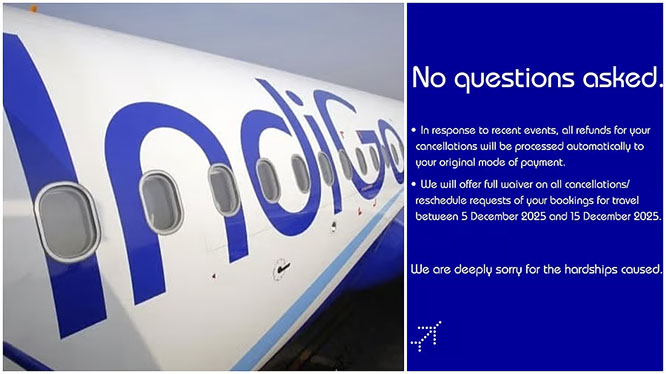
With IndiGo flight disruptions impacting thousands of passengers, the airline on Saturday said that it will offer full waiver on all cancellations/reschedule requests for travel bookings between December 5, 2025 and December 15, 2025.

Earlier in the day, the civil aviation ministry had directed the airline to complete the ticket refund process for the cancelled flights by Sunday evening, as well as ensure baggage separated from the travellers are delivered in the next two days.

In a post on X, titled 'No questions asked', IndiGo wrote, "In response to recent events, all refunds for your cancellations will be processed automatically to your original mode of payment."

"We are deeply sorry for the hardships caused," it further added.

Several passengers, however, complained of not getting full refund as promised by the airline.

Netizens have shared screenchots of getting charged for airline cancellation fee and convenience fee.

"Please tell me why u have did this airline cancellation charges when u say full amount will be refunded (sic)," a user wrote sharing a screenshot of the refund page.

"Well, but you have still debited the convenience charges," wrote another.

Passengers have also raised concerns about the "cancel" option being disabled on the IndiGo app. "First enable the 'Cancel' button on your App & offer full refund on tickets cancelled by customers between the said dates," wrote a user.

A day after the country's largest airline, IndiGo, cancelled more than 1,000 flights and caused disruptions for the fifth day on Saturday, the ministry said that any delay or non-compliance in refund processing will invite immediate regulatory action.

The refund process for all cancelled or disrupted flights must be completed by 8 pm on Sunday, the ministry said in a statement.

"Airlines have also been instructed not to levy any rescheduling charges for passengers whose travel plans were affected by cancellations," it said.

On Saturday, more than 400 flights were cancelled at various airports.

IndiGo has also been instructed to set up dedicated passenger support and refund facilitation cells.

Comments

Add new comment

  • Coastaldigest.com reserves the right to delete or block any comments.
  • Coastaldigset.com is not responsible for its readers’ comments.
  • Comments that are abusive, incendiary or irrelevant are strictly prohibited.
  • Please use a genuine email ID and provide your name to avoid reject.
News Network
December 13,2025

New Delhi: School-going children are picking up drug and smoking habits and engaging in consumption of alcohol, with the average age of introduction to such harmful substances found to be around 13 years, suggesting a need for earlier interventions as early as primary school, a multi-city survey by AIIMS-Delhi said.

The findings also showed substance use increased in higher grades, with grade XI/XII students two times more likely to report use of substances when compared with grade VIII students. This emphasised the importance of continued prevention and intervention through middle and high school.

The study led by Dr Anju Dhawan of AIIMS's National Drug Dependence Treatment Centre, published in the National Medical Journal of India this month, looks at adolescent substance use across diverse regions.

The survey included 5,920 students from classes 8, 9, 11 and 12 in urban government, private and rural schools across 10 cities -- Bengaluru, Chandigarh, Delhi, Dibrugarh, Hyderabad, Imphal, Jammu, Lucknow, Mumbai, and Ranchi. The data were collected between May 2018 and June 2019.

The average age of initiation for any substance was 12.9 (2.8) years. It was lowest for inhalants (11.3 years) followed by heroin (12.3 years) and opioid pharmaceuticals (without prescription; 12.5 years).

Overall, 15.1 per cent of participants reported lifetime use, 10.3 per cent reported past year use, and 7.2 per cent reported use in the past month of any substance, the study found.

The most common substances used in the past year, after tobacco (4 per cent) and alcohol (3.8 per cent), were opioids (2.8 per cent), followed by cannabis (2 per cent) and inhalants (1.9 per cent). Use of non-prescribed pharmaceutical opioids was most common among opioid users (90.2 per cent).

On being asked, 'Do you think this substance is easily available for a person of your age' separately for each substance category, nearly half the students (46.3 per cent) endorsed that tobacco products and more than one-third of the students (36.5 per cent) agreed that a person of their age can easily procure alcohol products.

Similarly, for Bhang (21.9 per cent), ganja/charas (16.1 per cent), inhalants (15.2 per cent), sedatives (13.7 per cent), opium and heroin (10 per cent each), the students endorsed that these can be easily procured.

About 95 per cent of the children, irrespective of their grade, agreed with the statement that 'drug use is harmful'.

The rates of substance use (any) among boys were significantly higher than those of girls for substance use (ever), use in the past year and use in the past 30 days. Compared to grade VIII students, grade IX students were more likely, and grade XI/XII students were twice as likely to have used any substance (ever).

The likelihood of past-year use of any substance was also higher for grade IX students and for grade XI/XII students as compared to grade VIII students.

About 40 per cent of students mentioned that they had a family member who used tobacco or alcohol each. The use of cannabis (any product) and opioid (any product) by a family member was reported by 8.2 per cent and 3.9 per cent of students, respectively, while the use of other substances, such as inhalants/sedatives by family was 2-3 per cent, the study found.

A relatively smaller percentage of students reported use of tobacco or alcohol among peers as compared to among family members, while a higher percentage reported inhalants, sedatives, cannabis or opioid use among peers.

Children using substances (past year) compared to non-users reported significantly higher any substance use by their family members and peers.

There were 25.7 per cent students who replied 'yes' to the question 'conflicts/fights often occur in your family'. Most students also replied affirmatively to 'family members are aware of how their time is being spent' and 'damily members are aware of with whom they spend their time'.

Comments

Add new comment

  • Coastaldigest.com reserves the right to delete or block any comments.
  • Coastaldigset.com is not responsible for its readers’ comments.
  • Comments that are abusive, incendiary or irrelevant are strictly prohibited.
  • Please use a genuine email ID and provide your name to avoid reject.