



PM Narendra Modi beats the drum for Indian business in Japan

September 2, 2014

Tokyo, Sep 2: Prime Minister Narendra Modi on Tuesday turned into a drummer, a day after signing a number of deals with Japanese PM Shinzo Abe.
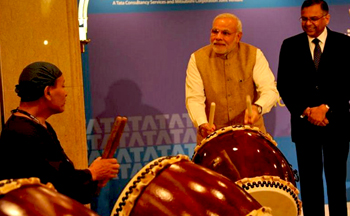
Modi beats drum
The PM amazed everyone when he played traditional Taiko drums with great vigour.

Modi’s performance came at the launch of Tata Consultancy Services’s Technology and Cultural Academy.

After concluding his opening remarks, TCS CEO N Chandrasekaran invited the PM to play a note on the drums after the professional drummers had finished.

The two drummers played their number and then the PM played the drums at a fast beat.

After flagging off the first batch of students who will be going to India for training with TCS, Prime Minister Narendra Modi asked IT experts to step out of their rooms and travel across India to enhance their learning.

"You will learn as much outside your rooms as you will learn inside them."

"I have a suggestion also - if you stay in India do not remain in TCS rooms daily. Take time out and travel across India," said a PMO tweet citing Modi whose Japan sojourn entered its fourth day on Tuesday.

He added: "I can tell you that even if you stay for six months and want to enjoy a new dish daily, you will not have to repeat a dish".

He further underlined that 21st century is the century of knowledge and the country with "knowledge and information will lead the world".

"...the one who has knowledge and information will lead the world than those who have wealth and arms," the Prime Minister said.

He also referred to India’s ‘knowledge’ heritage and leadership of the world in the past, through institutions such as Taxila and Nalanda.

He hoped the students would come back with fond memories and become Ambassadors of India.

Earlier in the day, the PM addressed students at the Sacred Hearts University here and met leaders from across the political spectrum of Japan.

Democratic Party of Japan leader Banri Kaieda, New Komeito president Natsuo Yamaguchi, Governor of Aichi Prefecture, Hideaki ?mura called on the PM.

Modi also met the head of Sasakawa-India Leprosy Foundation and said: “Service to people is service of God. Please continue your service.”

Later in the day, Modi will call on Japanese Emperor Akihito and deliver the keynote address at a business seminar.

Comments

Add new comment

  • Coastaldigest.com reserves the right to delete or block any comments.
  • Coastaldigset.com is not responsible for its readers’ comments.
  • Comments that are abusive, incendiary or irrelevant are strictly prohibited.
  • Please use a genuine email ID and provide your name to avoid reject.
News Network
December 13,2025

New Delhi: School-going children are picking up drug and smoking habits and engaging in consumption of alcohol, with the average age of introduction to such harmful substances found to be around 13 years, suggesting a need for earlier interventions as early as primary school, a multi-city survey by AIIMS-Delhi said.

The findings also showed substance use increased in higher grades, with grade XI/XII students two times more likely to report use of substances when compared with grade VIII students. This emphasised the importance of continued prevention and intervention through middle and high school.

The study led by Dr Anju Dhawan of AIIMS's National Drug Dependence Treatment Centre, published in the National Medical Journal of India this month, looks at adolescent substance use across diverse regions.

The survey included 5,920 students from classes 8, 9, 11 and 12 in urban government, private and rural schools across 10 cities -- Bengaluru, Chandigarh, Delhi, Dibrugarh, Hyderabad, Imphal, Jammu, Lucknow, Mumbai, and Ranchi. The data were collected between May 2018 and June 2019.

The average age of initiation for any substance was 12.9 (2.8) years. It was lowest for inhalants (11.3 years) followed by heroin (12.3 years) and opioid pharmaceuticals (without prescription; 12.5 years).

Overall, 15.1 per cent of participants reported lifetime use, 10.3 per cent reported past year use, and 7.2 per cent reported use in the past month of any substance, the study found.

The most common substances used in the past year, after tobacco (4 per cent) and alcohol (3.8 per cent), were opioids (2.8 per cent), followed by cannabis (2 per cent) and inhalants (1.9 per cent). Use of non-prescribed pharmaceutical opioids was most common among opioid users (90.2 per cent).

On being asked, 'Do you think this substance is easily available for a person of your age' separately for each substance category, nearly half the students (46.3 per cent) endorsed that tobacco products and more than one-third of the students (36.5 per cent) agreed that a person of their age can easily procure alcohol products.

Similarly, for Bhang (21.9 per cent), ganja/charas (16.1 per cent), inhalants (15.2 per cent), sedatives (13.7 per cent), opium and heroin (10 per cent each), the students endorsed that these can be easily procured.

About 95 per cent of the children, irrespective of their grade, agreed with the statement that 'drug use is harmful'.

The rates of substance use (any) among boys were significantly higher than those of girls for substance use (ever), use in the past year and use in the past 30 days. Compared to grade VIII students, grade IX students were more likely, and grade XI/XII students were twice as likely to have used any substance (ever).

The likelihood of past-year use of any substance was also higher for grade IX students and for grade XI/XII students as compared to grade VIII students.

About 40 per cent of students mentioned that they had a family member who used tobacco or alcohol each. The use of cannabis (any product) and opioid (any product) by a family member was reported by 8.2 per cent and 3.9 per cent of students, respectively, while the use of other substances, such as inhalants/sedatives by family was 2-3 per cent, the study found.

A relatively smaller percentage of students reported use of tobacco or alcohol among peers as compared to among family members, while a higher percentage reported inhalants, sedatives, cannabis or opioid use among peers.

Children using substances (past year) compared to non-users reported significantly higher any substance use by their family members and peers.

There were 25.7 per cent students who replied 'yes' to the question 'conflicts/fights often occur in your family'. Most students also replied affirmatively to 'family members are aware of how their time is being spent' and 'damily members are aware of with whom they spend their time'.

Comments

Add new comment

  • Coastaldigest.com reserves the right to delete or block any comments.
  • Coastaldigset.com is not responsible for its readers’ comments.
  • Comments that are abusive, incendiary or irrelevant are strictly prohibited.
  • Please use a genuine email ID and provide your name to avoid reject.