



Vatican City, Apr 27: Pope Francis proclaimed his predecessors John XXIII and John Paul II saints on Sunday in front of hundreds of thousands of pilgrims celebrating two 20th century giants of the Roman Catholic Church.
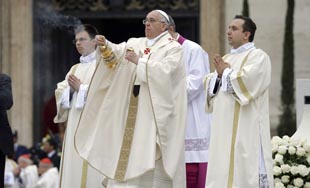
Cheers and applause rang out across St Peter's Square after the historic double canonization as many in the crowd fixed their gaze on huge tapestries of the two popes on the facade of the basilica behind Francis.
"We declare and define Blessed John XXIII and John Paul II to be saints and we enrol them among the saints, decreeing that they are to be venerated as such by the whole Church," Francis said in his formal proclamation in Latin about 30 minutes into the solemn service.
The crowd was so large it stretched back along all of Via della Conciliazione, the half kilometer-long, broad boulevard that starts at the Tiber river. Even its bridges were packed with pilgrims.
The Mass, which began under a light rain, was also attended by former Pope Benedict, who last year became the first pontiff in six centuries to step down. Benedict walked with a cane and was dressed in white vestments
His attendance gave the ceremony a somewhat surreal atmosphere created by the presence of reigning pope, a retired pope and two dead popes buried in the basilica behind the altar.
John XXIII, who reigned from 1958 to 1963 and called the modernizing Second Vatican Council, and John Paul II, the Pole who reigned for nearly 27 years, played a leading role on the world stage.
The overwhelming majority in the crowd were Poles who had traveled from their home country and immigrant communities as far afield as Chicago and Sydney to watch their most famous native son become a saint.
Hundreds of red and white Polish flags filled the square and the streets surrounding the Vatican, which were strewn with sleeping bags, backpacks and folding chairs. It was one of the biggest crowds since John Paul's beatification in 2011.
"For years Pope John Paul II took the Church to the ends of the earth and today the ends of the earth have come back here," said Father Tom Rosica, head of Canada's Salt and Light Catholic television network.
Twelve-hour wait
Families and other pilgrims had waited for more than 12 hours along the main street leading to the Vatican before police opened up the square at 5:30am.
Some people said they had managed to sleep on their feet because the crowd was so thick.
About 850 cardinals and bishops were celebrating the Mass with the pope and 700 priests were on hand to distribute communion to the huge crowd.
Francis' own huge popularity has added extra appeal to the unprecedented ceremony to raise two former leaders of the church to sainthood on the same day. But while both were widely revered, there has also been criticism that John Paul II, who only died nine years ago, has been canonized too quickly.
Groups representing victims of sexual abuse by Catholic priests also say he did not do enough to root out a scandal that emerged towards the end of his pontificate and which has hung over the church ever since.
The controversy did nothing to put off the rivers of Catholic faithful who have been arriving in Rome over the past few days.
"It is a great joy, an immense joy, because there is happiness everywhere and this is not an empty happiness," said Guillemette Chevalier, from France.
"Here we have found the joy of being together in the Church around two extraordinary men ... who give meaning to our lives. It is true happiness," she said.
Tight security
About 10,000 police and security personnel and special paramedic teams were deployed and large areas of Rome were closed to traffic.
Pilgrims who did not want to battle the crowd spent the night praying in Rome churches left open especially for the event and would watch the event on large television screens around the city.
The election of the Argentinian-born Pope Francis has injected fresh enthusiasm into a Church beset by sexual and financial scandals during the papacy of his predecessor Benedict XVI, who last year became the first pope to resign in 600 years.
He now lives in secluded retirement but will be present at the canonization mass, which will symbolically bring together four popes. The two new saints are buried in crypts in St. Peter's Basilica.
The fact that the two being canonized are widely seen as representing contrasting faces of the Church has added to the significance of an event that Francis hopes will draw the world's 1.2 billion Catholics closer together.
John, an Italian often known as the "Good Pope" because of his friendly, open personality, died before the Second Vatican Council ended its work in 1965 but his initiative set off one of the greatest upheavals in Church teaching in modern times.
The Council ended the use of Latin at Mass, brought in the use of modern music and opened the way for challenges to Vatican authority, which alienated some traditionalists.
John Paul was widely credited with helping to bring down communist rule in eastern Europe and hastening the end of the cold war. He continued many of the reforms but tightened central control, condemned theological renegades and preached a stricter line on social issues such as sexual freedom.
A charismatic, dominant pope, he was criticized by some as a rigid conservative but the adoration he inspired was shown by the huge crowds whose chants of "santo subito!" (make him a saint at once!) at his funeral 2005 were answered with the fastest declaration of sainthood in modern history.
Both canonizations have involved some adaptation of the normally strict rules governing declaration of a saint, which involve a close examination of each candidate's life and works and normally the attestation of at least two miracles.
Benedict waived a rule that normally requires a five-year waiting period before the preliminaries to sainthood can even begin to speed up John Paul's canonization, while Francis ruled that only one miracle was needed to declare John a saint.


Comments
Add new comment