



New Delhi, Oct 30: Thirty years later, the 90-year-old doctor remembers the event as if it was just the other day.
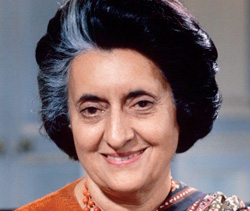
"I had left after chatting with her, like I used to do every morning after a routine check-up," said Dr K.P. Mathur, of his patient of 18 years, Prime Minister Indira Gandhi.
"But within 20 minutes I had to come back after getting an urgent call from the office. She had been shot."
Sitting in his modest East Delhi residence, Mathur, slightly bent with age, a little hard of hearing but upright with memory, recalls vividly the morning of Oct 31, 1984, the day that shook India and whose shock reverberated for the next three days, leading to the worst orgy of killings and communal hatred since probably the 1947 partition of the subcontinent.
"I had gone to her 1, Safdarjung Road residence as usual, the routine I had been following every day of the week," said Mathur to reporters as he sought to piece together fragments of his distintegrating memory for the fateful day in his and the nation's life.
"Indira Gandhi was her usual cheerful self even as make-up artists from Doordarshan prepared for her interview with Peter Ustinov who, along with his crew, were waiting in the adjoining 1, Akbar Road office.
"She talked of this and that, including how President Reagan prepared for his TV appearances, what I read on the flight back from Bhubaneswar where the PM had gone to address a political rally, and even remembered how my younger daughter had topped in her high school exams.
"She then went into the adjoining room, told her valet Nathu Ram about her evening programme, including that she has to go to the airport to receive President Zail Singh, who was returning from a foreign tour, asked us to join her for tea and then left for the interview."
Mathur recalled how he also left after that, driving out the car from the residence himself and headed for Ram Manohar Lohia Hospital, just 10 minutes' drive in those days, where he was the medical superintendent.
He had barely parked when his secretary came rushing to say there was an urgent call from the Prime Minister's House (there were no mobile phones then) that there was some shooting and probably the prime minister had been hit.
"I immediately got into my car and drove back, only to find complete disorder having descended on the residence where there was complete order and functional equilibrium just a little while ago," recounted Mathur to reporters.
Guards were running helter-skelter, with one guard shouting incoherently that "she has been shot, she has been shot!" It was only when Mathur went inside the compound that he realised what had happened.
Two of her Sikh bodyguards, Beant Singh and Satwant Singh, who were manning the wicker gate that separated her residence at 1, Safdarjung Road from her office at 1, Akbar Road, sprayed her with bullets from their automatic weapons as soon as she stepped across it. She came down in a pool of spurting blood, the crackle of guns that punctured the tranquil morning air had her daughter-in-law Sonia Gandhi come running out of her house in her nightgown, shouting "Mummy, Mummy!"
After initial pandemonium (there were no elite Special Protection Group then for the prime minister), a limp Indira Gandhi was put in her white Ambassador car, her head cradled in the arms of Sonia, and rushed to the All India Institute of Medical Sciences (AIIMS), about five kilometers away.
Recalled Mathur: "When I reached AIIMS, I saw her lying on a stretcher, her body drenched in blood. I felt her pulse, and knew she was no more." Doctors were still trying to revive her and para-medics were rushing in bringing bottles of blood. "Everyone knew it was all over, but no one wanted to believe it."
Slowly her senior aides like P.C. Alexander, principal secretary to the prime minister, arrived, and discussions reluctantly veered to government and constitutional matters and options before the nation.
Mathur says Indira Gandhi had a premonition of her death and used to talk of death and political violence in the weeks leading up to her assassination.
In Bhubaneswar, the evening before, on Oct 30, she said: "I am here today; I may not be here tomorrow... I do not care whether I live or die. I have lived a long life and I am proud that I spent the whole of my life in the service of my people... I shall continue to serve until my last breath and when I die, I can say, that every drop of my blood will invigorate India and strengthen it."
Mathur, who said he had not missed a day seeing Indira Gandhi, whether she was in or out of power, for the 18 years he was with her, and that "without any appointment letter", thinks she will be remembered for her genuine concern for the poor, the measures she took towards a more equitable society, for the way she engineered the creation of Bangladesh, for the way she returned to power in January 1980 after her stunning March 1977 electoral defeat.
"She was a very good, simple, informed, charming, well-meaning, helpful and a caring person," reminisced Mathur about his former patient who, from being just a former prime minister's daughter rose to become one of the world's most powerful and admired leaders of her time and even took stewardship in 1983 of the then powerful Non-Alignment Movement (NAM) of countries that were aligned with neither the western or eastern blocs and wanted to retain their strategic and functional independence.
But her death unleashed forces that she had fought against and the principles of secularism, religious tolerance and communal amity that she had sought to uphold.
Incensed by her killing by two Sikhs, organized mobs, backed by her Congress party, roamed the streets of Delhi and a few other cities, pulled Sikhs out of homes, shops and vehicles, beat them up and set them on fire in public view with police nowhere to be seen. Sikh homes and commercial establishments were burnt to cinder.
Close to 3,000 Sikhs were killed, mostly in Delhi, an incident that was dismissed by Indira Gandhi's son and successor, Rajiv Gandhi, with the words: "When a big tree falls, the earth shakes." The army finally moved in on the evening of Nov 2 to restore order. But by then Delhi had burnt in a way that left permanent scars on the collective psyche of a nation.


Comments
Add new comment