



Rahul Gandhi criticises PM Modi's economic policies

Agencies
September 12, 2017

Washington, Sep 12: Congress vice president Rahul Gandhi today criticised Prime Minister Narendra Modi's economic policies, accusing him of causing "tremendous damage" to India's economy with "reckless and dangerous" decisions like demonetisation and "hastily-applied" GST.

Gandhi, 47, who arrived in the US yesterday on a two- week-long tour, addressed students at the University of California, Berkeley, to reflect on contemporary India and the path forward for the world's largest democracy.

He said the November 8 demonetisation decision was taken without asking the Chief Economic Advisor and Parliament, which caused tremendous damage to the economy. Demonetisation, he alleged, imposed a devastating cost on India.

"Ignoring India's tremendous institutional knowledge and taking such decisions is reckless and dangerous," he charged. He said 30,000 new youngsters were joining the job market every single day and the government was only creating 500 jobs a day.

"This does not include the massive pool of already employed youngsters," he said. "The decline in economic growth today is leading to an upsurge of anger in the country. The government's economic policies demonetisation and hastily-applied GST have caused tremendous damage," he alleged.

Goods and Services Tax, a tax regime which combines all of India's states and union territories into a single market, was launched at midnight on June 30. Gandhi also accused the government of wiping out millions by demonetisation.

"Millions of small businesses were simply wiped out as a result of the demonetisation, farmers and many who use cash were hit extremely hard. Agriculture is in deep distress and farmers suicides have skyrocketed across the country."

Finance Minister Arun Jaitley, however, had said the fallout of demonetisation was on predicted lines and the economy will benefit in medium and long term.

Jaitley's remarks came after the Reserve Bank of India said that 99 per cent of the demonetised currency came back into the system. Jaitley had also insisted that money getting deposited in banks does not mean that all of it is legitimate.

But Gandhi described demonetisation "a completely self- inflicted wound" that caused approximately 2 per cent loss of the GDP.

India, the Congress leader said, cannot afford to grow and create jobs at the current rate. "If we continue at the current rate, if India cannot give the millions of people entering the job market employment, anger will increase and it has the potential to derail what has been built so far. That would be catastrophic for India and the world beyond," Gandhi warned.

The Congress vice president said that the central challenge for the country today is creating jobs. Noting that roughly 12 million young people join the Indian job market every year with nearly 90 per cent of them having a high school education or less, Gandhi said India, being a democratic country, cannot follow the Chinese model of coercion.

"Unlike China it has to create jobs in a democratic environment," he said, adding that India does not "want China's coercive" instruments. "We cannot follow the model of massive factories controlled by a few," Gandhi said.

Jobs in India, he said, are going to come in from small and medium scale industry. India, he asserted, needs to turn colossal numbers of small and medium businesses into international companies.

Alleging that currently all the attention in India is being paid to the top hundred companies, he said: "Everything is geared towards them, the banking systems are monopolised by them and the doors of government are always open to them."

"And laws are shaped by them," he said, adding that entrepreneurs running small and medium businesses are struggling to get bank loans.

"They have no protection and no support. Small and medium businesses are the bedrock of India and the world's innovation. Big businesses can easily manage the unpredictability of India. They are protected by their deep deep pockets and connections," he said. India, he said, has triggered a massive process of human transformation.

The momentum is so powerful that India's failure is no longer an option, he said, "Our success impacts the world," Gandhi said, warning that this momentum can be destroyed by "hatred, anger and violence".

"The politics of polarisation has raised its ugly head in India," he said, adding that liberal journalists are being shot. He was apparently referring to rights activist and journalist Gauri Lankesh's killing.

"People being lynched because they are Dalit," he alleged. "Muslims were killed on suspicion of eating beef. This is new in India and damages India very badly."

He said the politics of hate divided and polarised India and was making millions of people feel that they have no future in their own country.

"In today's connected world this is extremely dangerous," he said. Gandhi at the same time also acknowledged that Prime Minister Narendra Modi is a better communicator than him.

"I'm an opposition leader. But Mr Modi is also my prime minister. Mr Modi has certain skills. He's a very good communicator. Probably much better than me. He understands how to give a message to three or four different groups in a crowd. So his messaging abilities very subtle and very effective," Gandhi said.

He was responding to a question on what does he think about Modi as the prime minister. "What I sense is that he doesn't converse with the people he works with. Even members of Parliament of the BJP come to me and tell me that 'sunte nahi hain' (he does not listen to us)," Gandhi added.

He said Modi must speak to the people who work with him. "I mean there is a lot of information that the opposition for example has. He is not really interested in that input. So that is what has been going on," he said.

Gandhi described Modi's flagship policies like 'Make in India' and 'Swachh Bharat' as a good idea. "On what they have done well? What I like? I like the concept of 'Make in India'. But the orientation of 'Make in India' is slightly different than what I would. So, the orientation of Make in India is big business and a lot of it is defence.My orientation of 'Make in India' would be small and medium businesses," he said.

Gandhi said he would like to carve out space for small and medium businesses and bring in experts from Silicon Valley and take these small and medium businesses and transforming them into global companies.

"Swachh Bharat is something that Mr Modi likes. The idea of hygiene I think is a good one. And I think I think the sort of stuff that they are doing on open defecation is not a bad thing," Gandhi said.

The Congress vice president said the impression that he was a reluctant politician was a result of the campaign against him by the other political camp.

"There is a BJP machine about a thousand guys sitting on computers that basically tell you about me," he said as the audience burst into laughter.

"They tell you, I am reluctant, I'm stupid. They tell you all these things," he said amidst another round of laughter and applause.

"All they do is spread abuse about it. And the operation is basically run by the gentleman who is running our country," Gandhi said.

Responding to a question, Gandhi said the country needs political reform. "Administrative reform is important. But much more important than administrative report is actually political reform. Today, the real problem in India is that our political machine.. they are not empowered the way they should be... The laws in India are made by the ministers and five or six people surrounding the minister.

"And until you make that process transparent and out into the open, you are not really going to transform the system," he said.

He said the lawmakers who should be formulating policies are today more worried about building roads.

"Today our MPs don't make laws. They are worried about building roads in villages. And they get punished for not building roads in villages. They should be making laws. They should be empowered to make laws. That's their job. And that is the fundamental thing that has this gone wrong in India," he said.

Comments

Add new comment

  • Coastaldigest.com reserves the right to delete or block any comments.
  • Coastaldigset.com is not responsible for its readers’ comments.
  • Comments that are abusive, incendiary or irrelevant are strictly prohibited.
  • Please use a genuine email ID and provide your name to avoid reject.
News Network
November 27,2025

Bengaluru, Nov 27: Karnataka Chief Minister Siddaramaiah’s camp is reportedly on alert as the Congress leadership tussle in the state intensifies, particularly amid speculation over the potential promotion of Deputy Chief Minister D.K. Shivakumar. Siddaramaiah is said to be in a “wait-and-watch” mode after admitting to “confusion” earlier this week and urging the party to “put a full stop” to it.

Sources say his supporters are ready to act if senior leaders — including party chief Mallikarjun Kharge, Sonia Gandhi, and Rahul Gandhi — give any indication of backing Shivakumar. If the party insists on a leadership change, Siddaramaiah’s camp has a list of alternatives, underscoring the deep rift between the two leaders. One possible candidate is Home Minister G. Parameshwara, a Siddaramaiah loyalist and influential Dalit leader.

The strategy was reportedly finalized at a meeting led by PWD Minister Satish Jarkiholi, another Siddaramaiah supporter, who stressed that Delhi leaders need to resolve the issue. Kharge and the Gandhis are expected to meet soon, after which Siddaramaiah and Shivakumar may be summoned to Delhi.

Shivakumar has largely stayed non-confrontational, publicly endorsing Siddaramaiah and downplaying speculation about his own ambitions. However, he has made pointed comments emphasizing the importance of honoring promises, directed at Siddaramaiah.

The feud traces back to the 2023 state election, when Siddaramaiah was chosen as Chief Minister while Shivakumar, who led the party’s campaign, was made Deputy CM and state party chief — a departure from the Congress’ usual “one post per person” rule.

There were also hints of a prior understanding that Siddaramaiah would step down midway through the term. As the halfway mark passed last week, Shivakumar-aligned lawmakers have ramped up pressure on the party for a leadership change, with Shivakumar himself hinting at stepping down as state party chief to pursue the top job.

Comments

Add new comment

  • Coastaldigest.com reserves the right to delete or block any comments.
  • Coastaldigset.com is not responsible for its readers’ comments.
  • Comments that are abusive, incendiary or irrelevant are strictly prohibited.
  • Please use a genuine email ID and provide your name to avoid reject.
News Network
November 30,2025

The United Nations Committee against Torture (CAT) has condemned the Israeli regime for enforcing a policy of “organized torture” against Palestinians.

In a report published on Friday, CAT stated that the occupying regime enforces a deliberate policy of “organized and widespread torture and ill-treatment” against Palestinian abductees, particularly since October 7, 2023, when Israel launched its genocidal war on Gaza.

The committee expressed “deep concern over repeated severe beatings, dog attacks, electrocution, water-boarding, use of prolonged stress positions [and] sexual violence” inflicted on Palestinians.

Palestinian prisoners were degraded by “being made to act like animals or being urinated on,” systematically denied medical care, and subjected to excessive restraints, “in some cases resulting in amputation,” the report added.

CAT also condemned the routine application of “unlawful combatants law” to justify the prolonged detention without trial of thousands of Palestinian men, women, and children.

More than 10,000 Palestinians, including women and children, are currently held in Israeli prisons, according to Palestinian and international human rights groups, with 3,474 Palestinians in “administrative detention,” meaning they are imprisoned without trial for indefinite periods.

The report highlighted the “high proportion of children who are currently detained without charge or on remand,” noting that while Israel sets the age of criminal responsibility at 12, even younger children have been abducted.

Children designated as security prisoners face severe restrictions on family contact, may be subjected to solitary confinement, and are denied access to education, in clear violation of international law.

The committee further suggested that Israel’s policies across the Occupied Territories constitute collective torture against the Palestinian population.

“A range of policies adopted by Israel in the course of its continued unlawful presence in the Occupied Palestinian Territory amounts to cruel, inhuman or degrading living conditions for the Palestinian population,” the report said.

On Thursday, the Palestinian resistance movement Hamas condemned the systematic killing and torture of Palestinian abductees in Israeli prisons, urging international action to halt these abuses.

Citing human rights data, Hamas stated that 94 Palestinians have been killed in Israeli prisons since the start of Tel Aviv’s genocidal war on Gaza.

“This reflects an organized criminal approach that has turned these prisons into direct killing grounds to eliminate our people,” the resistance movement said.

Hamas called on the international community, the UN, and human rights organizations to immediately pressure Israel to end crimes against prisoners and uphold their rights as guaranteed by all international conventions and norms.

Comments

Add new comment

  • Coastaldigest.com reserves the right to delete or block any comments.
  • Coastaldigset.com is not responsible for its readers’ comments.
  • Comments that are abusive, incendiary or irrelevant are strictly prohibited.
  • Please use a genuine email ID and provide your name to avoid reject.
News Network
November 22,2025

gaza.jpg

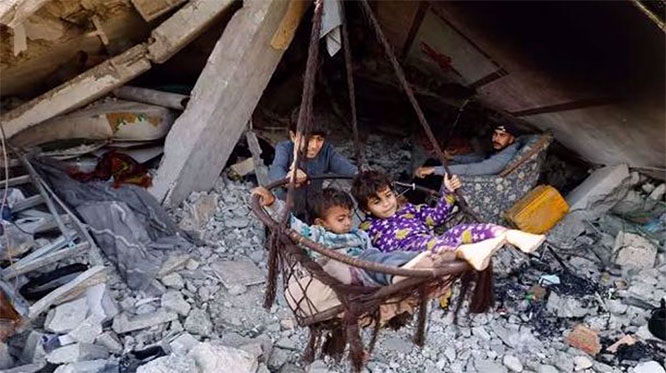
The Israeli regime’s forces have killed two Palestinian children in the Gaza Strip every day since the ceasefire began in early October, UNICEF has warned.

The UN children’s agency said on Friday that Israeli forces continue to attack Palestinians in Gaza even though the agreement was meant to stop the killing.

“Since 11 October, while the ceasefire has been in effect, at least 67 children have been killed in conflict-related incidents in the Gaza Strip. Dozens more have been injured. That is an average of almost two children killed every day since the ceasefire took effect,” UNICEF spokesperson Ricardo Pires said in Geneva, reminding that each number in the statistics represents a child whose life had ended violently.

“These are not statistics,” he said. “Each child had a story, a family, and a future that was stolen from them.”

Data from Palestinian factions, human rights groups, and government bodies recorded since the US-brokered ceasefire deal went into effect on October 10 show that Israeli forces have carried out numerous attacks, each constituting a separate ceasefire violation.

UNICEF teams say they repeatedly continue to witness heart-wrenching scenes of fearful Palestinian children sleeping outdoors with amputated limbs, while others live as orphans in flooded, makeshift shelters.

“I saw this myself in August. There is no safe place for them. The world cannot normalize their suffering,” Pires said, lamenting that the UN could “do a lot more if the aid that is really needed was entering faster.”

The UNICEF spokesperson warned that with the advent of winter, the risks for hundreds of thousands of displaced children will increase.

He warned, “The stakes are incredibly high” for children as winter acts as a threat multiplier, where children have no heating, no insulation, and few blankets. He said respiratory infections rise.

“Too many children have already paid the highest price,” Pires said. “Too many are still paying it, even under a ceasefire. The world promised them it would stop and that we would protect them.”

“Now we must act like it,” the UNICEF spokesperson added.

Since the Israeli regime launched its genocidal war against Palestinians in Gaza in October 2023, it has killed nearly 70,000 people in the territory, most of them women and children, and injured over 170,000 more, while reducing most of the structures in the enclave to rubble.

Comments

Add new comment

  • Coastaldigest.com reserves the right to delete or block any comments.
  • Coastaldigset.com is not responsible for its readers’ comments.
  • Comments that are abusive, incendiary or irrelevant are strictly prohibited.
  • Please use a genuine email ID and provide your name to avoid reject.