



Rahul Gandhi likely to become Congress president soon

February 16, 2015

New Delhi, Feb 16: Rahul Gandhi may be elevated to the post of the Congress president at the AICC session planned to be held sometime in April, marking a generational change in the party.
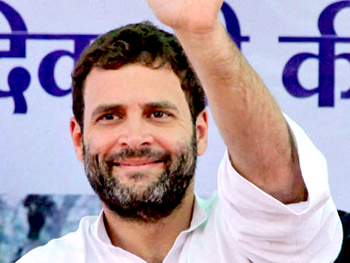
Rahul Gandhi
There were indications that Congress president Sonia Gandhi, who has been delegating party work to vice-president Rahul, may choose to pass on the mantle to him.

The change of guard at the top could also trigger a generational shift in the AICC with several younger leaders, who are currently secretaries at the headquarters, getting bigger responsibilities.

A senior leader said the changes could take place at the AICC session expected to be held sometime in April.

It was not immediately clear whether the elder leaders, mostly identified with Sonia Gandhi, would be given advisory roles. “She is best placed to choose a role for herself,” a senior leader remarked when asked about Sonia Gandhi’s role if she passes on the leadership mantle to Rahul.

After the Lok Sabha debacle, it is Rahul who took the lead in analysing the reasons for the defeat by holding meetings with a cross section of leaders. It was at the instance of Rahul that party leaders are getting inputs from workers at the district and state levels on changes they would like to see in the party. “The Congress is re-strategising its social-eco-political policy, reworking its organisation structure and would go back to the basics by April 2015,” AICC General Secretary Digvijay Singh said on Twitter.

Last month, Congress president Sonia Gandhi had written to party’s state unit chief to make suggestions on organisational reforms to progressively devolve power, increased accountability of leaders at all levels and the way forward for the party to win back confidence of all sections of the society.

These suggestions, along with the outcome of Rahul’s discussions with leaders, would form the “agenda for action” for the party which could be put before the AICC when it meets in April.

Another senior leader, also identified with the Rahul camp, gave indication that the party would shed its pro-reform image and aggressively take up pro-poor issues. “Carrying out reforms is the job of the government. While in opposition, you have to take up pro-poor issues and identify with the masses,” the leader said, adding that the party would aggressively take up the issue of easing up land laws through the ordinance route.


Comments

Add new comment

  • Coastaldigest.com reserves the right to delete or block any comments.
  • Coastaldigset.com is not responsible for its readers’ comments.
  • Comments that are abusive, incendiary or irrelevant are strictly prohibited.
  • Please use a genuine email ID and provide your name to avoid reject.
News Network
December 7,2025

SHRIMP.jpg

Mangaluru, Dec 7: A rare bamboo shrimp has been rediscovered on mainland India more than 70 years after it was last reported, confirming for the first time the presence of Atyopsis spinipes in the country. The find was made by researchers from the Centre for Climate Change Studies at Sathyabama Institute of Science and Technology, Chennai, during surveys in Karnataka and Odisha.

The team — shrimp expert Dr S Prakash, PhD scholar K Kunjulakshmi, and Mangaluru-based researcher Maclean Antony Santos — combined field surveys, ecological assessments and DNA analysis to identify the elusive species. Their findings, published in Zootaxa, resolve decades of taxonomic confusion stemming from a 1951 report that misidentified the species as Atyopsis moluccensis without strong evidence.

The shrimp has now been confirmed at two locations: the Mulki–Pavanje estuary near Mangaluru and the Kuakhai River in Bhubaneswar. Historical specimens from the Andaman Islands, previously labelled as A. moluccensis, were also found to be misidentified and actually belong to A. spinipes.

The rediscovery began after an aquarium hobbyist in Odisha spotted a shrimp in 2022, prompting systematic surveys across Udupi, Karwar and Mangaluru. Four female specimens were collected in Mulki and one in Odisha, all genetically matching.

Researchers warn the species may exist in very small, vulnerable populations as freshwater habitats face increasing pressure from pollution, sand mining and infrastructure development. All verified specimens have been deposited with the Zoological Survey of India for future reference.

Comments

Add new comment

  • Coastaldigest.com reserves the right to delete or block any comments.
  • Coastaldigset.com is not responsible for its readers’ comments.
  • Comments that are abusive, incendiary or irrelevant are strictly prohibited.
  • Please use a genuine email ID and provide your name to avoid reject.