Rahul Gandhi visits 4 temples, Congress says it is to 'counter' BJP-RSS's Hindutva line

Agencies
September 28, 2017

Chotila/Kagvad, Sept 28: Apparently seeking to showcase the Congress's soft Hindutva, Rahul Gandhi on Wednesday offered prayers at four temples in Gujarat before wrapping up his three-day visit to the poll-bound state, a move his party said was aimed at countering the hardline Hindutva of the BJP and RSS.

However, the ruling BJP took a dig at Gandhi, saying the Congress vice president was visiting temples as his party has failed to win elections in the state for long time.

In New Delhi, senior Congress leader P Chidambaram deprecated attempts at reading any political meaning into Gandhi's visit to temples.

Gandhi, who had kicked off his tour after offering prayers at the Dwarkadhish temple on Monday, resumed his road-show on Wednesday morning by trekking up the famous Chotila temple in Surendranagar district.

Starting his tour from Rajkot on Wednesday morning, Gandhi came to Chotila and began the steep climb immediately. He climbed around 1,000 steps in about 15 minutes without a break.

After he had offered prayers, the priests apprised him of the importance of the shrine.

The Congress leader climbed down the stairway in another 15 minutes, greeting devotees on his way back.

In the evening, Gandhi visited Khodal Dham temple in Kagvad village to offer prayers to Khodiyar Mata, the reigning deity of the Leuva Patel community. A section of Patels are up in arms against the state's BJP government over their demand for reservation in government jobs and educational institutions.

On his arrival, Gandhi was greeted by a large number of Patidars, who chanted their signature slogan - 'Jai Sardar, Jai Patidar' to welcome the Congress leader.

On his way to Jetpur from Kagvad, Gandhi also paid a visit to a temple dedicated to Dasi Jeevan, revered by Dalits and Buddhists.

He also made an unscheduled visit to another shrine — Jalaram temple — in Veerpur in Rajkot district.

"I don't think you should read political meaning into that. I think there is much else that is happening in his visit to Gujarat. I think we should focus on that," Chidambaram said in the national capital.

"We have always held that each one is entitled to practice his own faith, we treat all faiths equal. That is the position of the Congress party. From the days of Jawaharlal Nehru, Indira Gandhi, that is the stance of the Congress party," he said, while dismissing suggestions that the temple visits were an attempt to woo Hindu voters.

Commenting on Rahul Gandhi's visit to temples, Gujarat Congress spokesperson Manish Doshi said the party was deliberately projected as anti-Hindu by the BJP and the RSS.

"Rahul Gandhi's visit to various temples during his tour is aimed at countering the hardline Hindutva campaign of BJP and RSS," Doshi said.

"The RSS and BJP have deliberately tried to portray the Congress as anti-Hindu, which is not true," he said.

AICC spokesperson Shaktisinh Gohil said, "Our idea of secularism is different from them (BJP), as we visit religious places of all the faiths. This is nothing new. Our former PM Indira Gandhi used to do the same."

However, a state BJP leader said Gandhi was visiting temples as his party was not winning elections.

"Rahul Gandhi has started visiting temples and shrines as his party is not winning elections in any state," state BJP spokesperson Raju Dhruv said.

On Tuesday, Gandhi also attended a garba event organised by MLA Indranil Rajyaguru in Rajkot and performed 'aarti' in front of the idol of goddess Durga.

"The day ends well with garba in Rajkot," the Congress vice president had tweeted.

On his way from Chotila to Kagvad, Gandhi addressed people at some places. In his speeches, he promised that the Congress would waive all farm loans within 10 days of assuming power after the elections, which are due later this year.

In the last two days, Gandhi repeatedly attacked the BJP and Prime Minister Narendra Modi on GST, note ban and farm polices.

He had also invoked Sardar Patel's legacy to woo the Patel community ahead of the crucial state polls.

Gandhi had also expressed confidence about his party winning the assembly elections, claiming that there was a strong undercurrent in favour of the Congress in Gujarat.

Comments

Add new comment

  • Coastaldigest.com reserves the right to delete or block any comments.
  • Coastaldigset.com is not responsible for its readers’ comments.
  • Comments that are abusive, incendiary or irrelevant are strictly prohibited.
  • Please use a genuine email ID and provide your name to avoid reject.
News Network
November 21,2025

Bengaluru, Nov 21: The Karnataka government is facing pressure to overhaul its employment system after a high-level Cabinet sub-committee recommended the complete phase-out of job outsourcing in government offices, boards, and corporations by March 2028. The move is aimed at tackling a systemic issue that has led to the potential violation of constitutional reservation policies and the exploitation of workers.

The Call for Systemic Change

With over three lakh vacant posts currently being filled through private agencies on an outsource, insource, or daily wage basis, the sub-committee highlighted a significant lapse. "As a result, reservations are not being followed as per the Constitution and state laws. It’s an urgent need to take serious steps to change the system. It has been recommended to completely stop the system of outsourcing by March 2028," the panel stated in a document.

The practice of outsourcing involves private companies hiring workers to perform duties for a government agency. Critics argue this model results in lesser salaries, a lack of social security benefits (otherwise available to permanent government employees), and a failure to adhere to the provisions of Articles 14 and 15 of the Constitution, which guarantee equality before the law and prohibit discrimination.

The 'Bidar Model' as a Stop-Gap Solution

To regulate the current mode of employment and reduce worker exploitation until the 2028 deadline, the government plans to establish workers’ services multi-purpose cooperative societies across all districts, following the successful "Bidar Model."

The Bidar District Services of Labour Multi-purpose Cooperative Society Ltd., which operates under the District Commissioner, is cited as a successful example of providing a measure of social security to outsourced staff. Labour Department officials argue this society ensures workers receive their due wages and statutory facilities like ESI (Employees' State Insurance) and PF (Provident Fund), in exchange for a 1% service fee collected from the employees.

legislative push and Priority Insourcing

The recommendations, led by the sub-committee headed by Law and Parliamentary Affairs Minister H K Patil, are set to be discussed at the next Cabinet meeting. The committee has proposed the introduction of the Karnataka Outsourced Employees (Regulation, Placement and Welfare) Bill 2025.

In a move addressing immediate concerns, Labour Minister Santosh Lad, a member of the sub-committee, has reportedly assured that steps will be taken over the next 2-3 years to insource workers in "life-threatening services" on a priority basis. This includes essential personnel like pourakarmikas (sanitation workers), drivers, electrical staff in the Energy Department, and Health Department staff handling contagious diseases. The transition aims to grant these workers the long-term security and benefits they currently lack under the outsourcing system. 

Comments

Add new comment

  • Coastaldigest.com reserves the right to delete or block any comments.
  • Coastaldigset.com is not responsible for its readers’ comments.
  • Comments that are abusive, incendiary or irrelevant are strictly prohibited.
  • Please use a genuine email ID and provide your name to avoid reject.
News Network
November 21,2025

israel.jpg

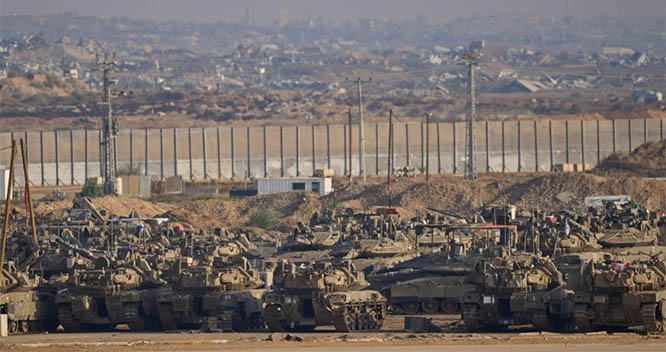
Local authorities say the Israeli military has expanded the so-called “yellow line” truce demarcation in Gaza City and repositioned its forces deeper into the territory in violation of a ceasefire agreement that came into force on October 10, besieging dozens of Palestinian families.

Gaza’s Government Media Office announced in a statement on Thursday that Israeli forces widened the boundary by shifting the markers, and advanced roughly 300 meters (984 feet) into the neighborhoods of Ash-Shaaf, An-Nazzaz and Baghdad Street.

The move pushed further into civilian areas, trapping families who were unable to flee as tanks rolled forward, it added.

“The fate of many of these families remains unknown amidst the shelling that targeted the area,” the office said, adding that the expansion of the yellow line shows a “blatant disregard” for the ceasefire deal.

On Friday, sources said the Israeli military carried out continued air and artillery strikes inside the so-called “yellow line” east of Khan Younis in the southern Gaza Strip.

According to the reports, Israeli warplanes and tanks targeted areas within the zone. One Palestinian was reported killed and several others wounded in the strikes, the sources said.

The fresh aggression came only a day after 25 Palestinians were killed in Israeli airstrikes on Gaza City and Khan Younis on Wednesday.

The media office reported that Israel has consistently violated the truce deal since its implementation last month, with near-daily attacks by air, artillery and direct shootings.

The office said over 400 violations have been documented. These breaches have resulted in the deaths of more than 300 Palestinians and left hundreds injured.

The Government Media Office in Gaza urged the guarantors of the ceasefire — the US, Egypt, Qatar and Turkey — to take swift action to halt the ongoing violations and facilitate the delivery of food, shelter materials, medical aid, and infrastructure equipment.

The so-called “yellow line,” set out in the agreement between Israel and Hamas resistance movement, refers to a non-physical partition where the Israeli military repositioned itself when the truce deal took effect.

It has allowed Israel, which routinely fires at Palestinians who approach the line, to retain control over more than half of the Gaza Strip.

International bodies, including the UN Independent International Commission of Inquiry, the International Association of Genocide Scholars, Amnesty International, Human Rights Watch, B’Tselem, and other rights groups, have concluded that the Israeli war on Gaza amounts to genocide.

In the attacks in Gaza since October 2023, Israel has killed at least 69,546 people and injured 170,833 others, leveling large swaths of the territory and displacing almost all of the population. 

Comments

Add new comment

  • Coastaldigest.com reserves the right to delete or block any comments.
  • Coastaldigset.com is not responsible for its readers’ comments.
  • Comments that are abusive, incendiary or irrelevant are strictly prohibited.
  • Please use a genuine email ID and provide your name to avoid reject.
News Network
December 3,2025

indigo.jpg

IndiGo, India’s largest airline, is battling one of its worst operational disruptions in recent years, with hundreds of delays and cancellations throwing domestic travel into chaos.

Government data on Tuesday showed its on-time performance plunging to 35%, an unusual dip for a carrier long associated with punctuality.

By Wednesday afternoon, airports in Delhi, Mumbai, Bengaluru and Hyderabad had collectively reported close to 200 cancellations, stranding travellers across the country.

Crew Shortage After New Duty Norms

A major trigger behind the meltdown is a severe crew shortage, especially among pilots, following the rollout of revised Flight Duty Time Limitation (FDTL) norms last month.

The rules mandate longer rest hours and more humane rosters — a shift IndiGo has struggled to incorporate across its vast network.

Sources said several flights were grounded due to lack of cabin crew, while some delays stretched upwards of eight hours.

With IndiGo controlling over 60% of India’s domestic aviation market, the ripple effect has impacted airports nationwide.

IndiGo Issues Apology, Lists “Compounding Factors”

In a statement, IndiGo acknowledged the large-scale disruption:

“We sincerely apologise to customers. A series of unforeseen operational challenges — technology glitches, winter schedule changes, adverse weather, system congestion and updated FDTL norms — created a compounding impact that could not have been anticipated.”

To stabilise operations, the airline has begun calibrated schedule adjustments for the next 48 hours, aiming to restore punctuality. Affected passengers are being offered refunds or alternate travel arrangements, IndiGo said.

What the FDTL Rules Require

The FDTL norms, designed to reduce pilot fatigue, cap duty and flying hours as follows:
•    Maximum 8 hours of flying per day
•    35 hours per week
•    125 hours per month
•    1,000 hours per year

Crew must also receive rest equalling twice the flight duration, with a minimum 10-hour rest period in any 24-hour window.

The DGCA introduced these limits to enhance flight safety.

Hyderabad: 33 Flights Cancelled, Long Queues Reported

Hyderabad’s Rajiv Gandhi International Airport saw heavy early-morning crowds as 33 IndiGo flights (arrivals and departures) were cancelled.

The airport clarified on X that operations were normal, advising passengers to contact IndiGo directly for latest flight status.

Cancellations included flights to and from Visakhapatnam, Goa, Ahmedabad, Delhi, Bengaluru, Chennai, Madurai, Hubli, Bhopal and Bhubaneswar.

Bengaluru: 42 Flights Disrupted

Bengaluru’s Kempegowda International Airport recorded 42 cancellations — 22 arrivals and 20 departures — affecting routes to Delhi, Mumbai, Chennai, Hyderabad, Goa, Kolkata and Lucknow.

Passengers Vent on Social Media

Irate travellers took to X to share their experiences. One passenger stranded in Hyderabad wrote: “I have been here since 3 a.m. and missed an important meeting.”

Another said: “My flight was pushed from 1:55 PM to 2:55 PM and now 4:35 PM. I was informed only three minutes before entering the airport.”

Delhi Airport Hit by Tech Glitch

At Delhi Airport, the disruption deepened due to a slowdown in the Amadeus system — used for reservations, check-ins and departure control.

The technical issue led to longer queues and sluggish processing, adding to delays already worsened by staff shortages.

Comments

Add new comment

  • Coastaldigest.com reserves the right to delete or block any comments.
  • Coastaldigset.com is not responsible for its readers’ comments.
  • Comments that are abusive, incendiary or irrelevant are strictly prohibited.
  • Please use a genuine email ID and provide your name to avoid reject.