



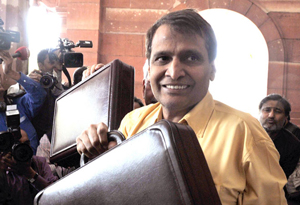
New Delhi, Feb 25: The Railway Budget for 2016-17 today spared passengers and goods movement from any increase in tariffs while it announced introduction of three new superfast trains and creation of dedicated north-south, east-west and east coast freight corridors by 2019.
Presenting his second Budget in the Lok Sabha, Railway Minister Suresh Prabhu promised rationalising of the tariff structure by undertaking a review to evolve competitive rates vis-a-vis other modes of transport and to expand the freight basket as a means of additional revenue mobilisation.
Unlike last year when he tweaked freight rates, Prabhu made no changes either in passenger fares or freight rates.
The three new superfast trains announced by him include 'Humsafar' which will be a fully air-conditioned 3AC service with option of meals. 'Tejas' will showcase the future of train travel in India with speeds up to 130 km per hour with onboard services such as entertainment, local cuisine and wifi.
The two trains will ensure cost recovery through tariff and non-tariff measures while 'Uday' will be an overnight double-decker along with 'Utkrishit' double-decker air-conditioned yatri express on the busiest routes.
For improving quality of travel for unreserved passenger, a superfast 'Antyodya' express service would be introduced. 'Deen Dayalu' unreserved coaches with portable water and higher number of mobile charging points would also be introduced.
He also announced setting up of a Rail Development Authority to enable fair pricing of services, promote competition, protect customer interest and determine efficiency standards. The draft Bill in this regard will be ready after holding extensive stakeholder consultations.
Outlining the Budget estimates for the coming year, the Minister put the plan size at Rs 1.21 lakh crore. The focus will be on capital expenditure with a mix of various sources of funding in order to ensure the projects are given assured funding.
Gross traffic receipts for the coming fiscal have been fixed at Rs 1.84 lakh crore with passenger earning growth pegged at 12.4 per cent and earning target budgeted at Rs 51,012 crore.
The freight traffic is pegged at an incremental tariff of 50 million tons, anticipating a healthier growth in the core sector of the economy.
Goods earning is accordingly proposed at Rs 1.17 lakh crore. Earnings on account of other coaching and sundries have been projected at Rs 6,185 crore and Rs 9,590 crore respectively.
Pension outgo has been budgeted at Rs 45,500 crore in the coming year. Revenue generation has been targeted at Rs 1.84 lakh crore. Financial performance for the current year has reflected a savings of Rs 8,720 crore, neutralising most of the revenue shortfall.
Operating ratio has been targeted at 92 per cent for the coming year as against 90 per cent in 2015-16, restricting the growth of ordinary expenses by 11.16 per cent after building in impact of 7th Pay Commission recommendation, planned reduction in diesel and electricity consumption.
The three new freight corridors of North-South will connect Delhi and Chennai, East-West connecting Kharagpur to Mumbai and East Coast from Kharagpur to Vijawada.
"It is proposed to put these three projects on high priority to ensure structuring, award and implementation in a time-bound manner through innovative financing schemes including PPP," Prabhu said in his more than hour long speech.
Before the current financial year ends on March 31, almost all contracts for civil engineering work would have been awarded.
Contracts worth Rs 24,000 crore have been awarded since he assumed office against Rs 13,000 crore worth of contracts in the last six years.
Presenting his "vision", Prabhu promised that by 2020 long-felt desires of the common man will be fulfilled.
The objectives include reserved accommodation on trains on demand, time-tabled freight trains, high-end technology to improve safety record, elimination of all unmanned level crossings, improved punctuality and higher speed of freight trains and zero direct discharge of human waste.
As part of improving customer interface, the Budget proposed interaction and feedback through social media and dedicated IVRS system and making travel comfortable by generating over 65,000 additional berths and installing 2,500 water vending machines.
Wi-Fi facility has been provided at 100 station and 400 more will be covered in the coming year.
As part of safety measures, 350 manned level crossings and 1000 unmanned level crossings have been closed. 820 road over bridges and rail under bridges have been completed in the current year and work is going on in 1,350 of them.
As a passenger-friendly measure, IRCTC will manage catering services in catering and stalls at stations in a phased manner. It will explore the possibility of making catering services operational, adding 10 more IRCTC operated base kitchens.
As part of improving customer interface, work is underway on installation of a high-tech centralised network of 20,000 screens across 2000 stations for enabling real-time flow of information to passengers and also unlock huge advertising potential.
Provision of passenger amenities and beautification of stations will be taken on priority in pilgrim centres like Ajmer, Amritsar, Bihar Sharif, Chengannur, Dwarka, Gaya, Haridwar, Mathura, Nagapattinam, Nanded, Nasik, Pali, Parasnath, Pri, Tirupati, Vailankanni, Varanasi and Vasco. The Railway also intends to run 'astha' circuit trains to connect pilgrim centres.

Comments
Add new comment