Sanghi Hindutva state would mark end of Indian idea: Shashi Tharoor

Agencies
October 31, 2020

New Delhi, Oct 31: The Hindutva movement is the "mirror image" of the Muslim communalism of 1947 and its triumph would mark the end of the Indian idea, says senior Congress leader Shashi Tharoor, asserting that Hindutva is a political doctrine, not a religious one.

A 'Hindu India' would not be Hindu at all, but a "Sanghi Hindutva state", which is a different country altogether, says Tharoor in his new book 'The Battle of Belonging' that was released on Saturday.

"People like me want to preserve the India we love, and not turn our beloved nation into the kind of religious state we were brought up to detest," he said.

Tharoor also asserted that Hindutva movement rhetoric echoes the bigotry that India was constructed to reject.

In the book published by Aleph Book Company, Tharoor makes a stinging critique of the Hindutva doctrine and the Citizenship (Amendment) Act, which he says is a challenge to, arguably, the most fundamental aspect of Indianness.

Devoting a chapter to the 'Hindu Pakistan' controversy in the book, the former Union minister writes: "I had inveighed against the ruling party’s attempts to create a Hindutva version of Pakistan, since that was not what our freedom movement fought for, nor was it the idea of India enshrined in our Constitution."

"This is not just about the minorities, as the BJP would have us believe. Many proud Hindus like myself cherish the inclusive nature of our faith and have no desire to live, as our Pakistani neighbours are forced to, in an intolerant mono-religious state," he writes.

Tharoor's reported comment last year that the BJP will pave the way for creation of a "Hindu Pakistan" had sparked a controversy with the party demanding his apology over the remarks.

Hinduism, as Swami Vivekananda asserted, teaches the acceptance of difference as a basic credo, Tharoor said in the book.

"Hindutva is not Hinduism; it is a political doctrine, not a religious one," he said.

"What is bizarre about the media drama over my remarks is that no one who was giving airtime to multiple BJP voices, frothing at the mouth about my words, actually asked them one simple question: 'Is the BJP giving up its dream of a Hindu rashtra?'" Tharoor said.

BJP apologists point out that the government has done nothing to amend the Constitution, and others have suggested that the Supreme Court's ruling that secularism is part of the 'basic structure' of the Constitution makes the idea of a 'Hindutva Pakistan' impossible, he said.

"But the fact is that both have only been held at bay by the simple fact that the BJP has not had the numbers required to achieve their goal -- two-thirds of both Houses of Parliament and half the states," he said.

Their overwhelming victory in the Lok Sabha elections in 2019 and winning a plurality of seats in the Rajya Sabha in June 2020 has ensured that they finally have all the elements needed to fulfil their "project", he said, adding that the nation has been "warned".

Tharoor argues in the book that the battle is between two opposing ideas of India or what might be described as ethno-religious nationalism versus civic nationalism.

In a sharp criticism of the CAA, Tharoor said it is the first law to question a basic building block of the nation -- that religion is not the determinant of our nationhood and, therefore, of our citizenship.

At a time when India's major national priority ought to have been its flailing economy, whose plummeting growth rate had already aroused widespread alarm even before the coronavirus struck, the Modi government plunged the country into an unwanted political crisis of its own making with the CAA, he said.

"With its penchant for shock-and-awe, the government pushed through Parliament legislation that fast-tracks citizenship for people fleeing persecution in Pakistan, Afghanistan, and Bangladesh -- provided they are not Muslim. By excluding members of just one community, the new law is antithetical to India's secular and pluralist traditions," writes Tharoor.

"The religious bigotry that partitioned the country with the founding of Pakistan has now been mirrored in pluralist India. As I told my fellow parliamentarians, that was a partition in the Indian soil; this is now a partition in the Indian soul," he said.

The Hindutva movement is the mirror image of the Muslim communalism of 1947; its rhetoric echoes the bigotry that India was constructed to reject, Tharoor said.

Its triumph would mark the end of the Indian idea, the Congress leader added.

In the book, Tharoor also delves into the issue of the slogan 'Bharat Mata Ki Jai' allegedly becoming an "acid test of Indian nationalism" and reiterated his stance that no Indian should be compelled to mouth a phrase that is nationalistic in the eyes of some, but not in his own.

Revisiting the 2016 controversy involving Muslim legislator Waris Pathan, who was suspended from the Maharashtra Assembly soon after for refusing to utter the slogan, Tharoor noted that some Muslims say, "'Tell us to say Jai Hind, Hindustan Zindabad, Jai Bharat, we'll do it -- but do not ask us to say Bharat Mata ki Jai'."

"The same Constitution that, in our civic nationalism, gives us the right to freedom of speech, also gives us the freedom of silence. We cannot put words in people's mouths," he asserted.

Tharoor also criticized the manner in which Article 370 was abrogated on August 5, 2019, saying Modi shocked the nation with an announcement on Kashmir that could well turn out to be the "political equivalent of demonetization"


Comments

Add new comment

  • Coastaldigest.com reserves the right to delete or block any comments.
  • Coastaldigset.com is not responsible for its readers’ comments.
  • Comments that are abusive, incendiary or irrelevant are strictly prohibited.
  • Please use a genuine email ID and provide your name to avoid reject.
News Network
November 21,2025

malpe.jpg

Udupi: The Malpe Police have arrested two men from Uttar Pradesh for allegedly sharing classified information related to Indian Navy vessels with individuals in Pakistan, posing a serious threat to national security.

According to a complaint filed by the CEO of Udupi Cochin Shipyard, Malpe—an institution under the Union Ministry of Ports, Shipping and Waterways—the prime accused, Rohit (29), was working as an insulator through subcontractor M/S Shushma Marine Pvt Ltd. He had earlier served at Cochin Shipyard Limited in Kochi, Kerala, where naval ships are under construction.

Udupi SP Hariram Shankar said the accused had unlawfully shared, via WhatsApp, confidential identification numbers of Navy-related ships and other classified details while working in Kerala, allegedly for illegal gains.

After joining the Malpe shipyard unit, Rohit reportedly continued collecting sensitive information through a friend in Kochi and circulated it to unauthorised individuals, violating national security protocols and potentially endangering India’s sovereignty, unity, and integrity.

Based on the complaint, Malpe Police registered a case under Section 152 of the Bharatiya Nyaya Sanhita (BNS) and Sections 3 and 5 of the Official Secrets Act, 1923.

A police team led by Karkala Subdivision Assistant Superintendent of Police Harsha Priyamvada—along with PSI Anil Kumar D, ASI Harish, and PC Ravi Jadhav—conducted the investigation and arrested the two accused, identified as Rohit (29) and Santri (37), both residents of Sultanpur district, Uttar Pradesh.

The duo was produced before the court, which remanded them in judicial custody till December 3. Further investigation is in progress.

Comments

Add new comment

  • Coastaldigest.com reserves the right to delete or block any comments.
  • Coastaldigset.com is not responsible for its readers’ comments.
  • Comments that are abusive, incendiary or irrelevant are strictly prohibited.
  • Please use a genuine email ID and provide your name to avoid reject.
News Network
November 21,2025

Bengaluru, Nov 21: The Karnataka government is facing pressure to overhaul its employment system after a high-level Cabinet sub-committee recommended the complete phase-out of job outsourcing in government offices, boards, and corporations by March 2028. The move is aimed at tackling a systemic issue that has led to the potential violation of constitutional reservation policies and the exploitation of workers.

The Call for Systemic Change

With over three lakh vacant posts currently being filled through private agencies on an outsource, insource, or daily wage basis, the sub-committee highlighted a significant lapse. "As a result, reservations are not being followed as per the Constitution and state laws. It’s an urgent need to take serious steps to change the system. It has been recommended to completely stop the system of outsourcing by March 2028," the panel stated in a document.

The practice of outsourcing involves private companies hiring workers to perform duties for a government agency. Critics argue this model results in lesser salaries, a lack of social security benefits (otherwise available to permanent government employees), and a failure to adhere to the provisions of Articles 14 and 15 of the Constitution, which guarantee equality before the law and prohibit discrimination.

The 'Bidar Model' as a Stop-Gap Solution

To regulate the current mode of employment and reduce worker exploitation until the 2028 deadline, the government plans to establish workers’ services multi-purpose cooperative societies across all districts, following the successful "Bidar Model."

The Bidar District Services of Labour Multi-purpose Cooperative Society Ltd., which operates under the District Commissioner, is cited as a successful example of providing a measure of social security to outsourced staff. Labour Department officials argue this society ensures workers receive their due wages and statutory facilities like ESI (Employees' State Insurance) and PF (Provident Fund), in exchange for a 1% service fee collected from the employees.

legislative push and Priority Insourcing

The recommendations, led by the sub-committee headed by Law and Parliamentary Affairs Minister H K Patil, are set to be discussed at the next Cabinet meeting. The committee has proposed the introduction of the Karnataka Outsourced Employees (Regulation, Placement and Welfare) Bill 2025.

In a move addressing immediate concerns, Labour Minister Santosh Lad, a member of the sub-committee, has reportedly assured that steps will be taken over the next 2-3 years to insource workers in "life-threatening services" on a priority basis. This includes essential personnel like pourakarmikas (sanitation workers), drivers, electrical staff in the Energy Department, and Health Department staff handling contagious diseases. The transition aims to grant these workers the long-term security and benefits they currently lack under the outsourcing system. 

Comments

Add new comment

  • Coastaldigest.com reserves the right to delete or block any comments.
  • Coastaldigset.com is not responsible for its readers’ comments.
  • Comments that are abusive, incendiary or irrelevant are strictly prohibited.
  • Please use a genuine email ID and provide your name to avoid reject.
Agencies
November 22,2025

indiapak.jpg

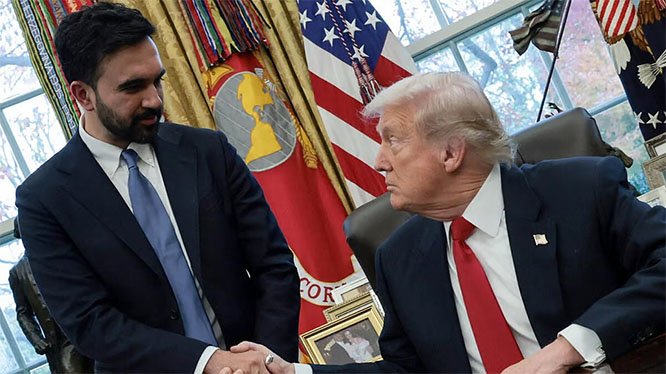
New York/Washington: US President Donald Trump has again claimed to have solved the conflict between India and Pakistan, repeating his assertion during a meeting with New York City Mayor-elect Zohran Mamdani in the Oval Office.

Mamdani flew to Washington DC for his first meeting with Trump in the White House on Friday. Trump said he “enjoyed” the meeting, which he described as “great.”

During remarks in the Oval Office, with Mamdani standing next to him, Trump repeated his claim that he solved the May conflict between India and Pakistan.

"I did eight peace deals of countries, including India and Pakistan,” he said.

On Wednesday, Trump had said he threatened to put 350 per cent tariffs on India and Pakistan if they did not end their conflict, repeating his claim that he solved the fighting between the nuclear-armed neighbours and that Prime Minister Narendra Modi had called him to say “we're not going to go to war.”

Since May 10, when Trump announced on social media that India and Pakistan had agreed to a “full and immediate” ceasefire after a “long night” of talks mediated by Washington, he has repeated his claim over 60 times that he “helped settle” the tensions between India and Pakistan.

India has consistently denied any third-party intervention. India launched Operation Sindoor on May 7, targeting terror infrastructure in Pakistan and Pakistan-occupied Kashmir in retaliation for the April 22 Pahalgam attack that killed 26 civilians. India and Pakistan reached an understanding on May 10 to end the conflict after four days of intense cross-border drone and missile strikes.

Mamdani emerged victorious in the closely-watched battle for New York City Mayor, becoming the first South Asian and Muslim to be elected to sit at the helm of the largest city in the US.

He had been the front-runner in the NYC Mayoral election for months and defeated Republican nominee Curtis Sliwa and political heavyweight former New York State Governor Andrew Cuomo, who ran as an independent candidate and was officially endorsed by Trump just hours before the elections.

Indian-descent Mamdani is the son of renowned filmmaker Mira Nair and Columbia University professor Mahmood Mamdani. He was born and raised in Kampala, Uganda and moved to New York City with his family when he was 7. Mamdani became a naturalised US citizen only recently, in 2018.

Comments

Add new comment

  • Coastaldigest.com reserves the right to delete or block any comments.
  • Coastaldigset.com is not responsible for its readers’ comments.
  • Comments that are abusive, incendiary or irrelevant are strictly prohibited.
  • Please use a genuine email ID and provide your name to avoid reject.