Reservation for Economically Backward: Another Jumla!

Ram Puniyani
January 18, 2019

Indian caste system has been a big obstacle to the journey towards equality. With Independence and the Indian Constitution coming into being, the provisions were made for socially backward classes for reservations for SC and ST. Later in 1990, VP Singh when faced with the threat to his power from Choudhary Devilal, implemented to report of Mandal Commission which gave 27% of reservation to other backward castes. This was in addition to the already existing quota for the ST and SC. Lately there have been demands from dominant castes like Jats, Marathas, Patels and others for reservations for them. The state Governments have been in dilemmas about these demands, for some of which massive agitations have been launched in recent history.

Coming in this backdrop is the BJP led NDA Government has introduced 10% reservation for the economically backward upper castes. The Central Cabinet gave approval to the same and the Parliament has passed the amendment for its implantation. At the same time ‘Youth for Equality’, which has been opposing the very concept of reservation on the grounds that only merit should be the criterion for jobs has challenged this in the Supreme Court. What is interesting is that BJP as a party has been in the forefront of ideological battle opposing the concept of reservations. Long agitations and movements have been witnessed in the past led by the right wing people opposing the very concept of reservation. The anti reservation riots of Ahmadabad in 1980s were against the quota for dalits. These witnessed massive violence against dalits. Similarly in 1985 onwards another series of violence was unleashed against the principle of reservation in promotion in jobs.

In the wake of Mandal Commission implementation the only party to oppose it was Shiv Sena. The other major outfit conceptually opposed to reservations and beating the drum of merit has been BJP. For electoral purpose it did not come forward to openly oppose the Mandal Commission. In place it went on to strengthen its Kamandal politics, the Ram temple politics, which polarized the society along religious lines leading to massive violence. Youth for Equality has been constantly opposing reservation of all and any types. It is now in Supreme Court.

The upper limit of reservations so far has been set to a total of 50%, with this 10% additional it will go up to 60%. Will it be legally tenable, needs to be seen. The definition of economically backward defies all the logic, what has been proposed is that all those having an annual income of below 8 Lakhs per year, having a household less that1000 square feet and having land less than 5 Acres will be put in this category. If we see the rough estimates around these parameters, over 90% of Indian population will be eligible for this 10% reservation, in effect it is like neutralizing the whole concept of affirmative action and surely poor of the upper caste are not going to benefit from it.

The points which emerge from this reservation initiative by this government show that its intention is not any way to help the poor upper caste to come up. So far in society those benefitting from quotas have been looked down in a humiliating way. It is to bypass this ST/ST/OBC reservation that the whole series of private colleges came up, where bypassing the merit, the money power was the major factor. The contradiction of merit versus money stood very much exposed during last many decades. While blaming the one’s coming from reserved category as being sub standard, the private colleges-donations and game of money has been the major player in the field of education. So while there has been opposition to the concept of reservation why this move, which in any way is not going to be of any use in bridging the divide of social-economic disparity.

It is interesting to note that while this move is being undertaken thousands of jobs are lying vacant; not being filled. In most of the areas, permanent work is being outsourced on contract to the temporary workers. The policy makers know that this move is not going to benefit the poor as new jobs are not being created. Be it the Government sector of the public sector, there is a massive stagnation in the jobs and that is what is leading to the frustration among the youth. When jobs are not being filled or created afresh what does the quota mean?

Mr. Modi came to power in 2014 on the promise of creating two crore jobs every year. Rather than creating more jobs he has landed up with reduction of jobs in informal sector due to demonetization. The ‘Make in India’ which was supposed to create jobs turned out to be a flop. With the growing unemployment not only we need think of our industrial policies but also focus on how we implement affirmative action. People are suffering due to social injustice and also due to discrimination on ground of religion. Rangnath Mishra Committee and Sachar Committee reports tell us the massive discrimination against Muslim minorities. How do we march towards a society with justice in this scenario? The short sighted Jumla led leaders cannot deliver justice or jobs. We need an inclusive government with inclusive agenda to address the ills of our society.

This so called reservation for economically backward section of society is yet another attempt by Modi-BJP to throw up another jumla, which has no content as for as implications on poorer upper caste is concerned. At another level bringing in economic criterion in the reservations is an admission of failure to alleviate poverty. It is also an attempt to undo the very basis of reservation as given in our Constitution, and that is social injustice, the social hierarchy. Reservation is not a poverty alleviation program, which any way needs to be undertaken. This again is just not possible by a government, which is more concerned about favoring big Corporate in its policy making.


Comments

Add new comment

  • Coastaldigest.com reserves the right to delete or block any comments.
  • Coastaldigset.com is not responsible for its readers’ comments.
  • Comments that are abusive, incendiary or irrelevant are strictly prohibited.
  • Please use a genuine email ID and provide your name to avoid reject.
News Network
November 21,2025

Bengaluru, Nov 21: The Karnataka government is facing pressure to overhaul its employment system after a high-level Cabinet sub-committee recommended the complete phase-out of job outsourcing in government offices, boards, and corporations by March 2028. The move is aimed at tackling a systemic issue that has led to the potential violation of constitutional reservation policies and the exploitation of workers.

The Call for Systemic Change

With over three lakh vacant posts currently being filled through private agencies on an outsource, insource, or daily wage basis, the sub-committee highlighted a significant lapse. "As a result, reservations are not being followed as per the Constitution and state laws. It’s an urgent need to take serious steps to change the system. It has been recommended to completely stop the system of outsourcing by March 2028," the panel stated in a document.

The practice of outsourcing involves private companies hiring workers to perform duties for a government agency. Critics argue this model results in lesser salaries, a lack of social security benefits (otherwise available to permanent government employees), and a failure to adhere to the provisions of Articles 14 and 15 of the Constitution, which guarantee equality before the law and prohibit discrimination.

The 'Bidar Model' as a Stop-Gap Solution

To regulate the current mode of employment and reduce worker exploitation until the 2028 deadline, the government plans to establish workers’ services multi-purpose cooperative societies across all districts, following the successful "Bidar Model."

The Bidar District Services of Labour Multi-purpose Cooperative Society Ltd., which operates under the District Commissioner, is cited as a successful example of providing a measure of social security to outsourced staff. Labour Department officials argue this society ensures workers receive their due wages and statutory facilities like ESI (Employees' State Insurance) and PF (Provident Fund), in exchange for a 1% service fee collected from the employees.

legislative push and Priority Insourcing

The recommendations, led by the sub-committee headed by Law and Parliamentary Affairs Minister H K Patil, are set to be discussed at the next Cabinet meeting. The committee has proposed the introduction of the Karnataka Outsourced Employees (Regulation, Placement and Welfare) Bill 2025.

In a move addressing immediate concerns, Labour Minister Santosh Lad, a member of the sub-committee, has reportedly assured that steps will be taken over the next 2-3 years to insource workers in "life-threatening services" on a priority basis. This includes essential personnel like pourakarmikas (sanitation workers), drivers, electrical staff in the Energy Department, and Health Department staff handling contagious diseases. The transition aims to grant these workers the long-term security and benefits they currently lack under the outsourcing system. 

Comments

Add new comment

  • Coastaldigest.com reserves the right to delete or block any comments.
  • Coastaldigset.com is not responsible for its readers’ comments.
  • Comments that are abusive, incendiary or irrelevant are strictly prohibited.
  • Please use a genuine email ID and provide your name to avoid reject.
News Network
November 30,2025

airportmetro.jpg

Udupi: The pontiffs of Sri Paryaya Puttige Mutt, the sacred seat of Jagadguru Shrimad Madhvacharya Moola Samsthanam, have submitted a proposal to the Prime Minister seeking comprehensive development for Udupi district. 

Proposal for International Airport

A key request is the establishment of an international airport. Highlighting that around 1,000 acres of land are available and suitable, the pontiffs noted that the existing Mangalore Airport provides limited international connectivity. They suggested the airport be developed under a Public-Private Partnership (PPP) or as a Greenfield Airport to boost trade, education, healthcare, and spiritual tourism.

Metro and Rapid Transit Connectivity

The proposal also calls for Metro Rail or Rapid Transit between Mangaluru and Udupi. The 55 km coastal stretch experiences heavy daily commuter traffic, causing congestion. The district administration is ready to prepare an initial project report for a Mass Rapid Transit corridor and requested inclusion under national urban mobility programmes to ensure safe, green, and time-efficient regional transport.

Port and Coastal Development

The pontiffs urged the development of an international-standard port with a cruise terminal along Udupi’s coast. They also requested fast-tracking of pending coastal tourism projects and revising Coastal Regulation Zone (CRZ) norms to encourage sustainable infrastructure and hospitality investment.

IT, AI and Technological Infrastructure

Support was sought for an IT and AI Innovation Park with incubation facilities under Digital India and Startup India initiatives. The proposal also emphasized the need for strengthened data security and cloud computing infrastructure to boost India’s technological independence.

Sports and Education Initiatives

The pontiffs requested national sports status for Kambala, along with financial and infrastructure support. They also sought the establishment of an AIIMS in Udupi, a new IIT campus, and approval for an IIM to promote higher education in the district.

Representation to the Prime Minister

Sri Sugunendra Tirtha Pontiff and Sri Sushrendra Tirtha Swamiji represented the pontiffs in submitting the comprehensive development proposal to the Prime Minister during his recent visit.

Comments

Add new comment

  • Coastaldigest.com reserves the right to delete or block any comments.
  • Coastaldigset.com is not responsible for its readers’ comments.
  • Comments that are abusive, incendiary or irrelevant are strictly prohibited.
  • Please use a genuine email ID and provide your name to avoid reject.
coastaldigest.com news network
November 28,2025

roadshow.jpg

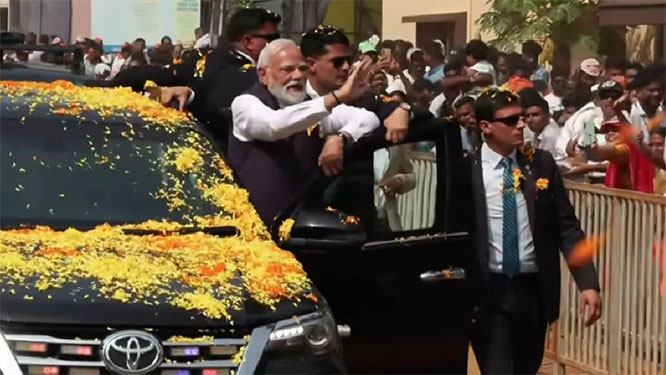
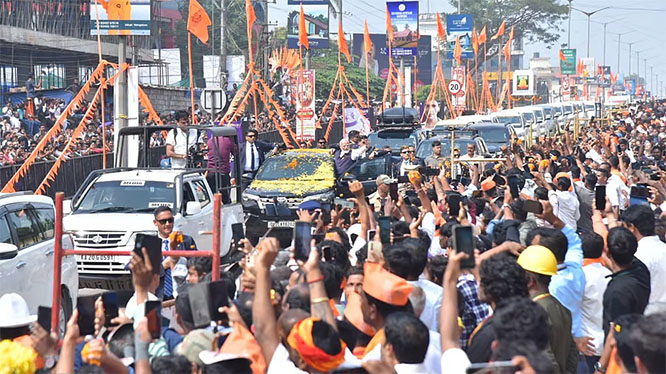
Udupi district transformed into a sea of saffron and celebration on Friday, November 28, as Prime Minister Narendra Modi’s roadshow swept through the coastal temple town. Thousands of residents lined the streets, turning the event into a vibrant public spectacle filled with cheers, flags, and festive energy.

The procession route—from the helipad to the historic Sri Krishna Math—was decked with buntings, saffron flags, and multilayered security barricades. One of the district’s largest-ever security deployments was put in place for the high-profile visit, with over 3,000 police personnel on duty. The arrangement included ten SPs, 27 DSPs, 49 inspectors, 127 sub-inspectors, 232 assistant sub-inspectors, 1,608 constables, and 39 women staff.

Six platoons of the Karnataka State Reserve Police, six Quick Response Teams, bomb detection units, and dog squads were stationed across Udupi. Enhanced surveillance covered Adi Udupi, Bannanje bus stand, and the Sri Krishna Math parking zone, with combing operations carried out along the roadshow corridor.

At the 800-year-old Sri Krishna Math, preparations reached a ceremonial peak. Paryaya Puttige Math seer Sugunendra Teertha Swamiji said the Prime Minister would take part in the Laksha Kantha Geetha Parayana, a mass chanting of the Bhagavad Gita by one lakh devotees, and inaugurate the new Suvarna Teertha Mantapa.

“He will first offer floral tributes to saint-poet Kanakadasa and then unveil the golden covering over the Kanakana Kindi,” the seer said.

The Prime Minister will also receive a Poorna Kumbha welcome and have darshan of Lord Sri Krishna, Mukhyaprana Devaru, and the Suvarna Paduke. Union Minister Pralhad Joshi, Karnataka Governor Thaawarchand Gehlot, Minister Bairathi Suresh, Dharmadhikari D. Veerendra Heggade, and seers from the Ashta Maths are expected to join the ceremony.

Ahead of his arrival, the Prime Minister posted on X that he felt “honoured” to attend the spiritually significant gathering. “This is a special occasion that brings together people from different sections of society for a recital of the Gita. This Matha has a very special significance in our cultural life,” he wrote, noting the institution’s long-standing legacy rooted in the teachings of Sri Madhvacharya.

roadshow2.jpg

Comments

Add new comment

  • Coastaldigest.com reserves the right to delete or block any comments.
  • Coastaldigset.com is not responsible for its readers’ comments.
  • Comments that are abusive, incendiary or irrelevant are strictly prohibited.
  • Please use a genuine email ID and provide your name to avoid reject.