RSS abandoned me after I exposed Vyapam: Anand Rai

July 19, 2015

Indore, Jul 19: A strange twist of fate or tactical disassociation? A man who based his work on the teachings of the RSS has been abandoned by the organisation while he is in the middle of a major corruption expose.
anand-rai-rss

Anand Rai, a doctor from Indore, considered instrumental in blowing the lid off the Vyapam scam in Madhya Pradesh, feels let down by the Hindutva organisation with which he had been affiliated since 2005. “If the Sangh can stand up for terror accused Pragya Bharti, who has brought public disgrace to the organisation, then why did it abandon me when I was exposing Vyapam?” asks Dr. Rai.

The relation between him and the Sangh took a dramatic turn in 2013 when the Vyapam scam came to light and Dr. Rai was projected as the key whistleblower. Following this, the Sangh distanced itself from him and stopped inviting him to its programmes and weekly workshops. The 2012-13 Nanaji Deshmukh award for social service, named after the RSS ideologue, for which he was recommended was also held back.

“They did not want anything to do with the controversy. Maybe to avoid making it appear as if RSS men were taking on the BJP government,” said Dr. Rai.

He feels that while the Sangh defends its “bad crop”, it does nothing for “honest karyakartas.”

The RSS “claims to fight for corruption, but till now has Mohan Bhagwat said a word on Vyapam,” Mr. Rai asks. “Is this deadly scam a lesser issue than Article 370 or the uniform civil code they claim to fight for?”

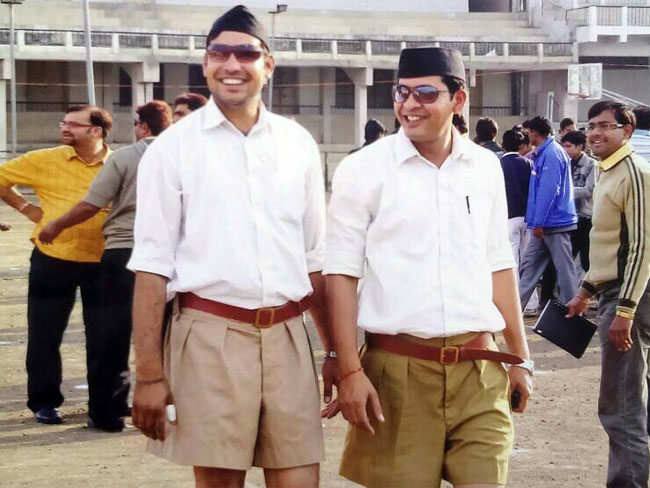
Backed by a strong footing in student politics, the doctor started his association with the Sangh in 2005, when he was designated the president of the BJP doctors’ cell in Indore. Not only did he regularly don the khaki shorts to attend shakhas and archana karyas, he held the prominent position of district vice-president of Arogya Bharti, the medical wing of the RSS. His proximity to RSS Indore vibhag pramukh Pramod Jha was an indication of his association with the outfit.

But now hounded and threatened for his efforts in exposing the culprits in the Vyapam scam, Dr. Rai faces fresh harassment as information leaked to him suggests that the State government plans to transfer him to the tribal belt of Dhar, a “punishment posting”. Senior State officials are pressuring Dr. Rai’s senior to relieve him of his post, and warned him not to allow the doctor give interviews to the media anymore.

Dr. Rai believes it is part of a sustained effort to demoralise him. His wife, Gauri, a gynaecologist, was recently suspended for seeking child-care leave. Though she was reinstated, she was transferred to Ujjain even as other doctors suspended along with her were promoted, Dr. Rai says. “We have a two-and-a half-year-old child to look after. What is the government trying to prove by transferring me? That this is the reward you get for exposing corruption?” he asks.

A meritorious student since his school days, Mr. Rai was born into the family of a schoolteacher in a small village Mahendra in Harda district. Possessing a sharp mind, he got an early sniff into the irregularities in medical education in the State in 1993 when the Geology paper he attempted in the Pre-Medical Test was leaked in Gwalior. His subsequent involvement in student politics and participation in exposing graft cases and raising incidence of partiality against students of Hindi-medium groomed his skills.

In 2005, his suspicions peaked while attempting the MD/MS exams. He was baffled to find that many of the top qualified students belonged to the same hostel block. “These were students with a poor educational record but from influential families, their fathers holding high bureaucratic posts,” said Mr. Rai, who began digging deep for evidence. Initially, his complaints yielded little. On July 5, 2009, the break came as he tipped off the Crime Branch about the presence of few impersonators lodged in an Indore hotel. Later that year, on his complaint, a committee was formed to identify the impersonators in fudged exams. But despite filing RTI queries he got no response.

In 2010, he was even fired from the Maharana Yashwant Rao Hospital in Bhopal for instigating student agitation and exposing the regulatory manner of clinical trials in the hospital. But in 2011, with the help of independent MLA Paras Saklecha, Mr. Rai managed to raise the issue in the State Assembly and it was found that 114 impersonators had been identified. The lid was off, and till 2012, 295 impersonators were found leading to some arrests. This also led to death threats by the accused.

DMAT scam worse

But undeterred, Mr. Rai is now eyeing exposing corruption in private colleges. He recently filed a petition in the Supreme Court demanding that the Vyapam CBI probe be extended to seat allotments through DMAT exam in private colleges. While hearing his petition, the apex court said the DMAT scam seems worse than Vyapam. Mr. Rai says there is a clear link between the corruption in Vyapam and DMAT. The same solvers who would impersonate for candidates in Vyapam also filled in seats in private colleges but later surrendered the seats which were then sold out.


Comments

Add new comment

  • Coastaldigest.com reserves the right to delete or block any comments.
  • Coastaldigset.com is not responsible for its readers’ comments.
  • Comments that are abusive, incendiary or irrelevant are strictly prohibited.
  • Please use a genuine email ID and provide your name to avoid reject.
News Network
December 16,2025

jordan.jpg

Prime Minister Narendra Modi on Monday held talks with Jordan’s King Abdullah II in Amman, during which the two leaders discussed ways to further strengthen bilateral relations, with the Prime Minister outlining an eight-point vision covering key areas of cooperation.

Describing the meeting as “productive”, PM Modi said he shared a roadmap focused on trade and economy, fertilisers and agriculture, information technology, healthcare, infrastructure, critical and strategic minerals, civil nuclear cooperation, and people-to-people ties.

In a post on social media platform X, the Prime Minister praised King Abdullah II’s personal commitment to advancing India–Jordan relations, particularly as both countries mark the 75th anniversary of the establishment of diplomatic ties this year.

“Held productive discussions with His Majesty King Abdullah II in Amman. His personal commitment towards vibrant India-Jordan relations is noteworthy. This year, we are celebrating the 75th anniversary of our bilateral diplomatic relations,” PM Modi said.

The meeting took place at the Al Husseiniya Palace, where the two leaders also exchanged views on regional and global issues of mutual interest. According to the Ministry of External Affairs (MEA), both sides agreed to further deepen cooperation in areas including trade and investment, defence and security, counter-terrorism and de-radicalisation, fertilisers and agriculture, infrastructure, renewable energy, tourism, and heritage.

The MEA said both leaders reaffirmed their united stand against terrorism.

PM Modi arrived in Amman earlier on Monday and was received by Jordanian Prime Minister Jafar Hassan, who accorded him a formal welcome. Following the talks, King Abdullah II hosted a banquet dinner in honour of the Prime Minister, reflecting the warmth of bilateral ties.

Jordan is the first leg of PM Modi’s three-nation tour. From Amman, the Prime Minister will travel to Ethiopia at the invitation of Prime Minister Abiy Ahmed Ali, marking his first official visit to the African nation. The tour will conclude with a visit to Oman.

Comments

Add new comment

  • Coastaldigest.com reserves the right to delete or block any comments.
  • Coastaldigset.com is not responsible for its readers’ comments.
  • Comments that are abusive, incendiary or irrelevant are strictly prohibited.
  • Please use a genuine email ID and provide your name to avoid reject.
News Network
December 6,2025

indigoticket.jpg

With IndiGo flight disruptions impacting thousands of passengers, the airline on Saturday said that it will offer full waiver on all cancellations/reschedule requests for travel bookings between December 5, 2025 and December 15, 2025.

Earlier in the day, the civil aviation ministry had directed the airline to complete the ticket refund process for the cancelled flights by Sunday evening, as well as ensure baggage separated from the travellers are delivered in the next two days.

In a post on X, titled 'No questions asked', IndiGo wrote, "In response to recent events, all refunds for your cancellations will be processed automatically to your original mode of payment."

"We are deeply sorry for the hardships caused," it further added.

Several passengers, however, complained of not getting full refund as promised by the airline.

Netizens have shared screenchots of getting charged for airline cancellation fee and convenience fee.

"Please tell me why u have did this airline cancellation charges when u say full amount will be refunded (sic)," a user wrote sharing a screenshot of the refund page.

"Well, but you have still debited the convenience charges," wrote another.

Passengers have also raised concerns about the "cancel" option being disabled on the IndiGo app. "First enable the 'Cancel' button on your App & offer full refund on tickets cancelled by customers between the said dates," wrote a user.

A day after the country's largest airline, IndiGo, cancelled more than 1,000 flights and caused disruptions for the fifth day on Saturday, the ministry said that any delay or non-compliance in refund processing will invite immediate regulatory action.

The refund process for all cancelled or disrupted flights must be completed by 8 pm on Sunday, the ministry said in a statement.

"Airlines have also been instructed not to levy any rescheduling charges for passengers whose travel plans were affected by cancellations," it said.

On Saturday, more than 400 flights were cancelled at various airports.

IndiGo has also been instructed to set up dedicated passenger support and refund facilitation cells.

Comments

Add new comment

  • Coastaldigest.com reserves the right to delete or block any comments.
  • Coastaldigset.com is not responsible for its readers’ comments.
  • Comments that are abusive, incendiary or irrelevant are strictly prohibited.
  • Please use a genuine email ID and provide your name to avoid reject.
News Network
December 13,2025

New Delhi: School-going children are picking up drug and smoking habits and engaging in consumption of alcohol, with the average age of introduction to such harmful substances found to be around 13 years, suggesting a need for earlier interventions as early as primary school, a multi-city survey by AIIMS-Delhi said.

The findings also showed substance use increased in higher grades, with grade XI/XII students two times more likely to report use of substances when compared with grade VIII students. This emphasised the importance of continued prevention and intervention through middle and high school.

The study led by Dr Anju Dhawan of AIIMS's National Drug Dependence Treatment Centre, published in the National Medical Journal of India this month, looks at adolescent substance use across diverse regions.

The survey included 5,920 students from classes 8, 9, 11 and 12 in urban government, private and rural schools across 10 cities -- Bengaluru, Chandigarh, Delhi, Dibrugarh, Hyderabad, Imphal, Jammu, Lucknow, Mumbai, and Ranchi. The data were collected between May 2018 and June 2019.

The average age of initiation for any substance was 12.9 (2.8) years. It was lowest for inhalants (11.3 years) followed by heroin (12.3 years) and opioid pharmaceuticals (without prescription; 12.5 years).

Overall, 15.1 per cent of participants reported lifetime use, 10.3 per cent reported past year use, and 7.2 per cent reported use in the past month of any substance, the study found.

The most common substances used in the past year, after tobacco (4 per cent) and alcohol (3.8 per cent), were opioids (2.8 per cent), followed by cannabis (2 per cent) and inhalants (1.9 per cent). Use of non-prescribed pharmaceutical opioids was most common among opioid users (90.2 per cent).

On being asked, 'Do you think this substance is easily available for a person of your age' separately for each substance category, nearly half the students (46.3 per cent) endorsed that tobacco products and more than one-third of the students (36.5 per cent) agreed that a person of their age can easily procure alcohol products.

Similarly, for Bhang (21.9 per cent), ganja/charas (16.1 per cent), inhalants (15.2 per cent), sedatives (13.7 per cent), opium and heroin (10 per cent each), the students endorsed that these can be easily procured.

About 95 per cent of the children, irrespective of their grade, agreed with the statement that 'drug use is harmful'.

The rates of substance use (any) among boys were significantly higher than those of girls for substance use (ever), use in the past year and use in the past 30 days. Compared to grade VIII students, grade IX students were more likely, and grade XI/XII students were twice as likely to have used any substance (ever).

The likelihood of past-year use of any substance was also higher for grade IX students and for grade XI/XII students as compared to grade VIII students.

About 40 per cent of students mentioned that they had a family member who used tobacco or alcohol each. The use of cannabis (any product) and opioid (any product) by a family member was reported by 8.2 per cent and 3.9 per cent of students, respectively, while the use of other substances, such as inhalants/sedatives by family was 2-3 per cent, the study found.

A relatively smaller percentage of students reported use of tobacco or alcohol among peers as compared to among family members, while a higher percentage reported inhalants, sedatives, cannabis or opioid use among peers.

Children using substances (past year) compared to non-users reported significantly higher any substance use by their family members and peers.

There were 25.7 per cent students who replied 'yes' to the question 'conflicts/fights often occur in your family'. Most students also replied affirmatively to 'family members are aware of how their time is being spent' and 'damily members are aware of with whom they spend their time'.

Comments

Add new comment

  • Coastaldigest.com reserves the right to delete or block any comments.
  • Coastaldigset.com is not responsible for its readers’ comments.
  • Comments that are abusive, incendiary or irrelevant are strictly prohibited.
  • Please use a genuine email ID and provide your name to avoid reject.