



Sadhvi Prachi refuses to apologise for terror remark in Parliament

April 27, 2016

New Delhi, April 27: VHP leader Sadhvi Prachi today remained defiant and stuck to her controversial “terrorists in Parliament” remarks after she appeared before Rajya Sabha Committee of Privileges, where opposition members asked her to tender an "unconditional" apology.
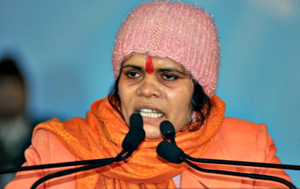
sadhvi-prachi

The committee headed by P J Kurien is examining a complaint of Opposition MPs against Prachi about her remarks made during the Monsoon Session. The panel had summoned Prachi to appear before it.

Emerging after the meeting, Prachi told reporters, "I am a daughter of the country. I won't backtrack. I am being pressurised to apologise. They (the committee members) shouted me down. I said I also have the right to speak."

Sources said that in the meeting, the panel chairman asked her to tender an apology multiple times but she kept on talking of some kind of "conditional apology" while members wanted her to tender an unconditional apology.

Sources said that Prachi, who appeared before the panel along with her lawyer, said that she was "not insulting Parliament as a institution" but stuck to her remarks that there are some terrorists in Parliament.

The matter was referred to the Committee in October last year under Rule 203 of the Rules of Procedure and Conduct of Business in the Rajya Sabha for examination, investigation and report.

Opposition leaders, including Ghulam Nabi Azad, CPI(M) leader Sitaram Yechury and TRS member K. Keshav Rao were among 20 members, who gave the privilege notice against the VHP leader, saying her remarks had “violated the dignity” of Parliament and the privilege of MPs.

Speaking at a public meeting in Roorkee, Prachi had earlier slammed those who had opposed the hanging of Yakub Memon, the 1993 Mumbai serial blasts convict.

"It is a big misfortune that in the Indian Parliament, we have one to two terrorists sitting there. I do not think there can be a bigger misfortune for India than this as they are disobeying the judegment of a court, because the court has proved that he (Yakub Memon) is a terrorist" she had said indirectly referring to the MPs who had opposed the hanging of Memon.

A bulletin of the Upper House had then said," Members are informed that Chairman, Rajya Sabha has referred a question of breach of privilege arising out of the complaint of Naresh Agrawal and other Members of Rajya Sabha pertaining to alleged derogatory remarks against Members of Parliament by Sadhvi Prachi, a leader of a religious organisation, to the Committee of Privileges."

Comments

Fair talker
 - 
Wednesday, 27 Apr 2016

This is the height of craziness.
The whole party is now fully infected and sick.
Crazies are ruling the country.
Modi is a big powerless remotely controlled puppet.

When this ship will sink, God save India.

Dawaa is the only solution at least the next generation will be rightly guided.

Add new comment

  • Coastaldigest.com reserves the right to delete or block any comments.
  • Coastaldigset.com is not responsible for its readers’ comments.
  • Comments that are abusive, incendiary or irrelevant are strictly prohibited.
  • Please use a genuine email ID and provide your name to avoid reject.
News Network
December 13,2025

New Delhi: School-going children are picking up drug and smoking habits and engaging in consumption of alcohol, with the average age of introduction to such harmful substances found to be around 13 years, suggesting a need for earlier interventions as early as primary school, a multi-city survey by AIIMS-Delhi said.

The findings also showed substance use increased in higher grades, with grade XI/XII students two times more likely to report use of substances when compared with grade VIII students. This emphasised the importance of continued prevention and intervention through middle and high school.

The study led by Dr Anju Dhawan of AIIMS's National Drug Dependence Treatment Centre, published in the National Medical Journal of India this month, looks at adolescent substance use across diverse regions.

The survey included 5,920 students from classes 8, 9, 11 and 12 in urban government, private and rural schools across 10 cities -- Bengaluru, Chandigarh, Delhi, Dibrugarh, Hyderabad, Imphal, Jammu, Lucknow, Mumbai, and Ranchi. The data were collected between May 2018 and June 2019.

The average age of initiation for any substance was 12.9 (2.8) years. It was lowest for inhalants (11.3 years) followed by heroin (12.3 years) and opioid pharmaceuticals (without prescription; 12.5 years).

Overall, 15.1 per cent of participants reported lifetime use, 10.3 per cent reported past year use, and 7.2 per cent reported use in the past month of any substance, the study found.

The most common substances used in the past year, after tobacco (4 per cent) and alcohol (3.8 per cent), were opioids (2.8 per cent), followed by cannabis (2 per cent) and inhalants (1.9 per cent). Use of non-prescribed pharmaceutical opioids was most common among opioid users (90.2 per cent).

On being asked, 'Do you think this substance is easily available for a person of your age' separately for each substance category, nearly half the students (46.3 per cent) endorsed that tobacco products and more than one-third of the students (36.5 per cent) agreed that a person of their age can easily procure alcohol products.

Similarly, for Bhang (21.9 per cent), ganja/charas (16.1 per cent), inhalants (15.2 per cent), sedatives (13.7 per cent), opium and heroin (10 per cent each), the students endorsed that these can be easily procured.

About 95 per cent of the children, irrespective of their grade, agreed with the statement that 'drug use is harmful'.

The rates of substance use (any) among boys were significantly higher than those of girls for substance use (ever), use in the past year and use in the past 30 days. Compared to grade VIII students, grade IX students were more likely, and grade XI/XII students were twice as likely to have used any substance (ever).

The likelihood of past-year use of any substance was also higher for grade IX students and for grade XI/XII students as compared to grade VIII students.

About 40 per cent of students mentioned that they had a family member who used tobacco or alcohol each. The use of cannabis (any product) and opioid (any product) by a family member was reported by 8.2 per cent and 3.9 per cent of students, respectively, while the use of other substances, such as inhalants/sedatives by family was 2-3 per cent, the study found.

A relatively smaller percentage of students reported use of tobacco or alcohol among peers as compared to among family members, while a higher percentage reported inhalants, sedatives, cannabis or opioid use among peers.

Children using substances (past year) compared to non-users reported significantly higher any substance use by their family members and peers.

There were 25.7 per cent students who replied 'yes' to the question 'conflicts/fights often occur in your family'. Most students also replied affirmatively to 'family members are aware of how their time is being spent' and 'damily members are aware of with whom they spend their time'.

Comments

Add new comment

  • Coastaldigest.com reserves the right to delete or block any comments.
  • Coastaldigset.com is not responsible for its readers’ comments.
  • Comments that are abusive, incendiary or irrelevant are strictly prohibited.
  • Please use a genuine email ID and provide your name to avoid reject.