



New Delhi, Apr 22: The Supreme Court today stayed till April 27 the judgement of the Uttarakhand High Court quashing the imposition of President's rule, giving a new turn to the continuing political drama in the state by restoring the Central rule there.
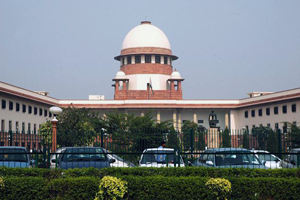
Before passing a brief order, a bench comprising Justices Dipak Misra and Shiva Kirti Singh recorded an undertaking given by Attorney General Mukul Rohatgi that the "Union of India shall not revoke the Presidential proclamation till the next date of hearing".
The apex court clarified that it was keeping in abeyance the judgement of the High Court till the next date of hearing on April 27 as a measure of balance for both the parties as the copy of the verdict was not made available to the parties.
While listing the matter for hearing on April 27, the bench said that the High Court shall provide the judgement passed yesterday to the parties by April 26 and on the same date the copy of the verdict shall also be placed before the apex court.
The Supreme Court's stay has the effect of undoing the revival of the Congress government led by Harish Rawat by the High Court judgement yesterday.
During the hearing, the bench also observed that as a matter of propriety the High Court should have signed the verdict so that it would be appropriate for it to go into the appeal.
The apex court issued notice to Harish Rawat and Chief Seceretary of the state on the petition by Centre challenging the quashing of Presidential proclamation under Article 356 of the Constitution in the state.
Appearing for the Centre, Attorney General Mukul Rohatgi, along with senior advocate Harish Salve, pressed for the stay of the HC judgement.
He said how one party can be put at advantage and assume the office of Chief Minister when the other party is pushed to disadvantage in the absence of the judgement.
Senior advocates Abhishek Manu Singhvi and Kapil Sibal, appearing for Rawat and the Assembly Speaker, argued hard against the passing of any interim order saying "you are allowing the appeal by giving the stay".
Sibal was of the view that allowing stay of operation of the High Court verdict would be like enforcing the proclamation of the President rule.
During the jam-packed hearing, the bench sought to pacify both the parties saying that it has to take a balanced view as this is a Constitutional court.
"We will take on record the copy of the judgement and go through it. This matter may go to Constitution bench," the bench said.
The high-voltage hearing at 3.30 pm started with the Attorney General attacking Rawat assuming the office as Chief Minister and chairing a cabinet meeting when the copy of the judgement passed yesterday was not made available to parties.
"How can the judgement be implemented unless you have the copy of it. It can't deny a party to file an appeal. I see on TV that the respondent (Rawat) says he has been resurrected as the Chief Minister and late in the night calls for cabinet meeting. How can you say that the government has been resurrected.
"In the absence of the copy of the judgement the other party cannot go to appeal. The idea is not that you steal a march," Rohatgi said while seeking a stay of the high court judgement quashing the imposition of President's rule in Uttarakhand and restoring the dismissed Congress government.
When the bench asked the Attorney General as to when the hearing on the appeal can take place, he said the judgement has to be signed as a signed judgement cannot be altered.
"Today we find that in the absence of the signed judgement, somebody is acting in his office which is not appropriate."
"If the judgement is subject to appeal, it cannot be allowed to be implemented. It cannot be subjected to the advantage of some and disadvantage of others," he submitted assailing the quashing of the March 27 notification on proclamation of President's rule and the granting of status quo ante by the High Court.
He said the Presidential proclamation was based on the Union Cabinet's note which has considered the apex court's S R Bommai judgement which has dealt in great length with the issue of Article 356 and the floor test.
Rohatgi referred to the March 18 incident when during the presentation and passing of the Appropriation Bill, the Rawat government was reduced to minority with nine Congress MLAs turning rebel and joining hands with 27 BJP MLAs in demanding vote by division which was not allowed by the Speaker and those 35 MLAs complained to the Governor.
"Something was brewing," he said, adding that "if the voting by division was allowed to have taken place, the Rawat government would have fallen on March 18 itself. So, if the money bill falls, the government would have fallen and the majority government would have become minority."
"The Speaker was acting in one way," the AG said, adding that the Speaker had declared the Appropriation Bill passed with a single sentence in Hindi - 'Bill paarit'.
When the bench asked about the communication of Governor to the President, he said, the Governor wrote a series of letters but he did not recommend President's rule as it was not necessary under the Constitution.
He referred to the sting operation aired on March 25 on TV allegedly showing the then Chief Minister clearly talking to some person named Sharma.
The discussions were going on for five to seven minutes which was the money talk going on and the then CM was speaking about Rs five crore, Rs 10 crore, Rs 20 crore etc, he contended.
Rohatgi said CM was allegedly seen saying he was unable to provide so much of funds. "It is nothing but horse trading," he said adding that even the Governor says that prima facie it is going on but calls for verification which was actually verified after the file went to the President.
"You have to examine the relevant materials and not the adequacy or the sufficiency of the material. Today, all these things are being taken into account," he said and further elaborated how the Appropriation Bill was in the middle which should have reached the Governor on March 19 but the Speaker kept it with himself and was aware of the fact that it was not passed.
He also criticised the High Court verdict which said that the nine rebel Congress MLAs have committed a constitutional sin without being party to the hearing. He said remarkes against them were made when their plea against the disqualification was pending before the single judge bench.
"The judgement is coloured by these remarks," he said and tried to drive the point that "a fallen government has been resurrected by the act of the Speaker." Rohatgi said March 18 was actually the day of floor test when the money bill was introduced in the house and the 35 MLAs were against it.
The AG was joined by senior advocate Harish Salve, appearing for the Centre, and another senior counsel C A Sundaram, representing the nine rebel MLAs, who submitted that there was material showing that there was some troublesome event on March 18.
While Sundaram said the High Court ignored the plea of the rebel MLAs challenging their disqualification, Salve said dismissing a government without floor test is an issue to be looked into by the Governor and not the President.
"If President takes a view that there is trouble on ground how do you say that this is abuse of power? Should not an institution come into action in such a situation?" said Salve.
The AG asked the apex court to stay the effect and implementation of the operation of the High Court judgement and also sought a direction to the HC to supply the copy of the verdict.
During the hearing, the bench said, "We make it clear what happens inside the Assembly, we would not go into it. We have to examine the grounds on which the Presidential proclamation was made. Whether it was right or not and based on the Bommai judgement."
"The whole issue is the interference by this court in exercise of judicial review pertaining to the justiciability of proclamation by the President is a serious matter. It has to be debated. Till it is debated, what arrangement can be made," the bench said.
Further, the bench told Sibal that since he was representing the Speaker, he has to speak by maintaining neutrality.
Singhvi, appearing for Rawat, said the challenge to the imposition of President's rule succeeded on the grounds that included it was against the tenets of the Bommai and Rameshwar Prasad Chaurasiya judgement.
While he was making the submission, the bench said, "Nobody has seen the judgement which was pronounced yesterday. Do you have a copy of the judgement?"
Singhvi said the judgement was pronounced in the open court and the pronouncement was by giving reasons and once the judgement is pronounced, it becomes a law. However, the bench said it wanted to know the contents of the judgement.
"The issue is what possible interim arrangement can be made till we get the copy of the judgement," the bench said even as Singhvi continued to counter the submission made by the Centre making the Speaker responsible for the March 18 incident.
Singhvi said Speaker is the master of the house and even if the 27 BJP MLAs wanted vote by division he had the right to say no. The fact that the nine rebel MLAs joined them clearly shows that "horse trading" was going on before the floor test.
At this point, the AG interrupted him and said "Does he (Rawat) deny he was not on TV speaking of money?"
Singhvi, who was opposing Centre's plea for stay of the High Court verdict, said "Between now and April 29 (the day of floor test) nothing is going to happen."
He said how can in the interim the CM, who has been restored by the High Court, not function.
The AG said it is for the Governor to function. Singhvi said that the BJP government at the Centre wants its man to be the Chief Minister.
However, the bench said, "there has to be a balance between both the sides."
It said it was slightly concerned about Article 356 which is a serious matter.
"We are not going to comment on the merits of the verdict. What is happening is a serious and grievous matter for any state," the bench said, adding "You don't revoke President's rule just like that. You should have called for files." Singhvi said files were examined by the High Court.
However, the bench interrupted him by saying "try to understand. Suppose horse trading is going on, does it not create a dent in democracy?"Sibal said does nine members of the Congress becoming rebels not amount to horse trading. The bench said that is horse trading.
Sibal said since the High Court refused to stay the disqualification of the nine rebel MLAs, the President's rule was imposed. "They (Centre) wanted to have a BJP government.




Comments
Add new comment