



SC verdict on adultery welcomed by lawyers, activists

Agencies
September 27, 2018

New Delhi, Sept 27: The Supreme Court verdict on Thursday declaring that adultery is not a crime was welcomed by several people who said it was a good riddance to an antiquated law, though some experts raised concerns over the judgement.

A five-judge Constitution bench headed by Chief Justice Dipak Misra was unanimous in striking down Section 497 of the Indian Penal Code dealing with the offence of adultery, holding it manifestly arbitrary, archaic and violative of the rights to equality and equal opportunity to women.

BJP spokesperson Nalin Kohli said that every judgement of the SC has to be welcomed because it becomes the law "which we all have to subscribe to.

"We have to look at judgements of the Supreme Court with regards to fundamental rights, whether it is equality of either men or women or everyone before the law or it is about right to privacy or it is about freedom of speech and expression.

"It has to been seen in context of this evolution. This judgement is a step in that direction. Every judgement of the SC has to be welcomed because it becomes the law which we all have to subscribe to," he said.

All India Majlis-E-Ittehadul Muslimeen president Asaduddin Owaisi raked up the issue of triple talaq, saying the Supreme Court decriminalised sections 377 and 497, but it had just "set aside" the practice of instant divorce among Muslims, and the government made it a penal offence through an ordinance.

"The Supreme Court didn't say Triple Talaaq is Unconstitutional but "set it aside "but Apex Court has said 377 & 497 is Unconstitutional will Modi Government learn from these judgments and take back their Unconstitutional Ordinance on Triple Talaaq (sic)," he tweeted.

Reacting to the judgement, social activist Brinda Adige asked if the judgement allows polygamy too? "Because we know that men very often marry two-three times and there is so much of problem when the first, second or third wife are abandoned."

"If adultery is not a crime, how is this women even going to file a case against the husband who might desert or abandon her. It's a concern," she said.

Congress leader Renuka Choudhary also sought more clarity on the issue.

"This is like criminalising the triple talaq law. They have done that but now the men will just abandon us or not give us talaq. They will have polygamy or nikah hallala which creates hell for us as women. I am glad its not a crime anymore but I do not see how it helps. The court should see across the board and give us a clarity," she said.

Other activists and lawyers hailed the judgement.

Senior Supreme Court lawyer Prashant Bhushan termed the verdict a fine judgement.

"Another fine judgement by the SC striking down the antiquated law in Sec 497 of Penal code, which treats women as property of husbands & criminalises adultery (only of man who sleeps with someone's wife). Adultery can be ground for divorce but not criminal," Bhushan said on Twitter.

Congress MP and president of women's wing of the party Sushmita Dev agreed with him.

"Excellent decision to de-criminalise adultery. Also a law that does not give women the right to sue her adulterer husband & can’t be herself sued if she is in adultery is unequal treatment & militates against her status as an individual separate entity," she tweeted.

Her party colleague Priyanka Chaturvedi lauded the verdict, saying there are some laws that need to be changed, modified or removed with time.

"It was a 150-year-old law which does not have a place in new India but at the same time we also want to note that adultery is not normal and can be a ground for divorce which in my opinion is a very fair judgement keeping in mind the country we live in and the century we are living in," she said.

Kavita Krishnan, Secretary, All India Progressive Women's Association (AIPWA) and a CPI(ML) Polit Bureau member said decriminalising adultery is welcome and was long overdue.

"Adultery is now grounds for divorce not crime. The law criminalising men for relations with some other man's wife was patriarchal, assumes wife is husband's property and has no autonomy. Good riddance #AdulteryVerdict," she tweeted.

National Commission for Women chief Rekha Sharma, too, welcomed the judgement and said it should have been removed long time ago.

"This is a law from the British era, although British had done away with it long back, we were still stuck with it," she said.

According to social activist Ranjana Kumari, "patriarchal control" over women was unacceptable. "We welcome the judgement by the SC striking down the 158yr old law based on Victorian values, in Sec 497 of Penal code, which treats women as property of husbands & criminalises adultery. Patriarchal control over women's body unacceptable," she tweeted.

The Supreme Court bench held that while adultery should not be a criminal offence it would continue to be treated as civil wrong, and can be ground for dissolution of marriage.

There can't be any social licence which destroys a home, Chief Justice Dipak Misra said.

Section 497 of the 158-year-old IPC says: "Whoever has sexual intercourse with a person who is and whom he knows or has reason to believe to be the wife of another man, without the consent or connivance of that man, such sexual intercourse not amounting to the offence of rape, is guilty of the offence of adultery."

Comments

Add new comment

  • Coastaldigest.com reserves the right to delete or block any comments.
  • Coastaldigset.com is not responsible for its readers’ comments.
  • Comments that are abusive, incendiary or irrelevant are strictly prohibited.
  • Please use a genuine email ID and provide your name to avoid reject.
News Network
December 16,2025

Mangaluru, Dec 16: The Mangaluru City police have significantly escalated their campaign against drug trafficking, arresting 25 individuals and booking 12 cases under the Narcotic Drugs and Psychotropic Substances (NDPS) Act between November 30 and December 13. The crackdown resulted in the seizure of a substantial quantity of illicit substances, including 685.6 grams of MDMA and 1.5 kg of ganja.

The success of this recent drive has been significantly boosted by the city’s innovative, QR code-based anonymous reporting system.

"The anonymous reporting system has received an encouraging response. Several recent arrests were made based on inputs received through this system, helping police tighten the noose around drug peddlers," said the City Police Commissioner.

The latest arrests contribute to a robust year-to-date record, underscoring the police's relentless commitment to combating the drug menace.

Up to December 14 this year, the police have registered a total of 107 cases of drug peddling, leading to the arrest of 219 peddlers. Furthermore, they have booked 562 cases of drug consumption, resulting in the arrest of 671 individuals.

The scale of the seizure for the year reflects the magnitude of the problem being tackled: police have seized 320.6 kg of ganja worth ₹88.7 lakh and 1.4 kg of MDMA valued at ₹1.2 crore. Other significant seizures include hydro-weed ganja worth ₹94.7 lakh and cocaine worth ₹1.9 lakh, among others.

The Commissioner emphasized a policy of rigorous enforcement: "We ensure that peddlers are caught red-handed so that they cannot later dispute the case or claim innocence."

To counter the rising trend of substance abuse among youth, the Mangaluru City police have rolled out uniform guidelines for random drug testing across educational institutions.

As part of the drive, tests were conducted in approximately 100 institutions, screening an estimated 5,500 to 6,000 students in the first phase. 20 students tested positive for drug consumption during the initial screening.

Students who tested positive have been provided counselling and are scheduled for re-testing in the second quarter. The testing will also be expanded to students not covered in the first phase. In a move to ensure strict implementation, police personnel were deployed in mufti in some institutions. Reiterating a zero-tolerance stance, the Commissioner confirmed that random testing will continue, and colleges have also been instructed to conduct drug tests at the time of admission to deter substance abuse from an early stage.

Comments

Add new comment

  • Coastaldigest.com reserves the right to delete or block any comments.
  • Coastaldigset.com is not responsible for its readers’ comments.
  • Comments that are abusive, incendiary or irrelevant are strictly prohibited.
  • Please use a genuine email ID and provide your name to avoid reject.
News Network
December 13,2025

New Delhi: School-going children are picking up drug and smoking habits and engaging in consumption of alcohol, with the average age of introduction to such harmful substances found to be around 13 years, suggesting a need for earlier interventions as early as primary school, a multi-city survey by AIIMS-Delhi said.

The findings also showed substance use increased in higher grades, with grade XI/XII students two times more likely to report use of substances when compared with grade VIII students. This emphasised the importance of continued prevention and intervention through middle and high school.

The study led by Dr Anju Dhawan of AIIMS's National Drug Dependence Treatment Centre, published in the National Medical Journal of India this month, looks at adolescent substance use across diverse regions.

The survey included 5,920 students from classes 8, 9, 11 and 12 in urban government, private and rural schools across 10 cities -- Bengaluru, Chandigarh, Delhi, Dibrugarh, Hyderabad, Imphal, Jammu, Lucknow, Mumbai, and Ranchi. The data were collected between May 2018 and June 2019.

The average age of initiation for any substance was 12.9 (2.8) years. It was lowest for inhalants (11.3 years) followed by heroin (12.3 years) and opioid pharmaceuticals (without prescription; 12.5 years).

Overall, 15.1 per cent of participants reported lifetime use, 10.3 per cent reported past year use, and 7.2 per cent reported use in the past month of any substance, the study found.

The most common substances used in the past year, after tobacco (4 per cent) and alcohol (3.8 per cent), were opioids (2.8 per cent), followed by cannabis (2 per cent) and inhalants (1.9 per cent). Use of non-prescribed pharmaceutical opioids was most common among opioid users (90.2 per cent).

On being asked, 'Do you think this substance is easily available for a person of your age' separately for each substance category, nearly half the students (46.3 per cent) endorsed that tobacco products and more than one-third of the students (36.5 per cent) agreed that a person of their age can easily procure alcohol products.

Similarly, for Bhang (21.9 per cent), ganja/charas (16.1 per cent), inhalants (15.2 per cent), sedatives (13.7 per cent), opium and heroin (10 per cent each), the students endorsed that these can be easily procured.

About 95 per cent of the children, irrespective of their grade, agreed with the statement that 'drug use is harmful'.

The rates of substance use (any) among boys were significantly higher than those of girls for substance use (ever), use in the past year and use in the past 30 days. Compared to grade VIII students, grade IX students were more likely, and grade XI/XII students were twice as likely to have used any substance (ever).

The likelihood of past-year use of any substance was also higher for grade IX students and for grade XI/XII students as compared to grade VIII students.

About 40 per cent of students mentioned that they had a family member who used tobacco or alcohol each. The use of cannabis (any product) and opioid (any product) by a family member was reported by 8.2 per cent and 3.9 per cent of students, respectively, while the use of other substances, such as inhalants/sedatives by family was 2-3 per cent, the study found.

A relatively smaller percentage of students reported use of tobacco or alcohol among peers as compared to among family members, while a higher percentage reported inhalants, sedatives, cannabis or opioid use among peers.

Children using substances (past year) compared to non-users reported significantly higher any substance use by their family members and peers.

There were 25.7 per cent students who replied 'yes' to the question 'conflicts/fights often occur in your family'. Most students also replied affirmatively to 'family members are aware of how their time is being spent' and 'damily members are aware of with whom they spend their time'.

Comments

Add new comment

  • Coastaldigest.com reserves the right to delete or block any comments.
  • Coastaldigset.com is not responsible for its readers’ comments.
  • Comments that are abusive, incendiary or irrelevant are strictly prohibited.
  • Please use a genuine email ID and provide your name to avoid reject.
News Network
December 22,2025

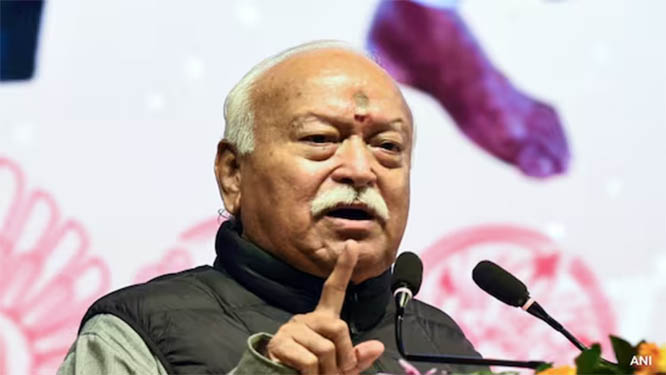
bhagavat.jpg

Kolkata: Stressing that India is a "Hindu nation," Rashtriya Swayamsevak Sangh (RSS) Chief Mohan Bhagwat on Sunday said that no constitutional approval is needed as it is the "truth".

Addressing an event marking 100 years of the RSS, Bhagwat said that India is, and will remain, a Hindu nation until Indian culture is appreciated in the country.

"The Sun rises in the east; we don't know since when this has been happening. So, do we need constitutional approval for that, too? Hindustan is a Hindu nation. Whoever considers India their motherland appreciates Indian culture, as long as there is even one person alive on the land of Hindustan who believes in and cherishes the glory of Indian ancestors, India is a Hindu nation. This is the ideology of the Sangh," he said at the '100 Vyakhyan Mala' program of RSS in Kolkata.

"If Parliament ever decides to amend the Constitution and add that word, whether they do it or not, it's fine. We don't care about that word because we are Hindus, and our nation is a Hindu nation. That is the truth. The caste system based on birth is not the hallmark of Hindutva," he added.

RSS has always argued that India is a "Hindu Nation," given the culture and majority's affiliations to Hinduism. However, 'secular' was not originally part of the Preamble of the Constitution, but it was added along with the word 'socialist' by the Constitution (42nd Amendment) Act, 1976, during the Emergency imposed by then Prime Minister Indira Gandhi.

Bhagwat also urged people to visit the organisation's offices and 'shakhas' to understand its work, so that what he dubbed as the “false perception” of the organisation as anti-Muslim can be dispelled!

Bhagwat said that people have understood that the organisation advocates for the protection of Hindus, and are "staunch nationalists," but not anti-muslim.

"If there is a perception that we are anti-Muslim, then, as I said, the RSS work is transparent. You can come anytime and see for yourself, and if you see anything like that happening, then you keep your views, and if you don't see it, then you change your views. There is a lot to understand (about RSS), but if you don't want to understand, then no one can change your mind," Bhagwat said.

He said, but anyone unwilling to learn cannot be helped.

"After seeing, people have said that you are staunch nationalists. You organise Hindus, and you advocate for the protection of Hindus. But you are not anti-Muslim. Many people have accepted this, and those who want to know more should come and see the RSS for themselves," he said.

Comments

Add new comment

  • Coastaldigest.com reserves the right to delete or block any comments.
  • Coastaldigset.com is not responsible for its readers’ comments.
  • Comments that are abusive, incendiary or irrelevant are strictly prohibited.
  • Please use a genuine email ID and provide your name to avoid reject.