This septuagenarian 'Green-Revolutionary' leads way with sustainable model farming

Anusha N Bhat | coastaldigest.com
February 2, 2019

At 73-years of age, Mahalinga Naik breaks into a smile, when residents of Amai village at Bantwal taluk point towards him as the local 'Green-Revolutionary'. For a man who never received formal education, Naik has been solely credited for creating a sustainable eco-friendly farmland, which once was barren land and could not even bear a sapling.

At a hillock farmland in Adyanadka, approximately 52 kilometre from the Mangalore city, a two-acre land boasts of 200 banana trees, 300 areca nut trees, 75 coconut palm trees, along with different types of cocoa, pepper vines. The layout of the farmland is not only systematic but does not leave any loose end for wastage. "From mini-irrigational system, conservation of water, to harvesting organic manure, the farmland is equipped to look into each aspect of traditional farm land," says famed Editor of Adike Patrike Shree Padre.

While today the agricultural revolution at Adyanadka has awed several agriculturists, in fact it has even fetched Mahalinga Naik with awards including ‘Krushi Panditha’ conferred by the Karnataka government in 2010. Recently, he was honoured with ‘Mangalore Press Club Award 2018’. Shree Padre has also released a small booklet on Naik by the title ‘Guddada Melina Ekvyakti Sainya’.

It was about forty years ago, when Naik was just another sharecropper at a land owned by one Mahabala Bhat. Earning a daily wage between Rs 1.50 to Rs 5, Naik managed his household. However, pleased with his dedication for the farmland, in 1979, Bhat gave Naik a two-acre land from his property.

“I was overjoyed with emotions, and swiftly was able to build a humble hut for my family. But the land had no water source for cultivation, we had to walk for about a kilometre for it and the effort was futile. I realised that to take care of my farmland and feed my family, I had to do something,” he says.

For the need of drawing water, Naik eventually decided to carve a ‘Suranga’ (tunnel) to naturally draw water for his cultivation. However, given his financial condition, Naik says he was unable to hire labourers, therefore he decided to use his part time from agriculture to dig the Suranga.

Each day, Naik would return from cultivation and then religiously start digging ‘Suranga’ to find the source of water. “My search for water was more instinctive than scientific. I started digging at places approximately about 100 feet each, where I thought I could find water, but was repeatedly disappointed,” he says.

In the pursuit for water, Naik says he has been mocked and even called names by locals for wasting his time. “I didn’t mind being called names, but I continued my effort for about 6-7 hours, day or night. At times I had to either crawl or squeeze myself between tiny spaces to get through these tunnels and excavate soil. My wife would not be happy, when she would come searching late at night,” he says.

For close to five-years, Naik failed in his endeavour. “Except rainy season, I never gave up on the excavation work. But by then, I had dug about four tunnels and not coming face to face with water was a bit unsettling,” he says.

It was only when Naik struck the sixth Suranga, in a bit further location that Naik felt some wetness in soil, which was an indication for the presence of water in the area.

With the new found development, Naik’s optimism had no bounds, he immediately went further to a higher topography and aggressively dug to find water and he did.  “It made me confident to probe further and I dug another one for domestic consumption,” he says.

To boost the texture and moisture of the soil, Naik also created small ponds across several places in the farmland which would capture rainwater, which Naik had learnt in an agriculture workshop. Naik even placed close to over 5,000 laterite stones to build retaining walls and prevent soil erosion.

Slowly the efforts paid-off, the same land which earlier harboured fragmented grass patches, eventually saw the growth of banana, cocoa, pepper vines, coconuts and areca-nuts. Besides, the farmland also hosts eight to ten honeycombs, alongside a vegetable garden where he grows ladies finger, cucumber, brinjal and so on.

Naik’s farm has become a must see model-farmland and has over 500 visitors a year. “When people visit, I feel very happy,” says Naik.

Sticking to his principle of Hasige Iddastu Kaalu Chachu (Being content with what one has), Naik says he would use only one acre of land for cultivation. “In another, I have built a house and want the same land to grow as natural forest so that future generation can benefit from it. If my experience can help others learn to make profit out of farming, then that would make me content,” he says.


Comments

Ann Pinto
 - 
Thursday, 9 May 2019

Wonderful....for sharing your story on how it’s possible to revive water and increase the water table and make a living too..

SD
 - 
Monday, 4 Feb 2019

Well done, Mr. Naik! Very happy that all your hard work paid off.

Add new comment

  • Coastaldigest.com reserves the right to delete or block any comments.
  • Coastaldigset.com is not responsible for its readers’ comments.
  • Comments that are abusive, incendiary or irrelevant are strictly prohibited.
  • Please use a genuine email ID and provide your name to avoid reject.
News Network
November 21,2025

Bengaluru, Nov 21: The Karnataka government is facing pressure to overhaul its employment system after a high-level Cabinet sub-committee recommended the complete phase-out of job outsourcing in government offices, boards, and corporations by March 2028. The move is aimed at tackling a systemic issue that has led to the potential violation of constitutional reservation policies and the exploitation of workers.

The Call for Systemic Change

With over three lakh vacant posts currently being filled through private agencies on an outsource, insource, or daily wage basis, the sub-committee highlighted a significant lapse. "As a result, reservations are not being followed as per the Constitution and state laws. It’s an urgent need to take serious steps to change the system. It has been recommended to completely stop the system of outsourcing by March 2028," the panel stated in a document.

The practice of outsourcing involves private companies hiring workers to perform duties for a government agency. Critics argue this model results in lesser salaries, a lack of social security benefits (otherwise available to permanent government employees), and a failure to adhere to the provisions of Articles 14 and 15 of the Constitution, which guarantee equality before the law and prohibit discrimination.

The 'Bidar Model' as a Stop-Gap Solution

To regulate the current mode of employment and reduce worker exploitation until the 2028 deadline, the government plans to establish workers’ services multi-purpose cooperative societies across all districts, following the successful "Bidar Model."

The Bidar District Services of Labour Multi-purpose Cooperative Society Ltd., which operates under the District Commissioner, is cited as a successful example of providing a measure of social security to outsourced staff. Labour Department officials argue this society ensures workers receive their due wages and statutory facilities like ESI (Employees' State Insurance) and PF (Provident Fund), in exchange for a 1% service fee collected from the employees.

legislative push and Priority Insourcing

The recommendations, led by the sub-committee headed by Law and Parliamentary Affairs Minister H K Patil, are set to be discussed at the next Cabinet meeting. The committee has proposed the introduction of the Karnataka Outsourced Employees (Regulation, Placement and Welfare) Bill 2025.

In a move addressing immediate concerns, Labour Minister Santosh Lad, a member of the sub-committee, has reportedly assured that steps will be taken over the next 2-3 years to insource workers in "life-threatening services" on a priority basis. This includes essential personnel like pourakarmikas (sanitation workers), drivers, electrical staff in the Energy Department, and Health Department staff handling contagious diseases. The transition aims to grant these workers the long-term security and benefits they currently lack under the outsourcing system. 

Comments

Add new comment

  • Coastaldigest.com reserves the right to delete or block any comments.
  • Coastaldigset.com is not responsible for its readers’ comments.
  • Comments that are abusive, incendiary or irrelevant are strictly prohibited.
  • Please use a genuine email ID and provide your name to avoid reject.
News Network
November 27,2025

siddDKS.jpg

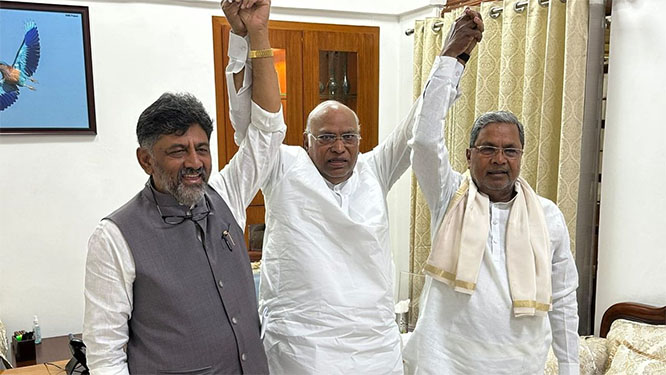
Congress president Mallikarjun Kharge on Thursday announced that he will convene a high-level meeting in New Delhi with senior leaders — including Rahul Gandhi, Karnataka Chief Minister Siddaramaiah and Deputy Chief Minister D.K. Shivakumar — to resolve the escalating leadership turmoil in Karnataka and “put an end to the confusion.”

Kharge said the discussions would focus on the way forward for the ruling party, as rumours of a possible leadership change continue to swirl. The speculation has intensified after the Congress government crossed the halfway mark of its five-year term on November 20, reviving talk of an alleged 2023 “power-sharing agreement” between Siddaramaiah and Shivakumar.

“After reaching Delhi, I will call three or four important leaders and hold discussions. Once we talk, we will decide how to move ahead and end this confusion,” Kharge told reporters in Bengaluru, according to PTI.

When asked specifically about calling Siddaramaiah and Shivakumar to Delhi, he responded: “Certainly, we should call them. We will discuss with them and settle the issue.”

He confirmed that Rahul Gandhi, the Chief Minister, the Deputy Chief Minister and other senior members would be part of the deliberations. “After discussing with everyone, a decision will be made,” he said.

Meanwhile, Siddaramaiah held a separate strategy meeting at his Bengaluru residence with ministers and leaders seen as his close confidants, including G. Parameshwara, Satish Jarkiholi, H.C. Mahadevappa, K. Venkatesh and K.N. Rajanna.
Signalling calm, the Chief Minister told reporters, “Will go to Delhi if the high command calls.”

Shivakumar echoed a similar stance, saying he too would head to the national capital if summoned by the party leadership.

Comments

Add new comment

  • Coastaldigest.com reserves the right to delete or block any comments.
  • Coastaldigset.com is not responsible for its readers’ comments.
  • Comments that are abusive, incendiary or irrelevant are strictly prohibited.
  • Please use a genuine email ID and provide your name to avoid reject.
News Network
December 3,2025

arrival.jpg

Mangaluru, Dec 3: A group of Congress workers gathered at the Mangaluru International Airport on Wednesday to welcome AICC general secretary K C Venugopal, but the reception quickly turned into a display of support for Deputy Chief Minister D K Shivakumar.

Venugopal arrived in the city to participate in the centenary commemoration of the historic dialogue between Mahatma Gandhi and Narayana Guru. The event, organised by the Sivagiri Mutt, Varkala, in association with the Mangalore University Sri Narayana Guru Study Chair, is being held on the university’s Konaje campus.

KPCC general secretary Mithun Rai and several party workers had assembled at the airport to receive Venugopal. However, the moment he stepped out, workers began raising slogans backing Shivakumar.

The university programme will be inaugurated by Chief Minister Siddaramaiah.

This show of support comes just a day after Siddaramaiah remarked that Shivakumar would lead the government “when the high command decides.” The chief minister made the comment after a breakfast meeting at Shivakumar’s residence—another public display of camaraderie between the two leaders amid ongoing attempts by the party high command to downplay their leadership rivalry.

Comments

Add new comment

  • Coastaldigest.com reserves the right to delete or block any comments.
  • Coastaldigset.com is not responsible for its readers’ comments.
  • Comments that are abusive, incendiary or irrelevant are strictly prohibited.
  • Please use a genuine email ID and provide your name to avoid reject.