



Shiv Sena-BJP set to kiss and make up by Monday: Fadnavis on course to be CM

October 25, 2014

Mumbai, Oct 25: After all the shadow-boxing and public posturing, the BJP appears to have succeeded in getting the Shiv Sena exactly where it wants it: as part of the Maharashtra government, but without undue clout.
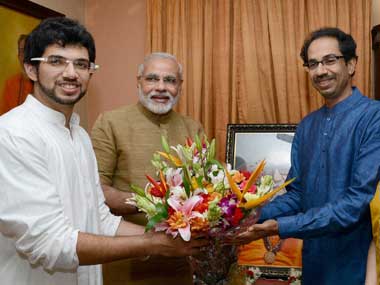
Modi-Uddhav-Aditya
Soon after the assembly results made the BJP the single largest party with 122 seats — 22 short of the half-way mark — the Sena had started playing hard-to-get, but its game went awry when the Nationalist Congress Party (NCP) announced unilateral support for the BJP. This enabled the latter to announce that it will form the government, with or without the Sena.

With a huge stake in the Brihanmumbai Municipal Corporation (where it is in alliance with the BJP), and at the Centre (where the Sena has a cabinet minister and expects more berths in the next reshuffle), the Sena saw the writing on the wall and decided that discretion is the better part of valour. It appears to have given up its old insistence of a 50:50 split of state ministries, and has accepted the reality that the BJP is now big brother.

The upshot: instead of a minority government, Maharashtra will now have a stable BJP-Sena coalition with 186 seats between them in a 288-member assembly. Add another 14-15 members from the smaller parties and independents, and the coalition could have nearly 200 members in its tally.

The final shape of the power-sharing arrangement and the coalition will be visible on Monday, when Union Home Minister Rajnath Singh and BJP general secretary JP Nadda arrive in Mumbai to kick off the process of government formation. They will hold consultations with the newly-elected legislators and elect Devendra Fadnavis, state BJP President, as leader of the legislature party.

Once this is done, Governor Vidyasagar Rao will invite Fadnavis to form the government. It appeared as if Nitin Gadkari, the Union Surface Transport and Rural Development Minister, had also thrown his hat in the ring when some Vidarbha MLAs lobbied for him as CM. But Gadkari said he was not keen to return to Maharashtra politics, which means the leadership issue is now settled in favour of Fadnavis. Both Fadnavis and Gadkari are from Vidarbha.

As part of the thaw in the Sena-BJP relationship, there are indications that all Shiv Sena MPs, 18 from the Lok Sabha and three from the Rajya Sabha, will attend a Diwali Milan dinner hosted by Prime Minister Narendra Modi for NDA MPs this Sunday (26 October). If all goes well, it would signal that ties between BJP and Sena have been mended, or at least have not broken down.

Sources told Firstpost that backroom talks over the last two days, held at various levels, helped Sena chief Uddhav Thackeray dilute his position on the Maharashtra power-sharing arrangement. He is now said to be inclined to accept the revised terms and conditions. The sources said that “he could not have been an equal partner in the Maharastra government but only an ally where mutual respect and coalition dharma is maintained by both sides.”

BJP sources said the party considers the Sena its “natural ally” and this means it should not unnecessarily criticise Prime Minister Narendra Modi or create tensions in the next state government. The BJP now expects greater circumspection in what the Sena mouthpiece, Saamna, writes. The current bout of pre-election tensions was triggered by negative write-ups in Saamna.

The BJP, by taking its time to offer an olive branch to the Sena, has forced the latter to take a more realistic view of the ground situation in the state. For its part, despite the bravado of setting up a minority government in Maharashtra, the BJP’s top leadership recognised that this can never result in stability. Hence the move make up with the Sena.

Despite claiming that it had not rejected the NCP’s offer of support, the party leadership was clear that taking this support would be politically too costly. The party was not so worried about what the NCP could demand in return, but was wary of the negative public perceptions it would have generated, especially for Modi, who called NCP a “naturally corrupt party” during the election campaign.

By the time Rajnath Singh lands in Mumbai on Monday, the alliance issue would, thus, in all likelihood have been clinched.


Comments

Add new comment

  • Coastaldigest.com reserves the right to delete or block any comments.
  • Coastaldigset.com is not responsible for its readers’ comments.
  • Comments that are abusive, incendiary or irrelevant are strictly prohibited.
  • Please use a genuine email ID and provide your name to avoid reject.
News Network
December 13,2025

New Delhi: School-going children are picking up drug and smoking habits and engaging in consumption of alcohol, with the average age of introduction to such harmful substances found to be around 13 years, suggesting a need for earlier interventions as early as primary school, a multi-city survey by AIIMS-Delhi said.

The findings also showed substance use increased in higher grades, with grade XI/XII students two times more likely to report use of substances when compared with grade VIII students. This emphasised the importance of continued prevention and intervention through middle and high school.

The study led by Dr Anju Dhawan of AIIMS's National Drug Dependence Treatment Centre, published in the National Medical Journal of India this month, looks at adolescent substance use across diverse regions.

The survey included 5,920 students from classes 8, 9, 11 and 12 in urban government, private and rural schools across 10 cities -- Bengaluru, Chandigarh, Delhi, Dibrugarh, Hyderabad, Imphal, Jammu, Lucknow, Mumbai, and Ranchi. The data were collected between May 2018 and June 2019.

The average age of initiation for any substance was 12.9 (2.8) years. It was lowest for inhalants (11.3 years) followed by heroin (12.3 years) and opioid pharmaceuticals (without prescription; 12.5 years).

Overall, 15.1 per cent of participants reported lifetime use, 10.3 per cent reported past year use, and 7.2 per cent reported use in the past month of any substance, the study found.

The most common substances used in the past year, after tobacco (4 per cent) and alcohol (3.8 per cent), were opioids (2.8 per cent), followed by cannabis (2 per cent) and inhalants (1.9 per cent). Use of non-prescribed pharmaceutical opioids was most common among opioid users (90.2 per cent).

On being asked, 'Do you think this substance is easily available for a person of your age' separately for each substance category, nearly half the students (46.3 per cent) endorsed that tobacco products and more than one-third of the students (36.5 per cent) agreed that a person of their age can easily procure alcohol products.

Similarly, for Bhang (21.9 per cent), ganja/charas (16.1 per cent), inhalants (15.2 per cent), sedatives (13.7 per cent), opium and heroin (10 per cent each), the students endorsed that these can be easily procured.

About 95 per cent of the children, irrespective of their grade, agreed with the statement that 'drug use is harmful'.

The rates of substance use (any) among boys were significantly higher than those of girls for substance use (ever), use in the past year and use in the past 30 days. Compared to grade VIII students, grade IX students were more likely, and grade XI/XII students were twice as likely to have used any substance (ever).

The likelihood of past-year use of any substance was also higher for grade IX students and for grade XI/XII students as compared to grade VIII students.

About 40 per cent of students mentioned that they had a family member who used tobacco or alcohol each. The use of cannabis (any product) and opioid (any product) by a family member was reported by 8.2 per cent and 3.9 per cent of students, respectively, while the use of other substances, such as inhalants/sedatives by family was 2-3 per cent, the study found.

A relatively smaller percentage of students reported use of tobacco or alcohol among peers as compared to among family members, while a higher percentage reported inhalants, sedatives, cannabis or opioid use among peers.

Children using substances (past year) compared to non-users reported significantly higher any substance use by their family members and peers.

There were 25.7 per cent students who replied 'yes' to the question 'conflicts/fights often occur in your family'. Most students also replied affirmatively to 'family members are aware of how their time is being spent' and 'damily members are aware of with whom they spend their time'.

Comments

Add new comment

  • Coastaldigest.com reserves the right to delete or block any comments.
  • Coastaldigset.com is not responsible for its readers’ comments.
  • Comments that are abusive, incendiary or irrelevant are strictly prohibited.
  • Please use a genuine email ID and provide your name to avoid reject.
News Network
December 16,2025

jordan.jpg

Prime Minister Narendra Modi on Monday held talks with Jordan’s King Abdullah II in Amman, during which the two leaders discussed ways to further strengthen bilateral relations, with the Prime Minister outlining an eight-point vision covering key areas of cooperation.

Describing the meeting as “productive”, PM Modi said he shared a roadmap focused on trade and economy, fertilisers and agriculture, information technology, healthcare, infrastructure, critical and strategic minerals, civil nuclear cooperation, and people-to-people ties.

In a post on social media platform X, the Prime Minister praised King Abdullah II’s personal commitment to advancing India–Jordan relations, particularly as both countries mark the 75th anniversary of the establishment of diplomatic ties this year.

“Held productive discussions with His Majesty King Abdullah II in Amman. His personal commitment towards vibrant India-Jordan relations is noteworthy. This year, we are celebrating the 75th anniversary of our bilateral diplomatic relations,” PM Modi said.

The meeting took place at the Al Husseiniya Palace, where the two leaders also exchanged views on regional and global issues of mutual interest. According to the Ministry of External Affairs (MEA), both sides agreed to further deepen cooperation in areas including trade and investment, defence and security, counter-terrorism and de-radicalisation, fertilisers and agriculture, infrastructure, renewable energy, tourism, and heritage.

The MEA said both leaders reaffirmed their united stand against terrorism.

PM Modi arrived in Amman earlier on Monday and was received by Jordanian Prime Minister Jafar Hassan, who accorded him a formal welcome. Following the talks, King Abdullah II hosted a banquet dinner in honour of the Prime Minister, reflecting the warmth of bilateral ties.

Jordan is the first leg of PM Modi’s three-nation tour. From Amman, the Prime Minister will travel to Ethiopia at the invitation of Prime Minister Abiy Ahmed Ali, marking his first official visit to the African nation. The tour will conclude with a visit to Oman.

Comments

Add new comment

  • Coastaldigest.com reserves the right to delete or block any comments.
  • Coastaldigset.com is not responsible for its readers’ comments.
  • Comments that are abusive, incendiary or irrelevant are strictly prohibited.
  • Please use a genuine email ID and provide your name to avoid reject.