Thousands of expatriate workers evicted in Qatar's capital ahead of World Cup

News Network
October 29, 2022

Doha.jpg

Doha, Oct 29: Qatar has emptied apartment blocks housing thousands of foreign workers in the centre of the capital Doha where visiting soccer fans will stay during the World Cup, workers who were evicted from their homes told Reuters.

They said more than a dozen buildings had been evacuated and shut down by authorities, forcing the mainly Asian and African workers to seek what shelter they could - including bedding down on the pavement outside one of their former homes.

The move comes less than four weeks before the Nov. 20 start of the global soccer tournament which has drawn intense international scrutiny of Qatar's treatment of foreign workers and its restrictive social laws.

At one building which residents said housed 1,200 people in Doha's Al Mansoura district, authorities told people at about 8 pm on Wednesday they had just two hours to leave.

Municipal officials returned around 10.30 pm, forced everyone out and locked the doors to the building, they said. Some men had not been able to return in time to collect their belongings.

"We don't have anywhere to go," one man told Reuters the next day as he prepared to sleep out for a second night with around 10 other men, some of them shirtless in the autumn heat and humidity of the Gulf Arab state.

He, and most other workers who spoke to Reuters, declined to give their names or personal details for fear of reprisals from the authorities or employers.

Nearby, five men were loading a mattress and a small fridge into the back of a pickup truck. They said they had found a room in Sumaysimah, about 40 km (25 miles) north of Doha.

A Qatari government official said the evictions are unrelated to the World Cup and were designed "in line with ongoing comprehensive and long-term plans to re-organise areas of Doha."

"All have since been rehoused in safe and appropriate accommodation," the official said, adding that requests to vacate "would have been conducted with proper notice."

World soccer's governing body FIFA did not respond to a request for comment and Qatar's World Cup organisers directed inquiries to the government.

"Deliberate ghetto-isation"

Around 85% of Qatar's three million population are foreign workers. Many of those evicted work as drivers, day labourers or have contracts with companies but are responsible for their own accommodation - unlike those working for major construction firms who live in camps housing tens of thousands of people.

One worker said the evictions targeted single men, while foreign workers with families were unaffected.

A Reuters reporter saw more than a dozen buildings where residents said people had been evicted. Some buildings had their electricity switched off.

Most were in neighbourhoods where the government has rented buildings for World Cup fan accommodation. The organisers' website lists buildings in Al Mansoura and other districts where flats are advertised for between $240 and $426 per night.

The Qatari official said municipal authorities have been enforcing a 2010 Qatari law which prohibits "workers' camps within family residential areas" - a designation encompassing most of central Doha - and gives them the power to move people out.

Some of the evicted workers said they hoped to find places to live amid purpose-built workers' accommodation in and around the industrial zone on Doha's southwestern outskirts or in outlying cities, a long commute from their jobs.

The evictions "keep Qatar's glitzy and wealthy facade in place without publicly acknowledging the cheap labour that makes it possible," said Vani Saraswathi, Director of Projects at Migrant-Rights.org, which campaigns for foreign workers in the Middle East.

"This is deliberate ghetto-isation at the best of times. But evictions with barely any notice are inhumane beyond comprehension."

Some workers said they had experienced serial evictions.

One said he was forced to change buildings in Al Mansoura at the end of September, only to be moved on 11 days later with no prior notice, along with some 400 others. "In one minute, we had to move," he said.

Mohammed, a driver from Bangladesh, said he had lived in the same neighbourhood for 14 years until Wednesday, when the municipality told him he had 48 hours to leave the villa he shared with 38 other people.

He said labourers who built up the infrastructure for Qatar to host the World Cup were being pushed aside as the tournament approaches.

"Who made the stadiums? Who made the roads? Who made everything? Bengalis, Pakistanis. People like us. Now they are making us all go outside." 

Comments

Add new comment

  • Coastaldigest.com reserves the right to delete or block any comments.
  • Coastaldigset.com is not responsible for its readers’ comments.
  • Comments that are abusive, incendiary or irrelevant are strictly prohibited.
  • Please use a genuine email ID and provide your name to avoid reject.
News Network
December 4,2025

indigoflight.jpg

Domestic carrier IndiGo has cancelled over 180 flights from three major airports — Mumbai, Delhi and Bengaluru — on Thursday, December 4, as the airline struggles to secure the required crew to operate its flights in the wake of new flight-duty and rest-period norms for pilots.

While the number of cancellations at Mumbai airport stands at 86 (41 arrivals and 45 departures) for the day, at Bengaluru, 73 flights have been cancelled, including 41 arrivals, according to a PTI report that quoted sources.

"IndiGo cancelled over 180 flights on Thursday at three airports-Mumbai, Delhi and Bengaluru," the source told the news agency.

Besides, it had cancelled as many as 33 flights at Delhi airport for Thursday, the source said, adding, "The number of cancellations is expected to be higher by the end of the day."

The Gurugram-based airline's On-Time Performance (OTP) nosedived to 19.7 per cent at six key airports — Delhi, Mumbai, Chennai, Kolkata, Bengaluru and Hyderabad — on December 3, as it struggled to get the required crew to operate its services, down from almost half of December 2, when it was 35 per cent.

"IndiGo has been facing acute crew shortage since the implementation of the second phase of the FDTL (Flight Duty Time Limitations) norms, leading to cancellations and huge delays in its operations across the airports," a source had told PTI on Wednesday.

Chaos continued at several major airports for the third day on Thursday because of the cancellations.

A spokesperson for the Kempegowda International Airport (KIA) in Bengaluru said that 73 IndiGo flights had been cancelled on Thursday.

At least 150 flights were cancelled and dozens of others delayed on Wednesday, airport sources said, leaving thousands of travellers stranded, according to news agency Reuters.

The Directorate General of Civil Aviation (DGCA) has said it is investigating IndiGo flight disruptions and has asked the airline to submit the reasons for the current situation, as well as its plans to reduce flight cancellations and delays.

It may be mentioned here that the pilots' body, Federation of Indian Pilots (FIP), has alleged that IndiGo, despite getting a two-year preparatory window before the full implementation of new flight duty and rest period norms for cockpit crew, "inexplicably" adopted a "hiring freeze".

The FIP said it has urged the safety regulator, the DGCA, not to approve airlines' seasonal flight schedules unless they have adequate staff to operate their services "safely and reliably" in accordance with the New Flight Duty Time Limitations (FDTL) norms.

In a letter to the DGCA late on Wednesday, the FIP urged the DGCA to consider re-evaluating and reallocating slots to other airlines, which have the capacity to operate them without disruption during the peak holiday and fog season if IndiGo continues to "fail in delivering on its commitments to passengers due to its own avoidable staffing shortages."

Comments

Add new comment

  • Coastaldigest.com reserves the right to delete or block any comments.
  • Coastaldigset.com is not responsible for its readers’ comments.
  • Comments that are abusive, incendiary or irrelevant are strictly prohibited.
  • Please use a genuine email ID and provide your name to avoid reject.
News Network
November 27,2025

DKSvokkaliga.jpg

Bengaluru: The Vokkaligara Sangha on Thursday issued a stern warning to the Congress, saying the party could face serious electoral repercussions if Deputy Chief Minister D.K. Shivakumar is not appointed as Chief Minister.

The warning follows the public backing of Shivakumar’s chief ministerial ambition by top Vokkaliga pontiff Nirmalanandanatha Swami, who urged the Congress high command to honor his claim.

“The community supported Congress in the 2023 Assembly elections only because Shivakumar had a real chance to become CM. If he is cheated, we’ll teach the party a big lesson,” said newly elected Sangha president L. Srinivas. He added that Vokkaligas would organize protests under the guidance of community leaders.

General Secretary C.G. Gangadhar pointed out that Congress won more seats in the Vokkaliga-dominated Old Mysuru region due to Shivakumar’s influence, adding, “If Congress wants to retain power, Shivakumar should be made the CM.”

Outgoing president Kenchappa Gowda emphasized Shivakumar’s contribution to Congress’ victory. “Our community voted for Congress thinking he would become CM. Siddaramaiah has also served the party well, but Shivakumar should now be given a chance,” he said.

Former general-secretary Konappa Reddy appealed to Sonia and Rahul Gandhi to recognize Shivakumar’s loyalty and service, saying, “Congress is known to keep its promises. We hope it won’t break the promise made to him.”

Comments

Add new comment

  • Coastaldigest.com reserves the right to delete or block any comments.
  • Coastaldigset.com is not responsible for its readers’ comments.
  • Comments that are abusive, incendiary or irrelevant are strictly prohibited.
  • Please use a genuine email ID and provide your name to avoid reject.
News Network
November 21,2025

israel.jpg

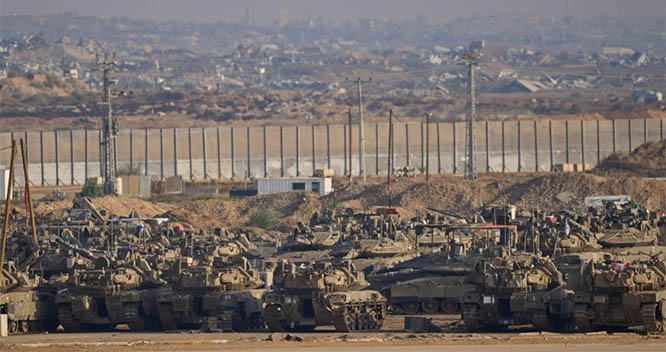
Local authorities say the Israeli military has expanded the so-called “yellow line” truce demarcation in Gaza City and repositioned its forces deeper into the territory in violation of a ceasefire agreement that came into force on October 10, besieging dozens of Palestinian families.

Gaza’s Government Media Office announced in a statement on Thursday that Israeli forces widened the boundary by shifting the markers, and advanced roughly 300 meters (984 feet) into the neighborhoods of Ash-Shaaf, An-Nazzaz and Baghdad Street.

The move pushed further into civilian areas, trapping families who were unable to flee as tanks rolled forward, it added.

“The fate of many of these families remains unknown amidst the shelling that targeted the area,” the office said, adding that the expansion of the yellow line shows a “blatant disregard” for the ceasefire deal.

On Friday, sources said the Israeli military carried out continued air and artillery strikes inside the so-called “yellow line” east of Khan Younis in the southern Gaza Strip.

According to the reports, Israeli warplanes and tanks targeted areas within the zone. One Palestinian was reported killed and several others wounded in the strikes, the sources said.

The fresh aggression came only a day after 25 Palestinians were killed in Israeli airstrikes on Gaza City and Khan Younis on Wednesday.

The media office reported that Israel has consistently violated the truce deal since its implementation last month, with near-daily attacks by air, artillery and direct shootings.

The office said over 400 violations have been documented. These breaches have resulted in the deaths of more than 300 Palestinians and left hundreds injured.

The Government Media Office in Gaza urged the guarantors of the ceasefire — the US, Egypt, Qatar and Turkey — to take swift action to halt the ongoing violations and facilitate the delivery of food, shelter materials, medical aid, and infrastructure equipment.

The so-called “yellow line,” set out in the agreement between Israel and Hamas resistance movement, refers to a non-physical partition where the Israeli military repositioned itself when the truce deal took effect.

It has allowed Israel, which routinely fires at Palestinians who approach the line, to retain control over more than half of the Gaza Strip.

International bodies, including the UN Independent International Commission of Inquiry, the International Association of Genocide Scholars, Amnesty International, Human Rights Watch, B’Tselem, and other rights groups, have concluded that the Israeli war on Gaza amounts to genocide.

In the attacks in Gaza since October 2023, Israel has killed at least 69,546 people and injured 170,833 others, leveling large swaths of the territory and displacing almost all of the population. 

Comments

Add new comment

  • Coastaldigest.com reserves the right to delete or block any comments.
  • Coastaldigset.com is not responsible for its readers’ comments.
  • Comments that are abusive, incendiary or irrelevant are strictly prohibited.
  • Please use a genuine email ID and provide your name to avoid reject.