



Stand-off continues: Chinese helicopters drop food for PLA

September 18, 2014

Leh/New Delhi, Sep 18: Tension persisted in Chumar area in Northeast Ladakh where Chinese troops were reported to have stepped up their presence in the wee hours of today camping at three places in the Indian territory and refusing to vacate.
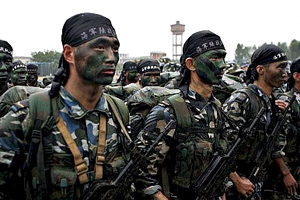
pla

Official sources said helicopters regularly air dropped food packets for the Chinese People's Liberation Army(PLA) personnel numbering around 600 at the three areas in Chumar, 300 km east of Leh.

The sources said both the Indian and Chinese armies were maintaining a distance of 200 metres from each other, as the continuing standoff in Demchok and Chumar cast a shadow on today's summit talks between Prime Minister Narendra Modi and visiting Chinese President Xi Jinping in New Delhi.

India also rushed reinforcements to the area and were not allowing the Chinese troops to proceed further and also asking them to retreat to their side.

Sources said that neither side has asked for a fresh Flag Meeting following the incident in Chumar which has been an epicentre of heightened activities of the Chinese army who were making repeated attempts to enter through this area.

According to sources, the Chinese side pushed in more troops before the break of dawn with more banners asking the Indian Army to leave the area. Chinese helicopters were seen hovering at least thrice during the day air dropping food packets for its troops, they said.

The Chinese side had been constructing a road on their side of LAC but on Sunday, its workers entered into Indian side to carry on the construction.

This was objected by the Indian side as Chinese workers were making assertions that they have instructions to build a road upto Tible, five kilometres deep into Indian territory, the sources said.

The Indian army asked the Chinese workers to leave as otherwise they would face prosecution under Indian laws of entering into the country illegally.

However, during the intervening night of Sunday and Monday, nearly 100 Indian soldiers were reported to have been encircled by 300 Chinese PLA men after which a face-off started and continues till date.

The two sides have held two flag meetings so far which included a marathon discussion yesterday that continued for several hours and remained inconclusive.

Meanwhile, the stand-off in Demchok where Chinese nomads -- Rebos -- had pitched their tents continued. The incursion in this area is nearly 500 metres deep into Indian territory, the sources said.

Chumar, the last village in Ladakh area bordering Himachal Pradesh, has been a bone of contention with China claiming it to be its own territory and has been frequenting the area with helicopter incursions almost every year.

In 2012, the PLA dropped some of its soldiers in this region and dismantled the makeshift storage tents of the Army and ITBP.

The area is not accessible from the Chinese side whereas the Indian side has a road almost to the last point on which the Army can carry loads up to nine tonnes.

Chumar had become a flash point during the fortnight long stand-off last year in Daulat Beg Oldie (DBO) last year as the Chinese side had objected to overhead bunkers erected by the Indian side.

As part of an agreement reached at the flag meeting to end the stand-off from April-May 2013 at DBO, the Indian side had to dismantle some overhead bunkers in Chumar.

Again, Chumar witnessed Chinese troops walking away with an Army surveillance camera on June 17 which was meant for keeping an eye on the PLA troops patrolling there. The same camera was returned after a few days.

During winter this year, Chinese soldiers attempted to enter this area riding on horses. The area witnessed frequent incursion attempts by the Chinese troops who had also adopted 'assertive posturing'.


Comments

Add new comment

  • Coastaldigest.com reserves the right to delete or block any comments.
  • Coastaldigset.com is not responsible for its readers’ comments.
  • Comments that are abusive, incendiary or irrelevant are strictly prohibited.
  • Please use a genuine email ID and provide your name to avoid reject.
News Network
December 13,2025

New Delhi: School-going children are picking up drug and smoking habits and engaging in consumption of alcohol, with the average age of introduction to such harmful substances found to be around 13 years, suggesting a need for earlier interventions as early as primary school, a multi-city survey by AIIMS-Delhi said.

The findings also showed substance use increased in higher grades, with grade XI/XII students two times more likely to report use of substances when compared with grade VIII students. This emphasised the importance of continued prevention and intervention through middle and high school.

The study led by Dr Anju Dhawan of AIIMS's National Drug Dependence Treatment Centre, published in the National Medical Journal of India this month, looks at adolescent substance use across diverse regions.

The survey included 5,920 students from classes 8, 9, 11 and 12 in urban government, private and rural schools across 10 cities -- Bengaluru, Chandigarh, Delhi, Dibrugarh, Hyderabad, Imphal, Jammu, Lucknow, Mumbai, and Ranchi. The data were collected between May 2018 and June 2019.

The average age of initiation for any substance was 12.9 (2.8) years. It was lowest for inhalants (11.3 years) followed by heroin (12.3 years) and opioid pharmaceuticals (without prescription; 12.5 years).

Overall, 15.1 per cent of participants reported lifetime use, 10.3 per cent reported past year use, and 7.2 per cent reported use in the past month of any substance, the study found.

The most common substances used in the past year, after tobacco (4 per cent) and alcohol (3.8 per cent), were opioids (2.8 per cent), followed by cannabis (2 per cent) and inhalants (1.9 per cent). Use of non-prescribed pharmaceutical opioids was most common among opioid users (90.2 per cent).

On being asked, 'Do you think this substance is easily available for a person of your age' separately for each substance category, nearly half the students (46.3 per cent) endorsed that tobacco products and more than one-third of the students (36.5 per cent) agreed that a person of their age can easily procure alcohol products.

Similarly, for Bhang (21.9 per cent), ganja/charas (16.1 per cent), inhalants (15.2 per cent), sedatives (13.7 per cent), opium and heroin (10 per cent each), the students endorsed that these can be easily procured.

About 95 per cent of the children, irrespective of their grade, agreed with the statement that 'drug use is harmful'.

The rates of substance use (any) among boys were significantly higher than those of girls for substance use (ever), use in the past year and use in the past 30 days. Compared to grade VIII students, grade IX students were more likely, and grade XI/XII students were twice as likely to have used any substance (ever).

The likelihood of past-year use of any substance was also higher for grade IX students and for grade XI/XII students as compared to grade VIII students.

About 40 per cent of students mentioned that they had a family member who used tobacco or alcohol each. The use of cannabis (any product) and opioid (any product) by a family member was reported by 8.2 per cent and 3.9 per cent of students, respectively, while the use of other substances, such as inhalants/sedatives by family was 2-3 per cent, the study found.

A relatively smaller percentage of students reported use of tobacco or alcohol among peers as compared to among family members, while a higher percentage reported inhalants, sedatives, cannabis or opioid use among peers.

Children using substances (past year) compared to non-users reported significantly higher any substance use by their family members and peers.

There were 25.7 per cent students who replied 'yes' to the question 'conflicts/fights often occur in your family'. Most students also replied affirmatively to 'family members are aware of how their time is being spent' and 'damily members are aware of with whom they spend their time'.

Comments

Add new comment

  • Coastaldigest.com reserves the right to delete or block any comments.
  • Coastaldigset.com is not responsible for its readers’ comments.
  • Comments that are abusive, incendiary or irrelevant are strictly prohibited.
  • Please use a genuine email ID and provide your name to avoid reject.
News Network
December 6,2025

pilot.jpg

New Delhi: IndiGo, India’s largest airline, faced major operational turbulence this week after failing to prepare for new pilot-fatigue regulations issued by the Directorate General of Civil Aviation (DGCA). The stricter rules—designed to improve flight safety—took effect in phases through 2024, with the latest implementation on November 1. IndiGo has acknowledged that inadequate roster planning led to widespread cancellations and delays.

Below are the key DGCA rules that affected IndiGo’s operations:

1. Longer Mandatory Weekly Rest

Weekly rest for pilots has been increased from 36 hours to 48 hours.

The government says the extended break is essential to curb cumulative fatigue. This rule remains in force despite the current crisis.

2. Cap on Night Landings

Pilots can now perform only two night landings per week—a steep reduction from the earlier limit of six.

Night hours, defined as midnight to early morning, are considered the least alert period for pilots.

Given the disruptions, this rule has been temporarily relaxed for IndiGo until February 10.

3. Reduced Maximum Night Flight Duty

Flight duty that stretches into the night is now capped at 10 hours.

This measure has also been kept on hold for IndiGo until February 10 to stabilize operations.

4. Weekly Rest Cannot Be Replaced With Personal Leave

Airlines can no longer count a pilot’s personal leave as part of the mandatory 48-hour rest.

Pilots say this closes a loophole that previously reduced actual rest time.

Currently, all airlines are exempt from this rule to normalise travel.

5. Mandatory Fatigue Monitoring

Airlines must submit quarterly fatigue reports along with corrective actions to DGCA.

This system aims to create a transparent fatigue-tracking framework across the industry.

The DGCA has stressed that these rules were crafted to strengthen flight safety and align India with global fatigue-management standards. The temporary relaxations are expected to remain until February 2025, giving IndiGo time to stabilise its schedules and restore normal air travel.

Comments

Add new comment

  • Coastaldigest.com reserves the right to delete or block any comments.
  • Coastaldigset.com is not responsible for its readers’ comments.
  • Comments that are abusive, incendiary or irrelevant are strictly prohibited.
  • Please use a genuine email ID and provide your name to avoid reject.