



With the results of Joint Entrance Examination (JEE) Main out, it is celebration time at CFAL (Centre for Advanced Learning), Mangalore’s top training institute as 64% of its students turned successful at the prestigious national examination. 65 of the 101 students who wrote JEE Main qualified for JEE Advanced and are eligible for seats at the NIT’s and other top institutions of the country.
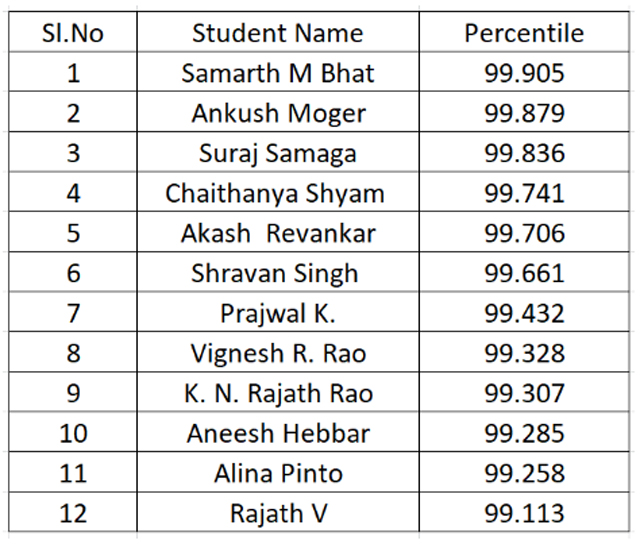
It is important to note that 12 among the 65 students have secured above 99 percentile.
One of the most trusted institutes
This is not the first time that CFAL students have excelled in National level competitive exams, it may be recalled that last week 13 of their students achieved great success at the KVPY examination, prominent among them being Vishnu Bharadwaj (AIR 35) and Shreyas Vasudev Pai (AIR 68). The achievement of their students at National level examinations year after year proves the superiority of the faculty, and the unique pattern-proof teaching modalities used at one of Mangalore’s most trusted institutes.
JEE – The most challenging undergraduate admission test
Joint Entrance Examination (JEE) conducted this year by National Testing Agency (NTA) is a national level examination for students to qualify and pursue engineering degree at under graduate level. Paper 1 is held for BE/B.Tech admissions and Paper 2 for B. Arch/B. Planning. JEE Main is a critical criterion for admission in India’s most prestigious and elite universities like IITs and NIT’s.
Those students who clear JEE Main can take the JEE advanced – which is a pre-requisite requirement for admission in the Indian Institute of Technology and Indian School of Mines (Dhanbad)
CFAL – The first name in training
CFAL trains the students for 2 years, the training consists of 1400 hours of class, tests and mock exams, unique course material, experienced professors and hence is the first choice for students appearing for STEM examinations including JEE, NTSE, KYPY, OLYMPIADS etc. The centre was established with the intention of giving students of Mangalore information, guidance and tools required to qualify the competitive exams. However, the main aim of CFAL is to inculcate passion for Math and Science learning among students and to encourage research and innovation in the subjects.
For further information contact:
CFAL,
Bejai- Kapikad, Mangalore.
Phone: 0824 4279374/9740939374/98457371320
Website: www.cfalindia.com


Comments
Add new comment