Swami Aseemanand Acquitted! Whither Indian Justice System?

Ram Puniyani
March 29, 2019

Seeing the pattern of justice delivery system of India currently it seems getting justice, punishing the guilty is not easy. The judgments come as an outcome of the evidence produced by the executive, police in front of the magistrates. The attitude of the ruling dispensation matters a lot in matters of the crimes related to the ideology being propounded and defended by the ruling party. Sometimes the assertion and strength of the ideologies, which are dominant but not in power also influence the delivery of justice. Times and over again this cruel fact has been staring at our face. In Mumbai violence of 1992-93 nearly one thousand persons was done to death, not too many convictions took place related to the heinous crimes committed during this carnage. In the aftermath of this carnage the bomb blasts took place, orchestrated by the underworld in collaboration with ISI of Pakistan. In these blasts nearly two hundred people died. In these cases some have been hanged to death for the crime, many have got life imprisonment and many others got other punishments. This is what should happen in a democracy. The most glaring case has been the contrast between Rubina Memon who is in prison for life for being the formal owner of the car which was used In Mumbai blasts, while Sadhvi Pragya Singh Thakur, whose motor cycle was used for Malegaon blast got the bail.

All this comes to one’s mind yet again when the NIA Court has acquitted Swami Aseemanand in case of Samjhauta Express blast in which 68 people (43 of them from Pakistan) died. Incidentally Swami was granted bail in the Mecca Masjid blast case earlier and the factors influencing justice delivery became obvious as the main file, a key document containing the disclosure by Aseemanand, wentmissing from the Court’s custody.

Swami Aseemanand, the associate of RSS, who was working in Dangs with Vanvasi Kalyan Ashram, was key figure in organizing the Shabri Kumbh in Dangs. He also emerged as the key figure in many a blast cases, Malegaon, Mecca Masjid, Ajmer Dargah and Samjhata Express. All these took place in 2006-2008. The whole series came to a stop when Maharashtra ATS Chief Hemant Karkare, while investigating these cases came across the fact that the motor cycle used in Malegaon Blast cases belonged to Sadhvi Pragya Thakur, and ex ABVP worker. The trail of investigation led to the role of many a followers of Hindutva ideology, influenced by or close to RSS related organizations. When these facts started coming out Karakare was criticized and attacked by the Hindu nationalists. Shiv Sena mouth Piece Saamna wrote that we spit on the face of Karkare. While the then Chief Minister of Gujarat Mr. Narendra Modi called him Deshdrohi (Anti national). Though Karkare was investigating with full professional integrity, such criticisms from political circles did shake him and he shared his anxiety with his senior and upright police officer Julio Rebiero. Later as NIA started maligning Karkare, Reibero stood by him and gave him the strongest testimony of professional integrity.

The involvement of elements like Pragya Thakur, Assemanand and company was a big revelation and some from then UPA Government used the word ‘Hindu terrorism’ or ‘saffron terrorism’ for these cases. This was a faulty word anyway. It came up on the lines of the prevalent term Islamic terrorism which has been in vogue since quite some time. Hemant Karkare was killed in 26/11 2008 terror attack in Mumbai. Many of those calling him anti-National now declared him as martyr! Later Rajasthan ATS further carried the investigation and many from RSS related stable were found to be accomplices in the acts of terror. Subhash Gatade’s book Godse’s Children chronicles it well.

The investigation changed the track with the coming of NDA II in power in center in 2014. Rohini Salian the public prosecutor from Mumbai, who was dealing with these cases was told to go soft onthese cases. Now a decade later Hemant Karkare’s investigation has been totally bypassed. Counter allegations against Karkare are floating around. At the same time doubts about the legal system and its role in punishing the guilty is coming to surface yet again.

In case of Swami Aseemanand, after his arrest he had given a confession in front of a magistrate. This confession was not in police custody; this was after two days of judicial custody. In his confession, which is legally valid, he gave the details of his central role and planning the blasts which took place during 2007-2008. He also indicated that even top level RSS leadership was also in the know of the goings on. In a long interviews spanning over two years, given to Caravan Magazine journalist Leena Raghunath (Believer, Caravan) he stated the things similar to what he told the magistrate. Later he withdrew the statement given in front of magistrate saying that the confession was given under pressure.

After this bail it is clear yet again that the justice system is so much dependent on the executive, the way police presents the case to the Magistrate examining the case. In the aftermath of this bail, Vikash Naraan Rai, who was Chief of SIT, investigating into Samjhauta blast, questions the handling of case by NIA. He asks "It is for the NIA to answer that why the witnesses resiled (back-traced) in this case. As they have turned hostile in the court even after giving statements under 164 of CrPC, the investigating agency should press perjury charges on them. The general perception is that NIA had gone soft in this case. One can further comment once the complete judgment comes,"

With this bail the question comes up who is responsible for the death of those 68 people, as usual it seems nobody did the blast leading to Samjhauta express tragedy! What we are witnessing is a sustained effort to undermine the process of justice in pursuit of sectarian nationalism.


Comments

Add new comment

  • Coastaldigest.com reserves the right to delete or block any comments.
  • Coastaldigset.com is not responsible for its readers’ comments.
  • Comments that are abusive, incendiary or irrelevant are strictly prohibited.
  • Please use a genuine email ID and provide your name to avoid reject.
News Network
November 21,2025

malpe.jpg

Udupi: The Malpe Police have arrested two men from Uttar Pradesh for allegedly sharing classified information related to Indian Navy vessels with individuals in Pakistan, posing a serious threat to national security.

According to a complaint filed by the CEO of Udupi Cochin Shipyard, Malpe—an institution under the Union Ministry of Ports, Shipping and Waterways—the prime accused, Rohit (29), was working as an insulator through subcontractor M/S Shushma Marine Pvt Ltd. He had earlier served at Cochin Shipyard Limited in Kochi, Kerala, where naval ships are under construction.

Udupi SP Hariram Shankar said the accused had unlawfully shared, via WhatsApp, confidential identification numbers of Navy-related ships and other classified details while working in Kerala, allegedly for illegal gains.

After joining the Malpe shipyard unit, Rohit reportedly continued collecting sensitive information through a friend in Kochi and circulated it to unauthorised individuals, violating national security protocols and potentially endangering India’s sovereignty, unity, and integrity.

Based on the complaint, Malpe Police registered a case under Section 152 of the Bharatiya Nyaya Sanhita (BNS) and Sections 3 and 5 of the Official Secrets Act, 1923.

A police team led by Karkala Subdivision Assistant Superintendent of Police Harsha Priyamvada—along with PSI Anil Kumar D, ASI Harish, and PC Ravi Jadhav—conducted the investigation and arrested the two accused, identified as Rohit (29) and Santri (37), both residents of Sultanpur district, Uttar Pradesh.

The duo was produced before the court, which remanded them in judicial custody till December 3. Further investigation is in progress.

Comments

Add new comment

  • Coastaldigest.com reserves the right to delete or block any comments.
  • Coastaldigset.com is not responsible for its readers’ comments.
  • Comments that are abusive, incendiary or irrelevant are strictly prohibited.
  • Please use a genuine email ID and provide your name to avoid reject.
News Network
November 21,2025

Bengaluru, Nov 21: The Karnataka government is facing pressure to overhaul its employment system after a high-level Cabinet sub-committee recommended the complete phase-out of job outsourcing in government offices, boards, and corporations by March 2028. The move is aimed at tackling a systemic issue that has led to the potential violation of constitutional reservation policies and the exploitation of workers.

The Call for Systemic Change

With over three lakh vacant posts currently being filled through private agencies on an outsource, insource, or daily wage basis, the sub-committee highlighted a significant lapse. "As a result, reservations are not being followed as per the Constitution and state laws. It’s an urgent need to take serious steps to change the system. It has been recommended to completely stop the system of outsourcing by March 2028," the panel stated in a document.

The practice of outsourcing involves private companies hiring workers to perform duties for a government agency. Critics argue this model results in lesser salaries, a lack of social security benefits (otherwise available to permanent government employees), and a failure to adhere to the provisions of Articles 14 and 15 of the Constitution, which guarantee equality before the law and prohibit discrimination.

The 'Bidar Model' as a Stop-Gap Solution

To regulate the current mode of employment and reduce worker exploitation until the 2028 deadline, the government plans to establish workers’ services multi-purpose cooperative societies across all districts, following the successful "Bidar Model."

The Bidar District Services of Labour Multi-purpose Cooperative Society Ltd., which operates under the District Commissioner, is cited as a successful example of providing a measure of social security to outsourced staff. Labour Department officials argue this society ensures workers receive their due wages and statutory facilities like ESI (Employees' State Insurance) and PF (Provident Fund), in exchange for a 1% service fee collected from the employees.

legislative push and Priority Insourcing

The recommendations, led by the sub-committee headed by Law and Parliamentary Affairs Minister H K Patil, are set to be discussed at the next Cabinet meeting. The committee has proposed the introduction of the Karnataka Outsourced Employees (Regulation, Placement and Welfare) Bill 2025.

In a move addressing immediate concerns, Labour Minister Santosh Lad, a member of the sub-committee, has reportedly assured that steps will be taken over the next 2-3 years to insource workers in "life-threatening services" on a priority basis. This includes essential personnel like pourakarmikas (sanitation workers), drivers, electrical staff in the Energy Department, and Health Department staff handling contagious diseases. The transition aims to grant these workers the long-term security and benefits they currently lack under the outsourcing system. 

Comments

Add new comment

  • Coastaldigest.com reserves the right to delete or block any comments.
  • Coastaldigset.com is not responsible for its readers’ comments.
  • Comments that are abusive, incendiary or irrelevant are strictly prohibited.
  • Please use a genuine email ID and provide your name to avoid reject.
coastaldigest.com news network
November 28,2025

roadshow.jpg

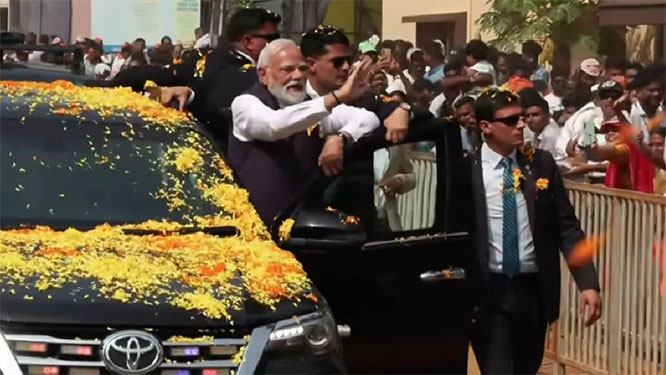
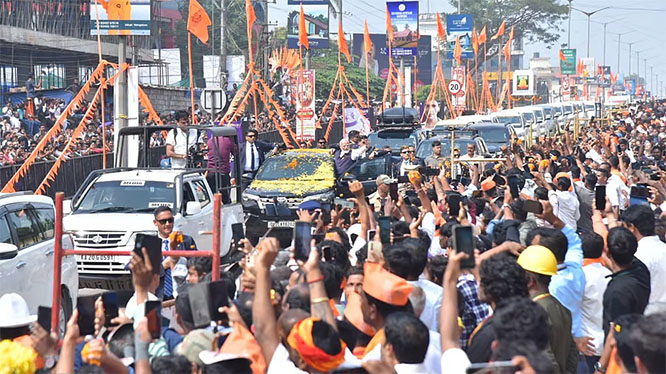
Udupi district transformed into a sea of saffron and celebration on Friday, November 28, as Prime Minister Narendra Modi’s roadshow swept through the coastal temple town. Thousands of residents lined the streets, turning the event into a vibrant public spectacle filled with cheers, flags, and festive energy.

The procession route—from the helipad to the historic Sri Krishna Math—was decked with buntings, saffron flags, and multilayered security barricades. One of the district’s largest-ever security deployments was put in place for the high-profile visit, with over 3,000 police personnel on duty. The arrangement included ten SPs, 27 DSPs, 49 inspectors, 127 sub-inspectors, 232 assistant sub-inspectors, 1,608 constables, and 39 women staff.

Six platoons of the Karnataka State Reserve Police, six Quick Response Teams, bomb detection units, and dog squads were stationed across Udupi. Enhanced surveillance covered Adi Udupi, Bannanje bus stand, and the Sri Krishna Math parking zone, with combing operations carried out along the roadshow corridor.

At the 800-year-old Sri Krishna Math, preparations reached a ceremonial peak. Paryaya Puttige Math seer Sugunendra Teertha Swamiji said the Prime Minister would take part in the Laksha Kantha Geetha Parayana, a mass chanting of the Bhagavad Gita by one lakh devotees, and inaugurate the new Suvarna Teertha Mantapa.

“He will first offer floral tributes to saint-poet Kanakadasa and then unveil the golden covering over the Kanakana Kindi,” the seer said.

The Prime Minister will also receive a Poorna Kumbha welcome and have darshan of Lord Sri Krishna, Mukhyaprana Devaru, and the Suvarna Paduke. Union Minister Pralhad Joshi, Karnataka Governor Thaawarchand Gehlot, Minister Bairathi Suresh, Dharmadhikari D. Veerendra Heggade, and seers from the Ashta Maths are expected to join the ceremony.

Ahead of his arrival, the Prime Minister posted on X that he felt “honoured” to attend the spiritually significant gathering. “This is a special occasion that brings together people from different sections of society for a recital of the Gita. This Matha has a very special significance in our cultural life,” he wrote, noting the institution’s long-standing legacy rooted in the teachings of Sri Madhvacharya.

roadshow2.jpg

Comments

Add new comment

  • Coastaldigest.com reserves the right to delete or block any comments.
  • Coastaldigset.com is not responsible for its readers’ comments.
  • Comments that are abusive, incendiary or irrelevant are strictly prohibited.
  • Please use a genuine email ID and provide your name to avoid reject.