



Terror suspect holed up, ATS operation on Lucknow outskirts

March 7, 2017

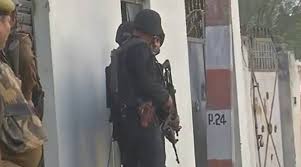
Lucknow, Mar 7: The Uttar Pradesh Anti-Terrorist Squad today launched an operation to flush out a suspected terrorist holed up in a house on the outskirts of Lucknow following inputs that he may be linked to Bhopal-Ujjain train blast this morning.
terror
The suspect was hiding in a house in Kakori area. The densely populated neighbourhood was cordoned off and at least 20 commandos were involved in the operation, police said.

"The operation is the result of the UP police receiving specific inputs regarding possible terror suspects in the state," Additional Director General of Police (Law and Order) Daljeet Chaudhary said, adding the terror suspect might be linked to train blast in Madhya Pradesh this morning.

At least eight persons were today injured, two of them seriously, in the blast in Bhopal-Ujjain passenger train near Jabdi station in Shajapur district. The ATS operation came hours before the final phase of polling in Assembly election covering 40 seats in eastern Uttar Pradesh.

According to locals, at around 3.30 PM over 30 policemen started vacating the houses in the locality to corner the suspect. "As the suspect got wind of their plans, he started firing at police party. Gunshots were fired from both the sides," local residents said.

IG ATS Aseem Arun summoned elite commandos from Bijnaur police facility. The ATS team is trying to ensure that the suspect runs out of ammunition before barging inside.

IG Lucknow Zone A Satish Ganesh said, "The suspect was not surrendering. Instead he was resorting to firing. Chilli bombs were used to smoke him out." Arun, who was conducting the operation, said, "When the police knocked the door (of the house where the terror suspect is holed up), he closed the door, and then there was a sound of pistol fire, which proved that he has weapons.

"We are not in a hurry to finish the operation, but want to catch him alive. Hence, we are using chilly powder," he said. He said the suspect resorted to intermittent firing. "We have withheld firing from our side. It appears only one person is hiding inside the house," he said.

The UP Police was tipped off by central intelligence agencies, Chaudhary said, and added that one arrest was made in Kanpur and there could be more than one terror suspect in Lucknow.

He also mentioned that terror linkage, connection to Ujjain train blast and details of the module would be revealed only after interrogation of the suspects. Police said that the area where the suspected terrorist is holed up is densely populated.

"We would be able to comment on the motive of the person once he is arrested. There is no point in sharing any input before the operation was over," the ADG said. He said it was a tactical operation, aimed at incurring minimum loss.

UP DGP Javeed Ahmed, when contacted, said the UP Police was trying to convince the person holed up in the house to surrender. He also said, "We have detained someone from Kanpur. However, it is too early to link this suspected terrorist to the train blast."

To a question on the incident taking place a day before the final phase of polling in UP tomorrow, the DGP said, "The conduct of polls in UP has been so far peaceful."


Comments

Add new comment

  • Coastaldigest.com reserves the right to delete or block any comments.
  • Coastaldigset.com is not responsible for its readers’ comments.
  • Comments that are abusive, incendiary or irrelevant are strictly prohibited.
  • Please use a genuine email ID and provide your name to avoid reject.
News Network
December 13,2025

New Delhi: School-going children are picking up drug and smoking habits and engaging in consumption of alcohol, with the average age of introduction to such harmful substances found to be around 13 years, suggesting a need for earlier interventions as early as primary school, a multi-city survey by AIIMS-Delhi said.

The findings also showed substance use increased in higher grades, with grade XI/XII students two times more likely to report use of substances when compared with grade VIII students. This emphasised the importance of continued prevention and intervention through middle and high school.

The study led by Dr Anju Dhawan of AIIMS's National Drug Dependence Treatment Centre, published in the National Medical Journal of India this month, looks at adolescent substance use across diverse regions.

The survey included 5,920 students from classes 8, 9, 11 and 12 in urban government, private and rural schools across 10 cities -- Bengaluru, Chandigarh, Delhi, Dibrugarh, Hyderabad, Imphal, Jammu, Lucknow, Mumbai, and Ranchi. The data were collected between May 2018 and June 2019.

The average age of initiation for any substance was 12.9 (2.8) years. It was lowest for inhalants (11.3 years) followed by heroin (12.3 years) and opioid pharmaceuticals (without prescription; 12.5 years).

Overall, 15.1 per cent of participants reported lifetime use, 10.3 per cent reported past year use, and 7.2 per cent reported use in the past month of any substance, the study found.

The most common substances used in the past year, after tobacco (4 per cent) and alcohol (3.8 per cent), were opioids (2.8 per cent), followed by cannabis (2 per cent) and inhalants (1.9 per cent). Use of non-prescribed pharmaceutical opioids was most common among opioid users (90.2 per cent).

On being asked, 'Do you think this substance is easily available for a person of your age' separately for each substance category, nearly half the students (46.3 per cent) endorsed that tobacco products and more than one-third of the students (36.5 per cent) agreed that a person of their age can easily procure alcohol products.

Similarly, for Bhang (21.9 per cent), ganja/charas (16.1 per cent), inhalants (15.2 per cent), sedatives (13.7 per cent), opium and heroin (10 per cent each), the students endorsed that these can be easily procured.

About 95 per cent of the children, irrespective of their grade, agreed with the statement that 'drug use is harmful'.

The rates of substance use (any) among boys were significantly higher than those of girls for substance use (ever), use in the past year and use in the past 30 days. Compared to grade VIII students, grade IX students were more likely, and grade XI/XII students were twice as likely to have used any substance (ever).

The likelihood of past-year use of any substance was also higher for grade IX students and for grade XI/XII students as compared to grade VIII students.

About 40 per cent of students mentioned that they had a family member who used tobacco or alcohol each. The use of cannabis (any product) and opioid (any product) by a family member was reported by 8.2 per cent and 3.9 per cent of students, respectively, while the use of other substances, such as inhalants/sedatives by family was 2-3 per cent, the study found.

A relatively smaller percentage of students reported use of tobacco or alcohol among peers as compared to among family members, while a higher percentage reported inhalants, sedatives, cannabis or opioid use among peers.

Children using substances (past year) compared to non-users reported significantly higher any substance use by their family members and peers.

There were 25.7 per cent students who replied 'yes' to the question 'conflicts/fights often occur in your family'. Most students also replied affirmatively to 'family members are aware of how their time is being spent' and 'damily members are aware of with whom they spend their time'.

Comments

Add new comment

  • Coastaldigest.com reserves the right to delete or block any comments.
  • Coastaldigset.com is not responsible for its readers’ comments.
  • Comments that are abusive, incendiary or irrelevant are strictly prohibited.
  • Please use a genuine email ID and provide your name to avoid reject.
News Network
December 6,2025

pilot.jpg

New Delhi: IndiGo, India’s largest airline, faced major operational turbulence this week after failing to prepare for new pilot-fatigue regulations issued by the Directorate General of Civil Aviation (DGCA). The stricter rules—designed to improve flight safety—took effect in phases through 2024, with the latest implementation on November 1. IndiGo has acknowledged that inadequate roster planning led to widespread cancellations and delays.

Below are the key DGCA rules that affected IndiGo’s operations:

1. Longer Mandatory Weekly Rest

Weekly rest for pilots has been increased from 36 hours to 48 hours.

The government says the extended break is essential to curb cumulative fatigue. This rule remains in force despite the current crisis.

2. Cap on Night Landings

Pilots can now perform only two night landings per week—a steep reduction from the earlier limit of six.

Night hours, defined as midnight to early morning, are considered the least alert period for pilots.

Given the disruptions, this rule has been temporarily relaxed for IndiGo until February 10.

3. Reduced Maximum Night Flight Duty

Flight duty that stretches into the night is now capped at 10 hours.

This measure has also been kept on hold for IndiGo until February 10 to stabilize operations.

4. Weekly Rest Cannot Be Replaced With Personal Leave

Airlines can no longer count a pilot’s personal leave as part of the mandatory 48-hour rest.

Pilots say this closes a loophole that previously reduced actual rest time.

Currently, all airlines are exempt from this rule to normalise travel.

5. Mandatory Fatigue Monitoring

Airlines must submit quarterly fatigue reports along with corrective actions to DGCA.

This system aims to create a transparent fatigue-tracking framework across the industry.

The DGCA has stressed that these rules were crafted to strengthen flight safety and align India with global fatigue-management standards. The temporary relaxations are expected to remain until February 2025, giving IndiGo time to stabilise its schedules and restore normal air travel.

Comments

Add new comment

  • Coastaldigest.com reserves the right to delete or block any comments.
  • Coastaldigset.com is not responsible for its readers’ comments.
  • Comments that are abusive, incendiary or irrelevant are strictly prohibited.
  • Please use a genuine email ID and provide your name to avoid reject.