



Transit of Mercury over sun on May 9

May 4, 2016

Kolkata, May 4: A transit of Mercury over the disc of the sun will take place in the afternoon of May 9 and will be visible from India after a gap of about ten years.
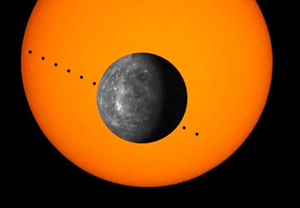
mecury

The transit of Mercury is a phenomenon in which the planet will be seen as a small black dot travelling from one end of the solar disc to the other, according to Sanjib Sen, Director, Positional Astronomy Centre.

This phenomenon is seen when mercury passes between the sun and the earth and it happens only when the three are lined up, Sen said.

Mercury appears as a dot on the solar disc because its angular size is very small compared to that of the sun as seen from earth.

Sen said the transit of mercury will be visible from most of Asia (except south eastern parts and Japan), Europe, Africa, Greenland, South America, North America, Arctic, North Atlantic Ocean and most of the Pacific Ocean.

The transit will be visible in India after ten years and the next it will be visible in the country after a long gap of 16 years in 2032, he said.

The transit of Mercury begins with contact-I, the instant when the disc of Mercury is externally tangent with the sun (ingress exterior) followed by contact-II, when Mercury is internally tangent with the Sun (ingress interior).

Mercury will be seen as a black spot, travelling several hours over the face of the disc and will reach the opposite limb of the sun at contact-III, when the disc of Mercury is internally tangent with the sun (Egress interior).

Finally the transit ends at contact-IV when the disc of Mercury is externally tangent with the sun (egress exterior).

The transit of Mercury is relatively a rare phenomenon, occurs 13 or 14 times in a century, mostly in the months of May and November.

The interval between one November transit and next November transit may be seven, 13 or 33 years, whereas the interval between a May transit and the next May transit may be 13 or 33 years.

The beginning of the event - Ingress exterior (contact-I) and Ingress interior (contact-II) will be visible from all places in India, Sen said.

The duration of the entire transit event will be about 7.30 hours. The observers in India will not see the ending of the event as the same will be in progress after sunset.

Depending upon the sunset time of different places in India, the observer located at the extreme east of the country will witness the event for an hour from the beginning and the observer located at the extreme west in the country will see the event for about 2.40 hours from the beginning, he said.

In Delhi, the event can be seen for a duration of about 2.20 hours as it will start at 4.41 PM and sunset will take place at 7.01 PM.

Similarly, in Kolkata the event will start at 4.41 PM and can be seen for a duration of about 1.26 hours.

In Mumbai, the event will start at 4.41 PM and can be seen for a duration of about 2.24 hours and in Chennai the event will start at 4.41 PM and it can be seen for a duration of about 1.45 hours, Sen said.

The last transit of Mercury occurred on November 6, 2006, when the end of the event was visible from the extreme north eastern parts of India at the time of sunrise.

The next transit of Mercury will take place on 11 November, 2019 but the event will not be seen from India as it will begin after the time of sunset in India. The transit of Mercury on 13 November, 2032 will be again visible from India.

The apparent diameter of Mercury will be nearly 12 arc-second which is 1/158 of Sun's apparent diameter. Thus, it will be difficult to see the Mercury at transit over the face of the sun without optical magnification.

This event can be viewed with the help of binoculars or telescope attached with proper solar filter or by making projection of the sun's image on a white board by telescope.
The sun should never be seen with the naked eye, cautioned Sen.

The safe technique to observe is by using filter-like aluminised mylar, black polymer or welding glass of shade number 14.

The Positional Astronomy Centre is planning to show the event to general public from its office at Sector-5 in Salt Lake on May 9.


Comments

Add new comment

  • Coastaldigest.com reserves the right to delete or block any comments.
  • Coastaldigset.com is not responsible for its readers’ comments.
  • Comments that are abusive, incendiary or irrelevant are strictly prohibited.
  • Please use a genuine email ID and provide your name to avoid reject.
News Network
December 15,2025

Mangaluru, Dec 15: Air India Express has announced that it will resume direct flight services between Mangaluru and Muscat from March 2026, restoring an important international air link for passengers from the coastal region.

Airport authorities said the service will operate twice a week—on Sundays and Tuesdays—from March 1. The initial flights are scheduled on March 3, 8 and 10, followed by March 15 and 17, with the same operating pattern to continue thereafter. The flight duration is approximately three hours and 25 minutes.

The Mangaluru–Muscat route was earlier operated under the 2025 summer schedule, with services beginning on July 14. At that time, Air India Express had operated four flights a week before suspending the service.

Officials said the summer schedule will come into effect from March 29, after which changes in flight timings and departure schedules from Mangaluru are expected. Passengers have been advised to check the latest schedules while planning their travel.

The resumption of direct flights to Muscat is expected to significantly benefit expatriates, business travellers and others, further strengthening Mangaluru’s air connectivity with the Gulf region.

Comments

Add new comment

  • Coastaldigest.com reserves the right to delete or block any comments.
  • Coastaldigset.com is not responsible for its readers’ comments.
  • Comments that are abusive, incendiary or irrelevant are strictly prohibited.
  • Please use a genuine email ID and provide your name to avoid reject.
News Network
December 7,2025

Mangaluru, Dec 7: A 34-year-old fruit and vegetable trader in Mangaluru has reportedly lost ₹33.1 lakh after falling victim to an online investment scam run through a fake mobile app.

Police said the scam began in September, when the victim received a link on Facebook. Clicking it connected him to a WhatsApp number, where an unidentified person introduced a high-return investment scheme and instructed him to download an app.

To build trust, the fraudster asked him to invest ₹30,000 on September 24. The trader soon received ₹34,000 as “profit,” convincing him the scheme was genuine. Over the next two months, he transferred money in multiple instalments via Google Pay and IMPS to different scanner codes and bank accounts shared by the scammers. Between September 24 and December 3, he ended up sending a total of ₹33.1 lakh.

When he later requested a refund of his investment and promised returns, the scammers demanded additional payments, claiming he needed to pay a “service tax” first. Even after he paid a small amount, no money was returned, and the scammers continued pressuring him for more.

A case has been registered at the CEN Crime Police Station.

Comments

Add new comment

  • Coastaldigest.com reserves the right to delete or block any comments.
  • Coastaldigset.com is not responsible for its readers’ comments.
  • Comments that are abusive, incendiary or irrelevant are strictly prohibited.
  • Please use a genuine email ID and provide your name to avoid reject.
News Network
December 7,2025

SHRIMP.jpg

Mangaluru, Dec 7: A rare bamboo shrimp has been rediscovered on mainland India more than 70 years after it was last reported, confirming for the first time the presence of Atyopsis spinipes in the country. The find was made by researchers from the Centre for Climate Change Studies at Sathyabama Institute of Science and Technology, Chennai, during surveys in Karnataka and Odisha.

The team — shrimp expert Dr S Prakash, PhD scholar K Kunjulakshmi, and Mangaluru-based researcher Maclean Antony Santos — combined field surveys, ecological assessments and DNA analysis to identify the elusive species. Their findings, published in Zootaxa, resolve decades of taxonomic confusion stemming from a 1951 report that misidentified the species as Atyopsis moluccensis without strong evidence.

The shrimp has now been confirmed at two locations: the Mulki–Pavanje estuary near Mangaluru and the Kuakhai River in Bhubaneswar. Historical specimens from the Andaman Islands, previously labelled as A. moluccensis, were also found to be misidentified and actually belong to A. spinipes.

The rediscovery began after an aquarium hobbyist in Odisha spotted a shrimp in 2022, prompting systematic surveys across Udupi, Karwar and Mangaluru. Four female specimens were collected in Mulki and one in Odisha, all genetically matching.

Researchers warn the species may exist in very small, vulnerable populations as freshwater habitats face increasing pressure from pollution, sand mining and infrastructure development. All verified specimens have been deposited with the Zoological Survey of India for future reference.

Comments

Add new comment

  • Coastaldigest.com reserves the right to delete or block any comments.
  • Coastaldigset.com is not responsible for its readers’ comments.
  • Comments that are abusive, incendiary or irrelevant are strictly prohibited.
  • Please use a genuine email ID and provide your name to avoid reject.