



Trying to convince China that India's rise not harmful to its ascent: Jaishankar

January 18, 2017

New Delhi, Jan 18: In the backdrop of growing unease in Sino-India ties, India today said it has been trying to convince the Chinese government that its ascent is not harmful to the rise of China and that both countries should be sensitive on matter relating to sovereignty.
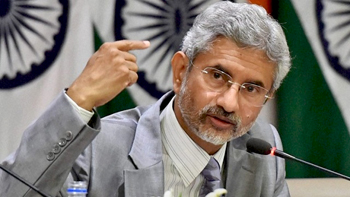
jaishankar
In an address at the Raisina Dialogue, Foreign Secretary S Jaishankar took strong objection to the China-Pakistan Economic Corridor (CPEC) which passes through Pakistan-occupied-Kashmir, saying there should have been some reflection on India's unhappiness over it.

"What we are trying to do is to convince China that our rise is not harmful to China's rise just as China's rise need not be to India's rise," he said at the gathering attended by representatives from across the world.

Chill has set in Sino-India ties following China's opposition to India's membership at the Nuclear Suppliers Group as well as Beijing blocking India's move at the UN to designate Masood Azhar as a global terrorist.

During the interactive session, during which he touched upon a vast array of subjects concerning international relations, Jaishankar said the SAARC has been made "ineffective due to the insecurity of one member".

Identifying terrorism as the most "pervasive and serious challenge" to international security, the Foreign Secretary said developing a serious global response to it is of the highest priority but rued that it is hard to do.

On ties with China, Jaishankar said there has been overall broadening of ties, especially in areas of business and people-to-people contact, but they have been overshadowed by differences on certain political issues.

"But it is important for the two countries not to lose sight of the strategic nature of their engagement, or falter in their conviction that their rise can be mutually supportive," he said.

Replying to a question on CPEC, he said both countries should show sensitivity to each other's sovereignty.

"China is a country which is very sensitive on matters concerning its sovereignty. So we would expect that they would have some understanding of other people's sensitivity on their sovereignty," he said.

Jaishankar said the CPEC passes through a "piece of land that we call Pakistan-occupied-Kashmir which is territory belongs to India and which is illegally occupied by Pakistan".

He said the project has been undertaken without consultation with India and that its sensitivity and concerns towards it are natural.

On India's overall ties with China, he said both the countries have opened up significantly since 1945.

"In a sense, both of us, if you step back and look at it, are opening up a very close international order. When people talk about change since 1945, I think two big changes are really India and China.

"I would say if China had not opened up the international order the way it did, I think it would be much harder today for India also to exploit those phases. There is a high degree of shared interests," he said.

On SAARC, in an obvious reference to Pakistan's obstructionist approach, he said, "We hope to partially remedy this through the BBIN (Bangladesh, Bhutan, India, Nepal) sub-regional grouping.

"It is also our expectation that the current level of enthusiasm among members of BIMSTEC can be channelled towards more far-reaching initiatives."

Jaishankar said it is important for India and China not to lose sight of the strategic nature of their engagement, or falter in their conviction that their rise can be mutually supportive.

Talking about geo-political issues, he said the world in 2017 is marked by "unevenness, possibilities and uncertainties" and that US seemed ready to change the terms of its engagement with the world.

"Relations between US and Russia could undergo a transformation that we may not have seen since 1945. Its dimensions, leave alone implications, are hard to predict.

Europe, engrossed in multiple domestic challenges and reconfiguring itself, signals less appetite for more distant politics, even as it watches these developments," he said.

The Foreign Secretary said "instead of being driven by headlines – or tweets – let's look at what's different and what is not."

"Terrorism remains the most pervasive and serious challenge to international security. Developing a serious global response is of the highest priority, yet hard to do. Climate change is an existential challenge on which some common ground exists, that needs to be consolidated," he said.

Talking about Asia, he said various disputes including in maritime sphere acquired salience in the last few years.

"Broadly speaking, the growth in China's power and its expression abroad remain a dynamic factor in Asia," he said.

In the Western world, he said, optimism that trade and investment overcome political divides has also faded.

"More dangers than convenience are perceived from connectivity. And there is a lack of purpose in confronting global challenges like terrorism, though some important exceptions should be acknowledged. The world has not just got flatter. Suddenly, one part of it is also more inward looking; in some ways, more tired," he said.

He said Asia is facing a host of challenges including emerging multipolarity, heightened nationalism and disputed boundaries among others.

Referring to financial slowdown, Jaishankar said globalisation has not stopped and cannot stop, just because "someone somewhere has called 'time out'".

He observed that an immediate precursor to the current global situation was in the aftermath of the 2008 financial crisis and in many ways, this laid the basis for a more multipolar world.

"Ironically, while the Western-led G8 gave way to the more representative G20, the more diverse UNSC remained as resistant to change as before," he said.

On India's foreign policy, the Foreign Secretary said the country has actually broadened its footprint and intensified its investment, trade and technical activities in an "unprecedented manner".

"The rapid growth of Chinese power, the strengthening of India's position, the sharper role of Russia, the activity of Japan, the divisions in the Gulf, the interests of Europe, and the entrenched position of the United States have not made this calculus an easy one," said the Foreign Secretary.


Comments

Add new comment

  • Coastaldigest.com reserves the right to delete or block any comments.
  • Coastaldigset.com is not responsible for its readers’ comments.
  • Comments that are abusive, incendiary or irrelevant are strictly prohibited.
  • Please use a genuine email ID and provide your name to avoid reject.
News Network
December 20,2025

train.jpg

At least seven elephants were killed and one calf injured after a herd collided with the Sairang-New Delhi Rajdhani Express in Assam's Hojai on Saturday morning, leading to disruption of rail services. 

The Sairang-New Delhi Rajdhani Express struck a herd of elephants, resulting in the derailment of the locomotive and five coaches. No passenger casualties or injuries were reported, officials said.

The New Delhi-bound train met with the accident around 2.17 am, PTI reported. The Sairang-New Delhi Rajdhani Express connects Mizoram's Sairang (near Aizawl) to Anand Vihar Terminal (Delhi). 

Railway has issued helpline numbers at the Guwahati Railway Station:-

•    0361-2731621
•    0361-2731622
•    0361-2731623

The accident site is located about 126 km from Guwahati. Following the incident, accident relief trains and railway officials rushed to the spot to initiate rescue operations.

Train Services Disrupted

Sources said that due to the derailment and elephant body parts scattered on the tracks, train services to Upper Assam and other parts of the Northeast were affected.

Passengers from the affected coaches were temporarily accommodated in vacant berths available in other coaches of the train. Once the train reaches Guwahati, additional coaches will be attached to accommodate all passengers, after which the train will resume its onward journey.

The incident occurred at a location that is not a designated elephant corridor. The loco pilot, upon spotting the herd on the tracks, applied emergency brakes. Despite this, the elephants dashed into the train, leading to the collision and derailment.

Last month, an elephant was killed after being hit by a train in Dhupguri in West Bengal's Jalpaiguri district. The incident took place on November 30. 

The adult elephant was killed on the spot, and a calf was discovered lying injured beside the tracks. 

Over 70 Elephants Killed In Train Collisions Over Last 5 Years

At least 79 elephants have died in train collisions across the country in the last five years, the Environment Ministry had informed Parliament in August.

In a written reply in the Lok Sabha, Minister of State for Environment Kirti Vardhan Singh had said the figure is based on reports from state governments and Union Territory administrations for the period 2020-21 to 2024-25.

He said that the ministry does not maintain consolidated data on the deaths of other wild animals on railway tracks, including in designated elephant corridors.

Singh confirmed that three elephants, including a mother and her calf, were killed on July 18 this year after being hit by a speeding express train on the Kharagpur-Tatanagar section in West Bengal's Paschim Midnapore district. The incident took place near Banstala between Jhargram and Banstala stations.

The minister said several measures have been taken jointly by the Environment Ministry and the Railways to prevent such accidents.

These include imposing speed restrictions in elephant habitats, pilot projects such as seismic sensor-based detection of elephants near tracks and construction of underpasses, ramps and fencing at vulnerable points.

The Wildlife Institute of India, in consultation with the ministry and other stakeholders, has also issued guidelines titled 'Eco-friendly Measures to Mitigate Impacts of Linear Infrastructure' to help agencies design railways and other projects in ways that reduce human-animal conflicts.

Singh added that capacity-building workshops were conducted for railway officials at the Wildlife Institute of India in 2023 and 2024 to raise awareness on elephant conservation and protection.

A detailed report titled 'Suggested Measures to Mitigate Elephant & Other Wildlife Train Collisions on Vulnerable Railway Stretches in India' had also been prepared after surveys across 127 railway stretches covering 3,452 km.

Of these, 77 stretches spanning 1,965 km in 14 states were prioritised for mitigation, with site-specific interventions suggested. 

Comments

Add new comment

  • Coastaldigest.com reserves the right to delete or block any comments.
  • Coastaldigset.com is not responsible for its readers’ comments.
  • Comments that are abusive, incendiary or irrelevant are strictly prohibited.
  • Please use a genuine email ID and provide your name to avoid reject.
News Network
December 16,2025

jordan.jpg

Prime Minister Narendra Modi on Monday held talks with Jordan’s King Abdullah II in Amman, during which the two leaders discussed ways to further strengthen bilateral relations, with the Prime Minister outlining an eight-point vision covering key areas of cooperation.

Describing the meeting as “productive”, PM Modi said he shared a roadmap focused on trade and economy, fertilisers and agriculture, information technology, healthcare, infrastructure, critical and strategic minerals, civil nuclear cooperation, and people-to-people ties.

In a post on social media platform X, the Prime Minister praised King Abdullah II’s personal commitment to advancing India–Jordan relations, particularly as both countries mark the 75th anniversary of the establishment of diplomatic ties this year.

“Held productive discussions with His Majesty King Abdullah II in Amman. His personal commitment towards vibrant India-Jordan relations is noteworthy. This year, we are celebrating the 75th anniversary of our bilateral diplomatic relations,” PM Modi said.

The meeting took place at the Al Husseiniya Palace, where the two leaders also exchanged views on regional and global issues of mutual interest. According to the Ministry of External Affairs (MEA), both sides agreed to further deepen cooperation in areas including trade and investment, defence and security, counter-terrorism and de-radicalisation, fertilisers and agriculture, infrastructure, renewable energy, tourism, and heritage.

The MEA said both leaders reaffirmed their united stand against terrorism.

PM Modi arrived in Amman earlier on Monday and was received by Jordanian Prime Minister Jafar Hassan, who accorded him a formal welcome. Following the talks, King Abdullah II hosted a banquet dinner in honour of the Prime Minister, reflecting the warmth of bilateral ties.

Jordan is the first leg of PM Modi’s three-nation tour. From Amman, the Prime Minister will travel to Ethiopia at the invitation of Prime Minister Abiy Ahmed Ali, marking his first official visit to the African nation. The tour will conclude with a visit to Oman.

Comments

Add new comment

  • Coastaldigest.com reserves the right to delete or block any comments.
  • Coastaldigset.com is not responsible for its readers’ comments.
  • Comments that are abusive, incendiary or irrelevant are strictly prohibited.
  • Please use a genuine email ID and provide your name to avoid reject.
