Whither Secularism: Democratic Society and Minority Rights

Ram Puniyani
June 9, 2019

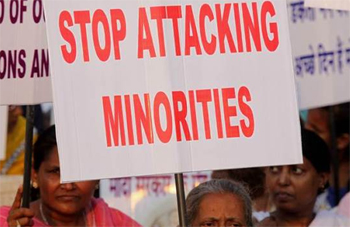
We are living in times where the social norms, the values of Constitution have been violated times and over again. The increasing atrocities on dalits, the lynchings of minorities in the name of Cow-Beef have changed the social equations in a drastic way during last few years. This in a way is part of the ascendance of a politics of communalism which believes in narrow, sectarian religious identity as its defining point. This may get further worsened with the big mandate for Modi in 2019 elections. In the aftermath of elections leading to his return to power, Modi in his victory speech made certain observations which are very disturbing on one hand and also give an idea of shape of things to come.

He stated that this election campaign has unmasked the deceitful claims of secularists and that said that now they can’t mislead the country. As per him secularism as a mask has been destroyed in these elections and that secularism was a cover for minority appeasement. He states that minorities have been deceived and cheated by the parties claiming to be secular.

This statement is not just in the euphoria of victory. For communalism it has been a deeper agenda to do away with the practice of secularism. It is true that there had been aberrations and weaknesses in the practice of this concept, with fallacies like the reversal of Shah Bano judgment or opening the gates of Babri mosque for Shilanyas. The assertion that minorities have been appeased is a total lie. The reports of Gopal Singh Commission, Rangnath Mishra Commission and Sachar Committee tell us about the worsening plight of the Muslim minorities. Some fundamentalist elements within Muslim community have been promoted but the Muslim community as a whole has on one hand been economically marginalized and on the other been subjected to social insecurity. Going beyond the obvious one need to understand as to why the shortfalls in the practice of secularism have dogged our nation?

Secularism has been defined and interpreted a various ways. In Indian context ‘Sarva Dharma Sambhave’ has been the major interpretation. Also that state will not interfere in the maters of religion and religion (clergy) will not dictate and state policy has been the major understanding of this concept, secularism, which is core and integral part of the concept of democracy. Some examples of this are in order. In the wake of demand for renovation of Somnath Temple, Gandhi said that Hindu community is capable of building its own temple. While his disciple Nehru did follow Gandhi’s path in times to come. Same Nehru later called the dams, industries and universities as temples of Modern India.

Gandhi in his own way puts it up brilliantly when he says, “Religion and state will be separate. I swear by my religion, I will die for it. But it is my personal affair. The state has nothing to with it. The state will look after your secular welfare…”

Social scientist Rajiv Bhargava points out that secularism “…combats not just discrimination and other worse forms of inter-religious domination such as exclusion, oppression and humiliation. It is equally opposed to intra-religious domination, i.e. the domination (of women, Dalits, dissenters) within every religious community”

Secularism did not have smooth march in India. It came up with the rising classes during colonial period. The classes which came up with the changes like industrialization, communication and modern education. They called the process of comprehensive change as ‘India as a nation in the making’. The streams like those represented by Bhagat Singh, Ambedkar and Gandhi made it the foundation of their political ideology and struggle for better society. They stood for Indian nationalism. While the declining classes of Landlords and kings shaken by the changes in social fabric and loss of their earlier hegemony came up with communal politics. This communal politics in turn had a bifurcation, Muslim communalism and Hindu communalism. They dreamt of Muslim Nation and Hindu nation respectively. As Professor Bipan Chandra points out Communalism regards a community of one religion as a nation. In India it went through different phases of mild, moderate and extreme communalism. Its understanding is that people of one religion have similar interests, which in turn are different from those of other religion, and so the religious communities are made to pitch against each other. This politics regards the ‘other’ community as a threat to its’ own self. At the same time the intra societal hierarchies are put under the carpet, as the deeper agenda of these groups is to maintain those hierarchies of caste and gender.

One of the weaknesses of practice of secularism in India has been the tremendous opposition from communalism which has been on a rise. While in Pakistan, Muslim communalism was strong right from the beginning; in India it has become stronger during last four decades or so. Its strength has been founded on the polarization, which is an outcome of communal violence. Its issues are those of identity issues like Ram Temple, Love Jihad, Ghar wapsi and Holy cow-beef. It is this communalism which has stood as a counter to the secular ethos of the country; it is this which is the major obstacle for secularism being properly implemented. There are many factors which have been conducive to and helping in the promotion of divisive politics of communalism, one of them being the non completion of secularization process, the process whereby the power of landlord-clergy duo is abolished in a society marching towards democracy.

In India, due to colonial rule, the national movement had to direct its energy primarily against the colonial rulers, while the landlords-kings, to be later joined by some elite-middle classes, continued on the margins, giving the life breath to communalism, leading to partition of the country among other negative phenomenon in the society. Surely India’s plurality and diversity, though currently under cloud, will not let the secular values being eclipsed by the sectarian politics, which is currently on the prowl.

Comments

Add new comment

  • Coastaldigest.com reserves the right to delete or block any comments.
  • Coastaldigset.com is not responsible for its readers’ comments.
  • Comments that are abusive, incendiary or irrelevant are strictly prohibited.
  • Please use a genuine email ID and provide your name to avoid reject.
coastaldigest.com news network
November 28,2025

roadshow.jpg

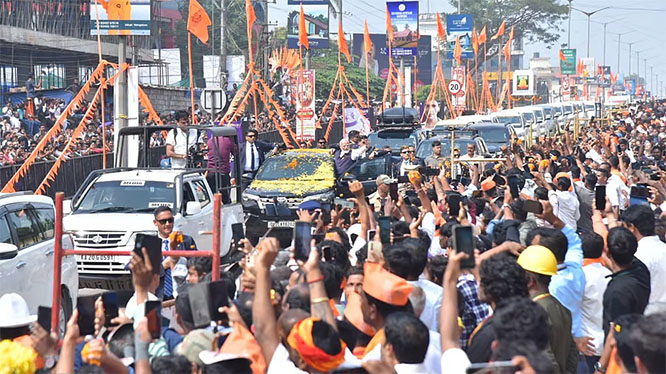
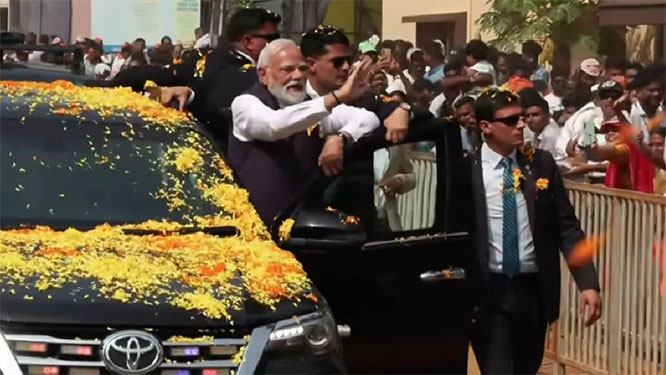
Udupi district transformed into a sea of saffron and celebration on Friday, November 28, as Prime Minister Narendra Modi’s roadshow swept through the coastal temple town. Thousands of residents lined the streets, turning the event into a vibrant public spectacle filled with cheers, flags, and festive energy.

The procession route—from the helipad to the historic Sri Krishna Math—was decked with buntings, saffron flags, and multilayered security barricades. One of the district’s largest-ever security deployments was put in place for the high-profile visit, with over 3,000 police personnel on duty. The arrangement included ten SPs, 27 DSPs, 49 inspectors, 127 sub-inspectors, 232 assistant sub-inspectors, 1,608 constables, and 39 women staff.

Six platoons of the Karnataka State Reserve Police, six Quick Response Teams, bomb detection units, and dog squads were stationed across Udupi. Enhanced surveillance covered Adi Udupi, Bannanje bus stand, and the Sri Krishna Math parking zone, with combing operations carried out along the roadshow corridor.

At the 800-year-old Sri Krishna Math, preparations reached a ceremonial peak. Paryaya Puttige Math seer Sugunendra Teertha Swamiji said the Prime Minister would take part in the Laksha Kantha Geetha Parayana, a mass chanting of the Bhagavad Gita by one lakh devotees, and inaugurate the new Suvarna Teertha Mantapa.

“He will first offer floral tributes to saint-poet Kanakadasa and then unveil the golden covering over the Kanakana Kindi,” the seer said.

The Prime Minister will also receive a Poorna Kumbha welcome and have darshan of Lord Sri Krishna, Mukhyaprana Devaru, and the Suvarna Paduke. Union Minister Pralhad Joshi, Karnataka Governor Thaawarchand Gehlot, Minister Bairathi Suresh, Dharmadhikari D. Veerendra Heggade, and seers from the Ashta Maths are expected to join the ceremony.

Ahead of his arrival, the Prime Minister posted on X that he felt “honoured” to attend the spiritually significant gathering. “This is a special occasion that brings together people from different sections of society for a recital of the Gita. This Matha has a very special significance in our cultural life,” he wrote, noting the institution’s long-standing legacy rooted in the teachings of Sri Madhvacharya.

roadshow2.jpg

Comments

Add new comment

  • Coastaldigest.com reserves the right to delete or block any comments.
  • Coastaldigset.com is not responsible for its readers’ comments.
  • Comments that are abusive, incendiary or irrelevant are strictly prohibited.
  • Please use a genuine email ID and provide your name to avoid reject.
News Network
December 4,2025

Udupi: A 40-year-old NRI from Udupi has reportedly lost more than Rs 12.25 lakh in an online investment scam operated through Telegram.

According to a complaint filed at the CEN police station, Leo Jerome Mendonsa, who has been working in Dubai for the past 15 years in computer accessories sales, maintains NRI accounts in Karkala and Nitte.

On November 12, 2025, Mendonsa was added to a Telegram group called Instaflow Earnings by unknown individuals. Users identified as Priya and Dipannita persuaded him to invest in “Revenue Tasks.” Initially, Mendonsa transferred Rs 1,100 multiple times and received the promised returns, encouraging him to continue.

On November 14, another user, Nishmitha Shetty, directed him to register on a website, digitvisionuoce.cc, and invest Rs 4 lakh in various shares. Over the next few days, he made multiple transfers totaling Rs 12,25,000, including Rs 50,000 via Google Pay, believing the scheme was legitimate.

After receiving the money, the alleged handlers stopped responding, and neither the invested amount nor the promised profits were returned.

The CEN police have registered a case under Sections 66(C) and 66(D) of the IT Act and Section 318(4) of the Bharatiya Nyaya Sanhita (BNS), and investigations are ongoing.

Comments

Add new comment

  • Coastaldigest.com reserves the right to delete or block any comments.
  • Coastaldigset.com is not responsible for its readers’ comments.
  • Comments that are abusive, incendiary or irrelevant are strictly prohibited.
  • Please use a genuine email ID and provide your name to avoid reject.
News Network
November 26,2025

students.jpg

Bengaluru, Nov 26: Karnataka is taking its first concrete steps towards lifting a three-decade-old ban on student elections in colleges and universities. Deputy Chief Minister D.K. Shivakumar announced Wednesday that the state government will form a small committee to study the reintroduction of campus polls, a practice halted in 1989 following incidents of violence.

Speaking at a 'Constitution Day' event organised by the Karnataka Congress, Mr. Shivakumar underscored the move's aim: nurturing new political leadership from the grassroots.

"Recently, (Leader of the Opposition in Lok Sabha) Rahul Gandhi wrote a letter to me and Chief Minister (Siddaramaiah) asking us to think about restarting student elections," Shivakumar stated. "I'm announcing today that we'll form a small committee and seek a report on this."

Student elections were banned in Karnataka in 1989, largely due to concerns over violence and the infiltration of political party affiliates into campus life. The ban effectively extinguished vibrant student bodies and the pipeline of young leaders they often produced.

Mr. Shivakumar, who also serves as the Karnataka Congress president, said that former student leaders will be consulted to "study the pros and cons" of the re-introduction.

Acknowledging the history of the ban, he added, "There were many criminal activities taking place back then. We’ll see how we can conduct (student) elections by regulating such criminal activities."

The Deputy CM reminisced about his own journey, which began on campus. He recalled his political activism at Sri Jagadguru Renukacharya College leading to his first Assembly ticket in 1985 at the age of 23. "That's how student leadership was at the time. Such leadership has gone today. College elections have stopped," he lamented, adding that for many, college elections were "like a big movement" where leaders were forged.

The move, driven by the Congress high command's push to cultivate young talent, will face scrutiny from academics and university authorities who have, in the past, expressed concern that the return of polls could disrupt the peaceful academic environment and turn campuses into political battlegrounds.

Comments

Add new comment

  • Coastaldigest.com reserves the right to delete or block any comments.
  • Coastaldigset.com is not responsible for its readers’ comments.
  • Comments that are abusive, incendiary or irrelevant are strictly prohibited.
  • Please use a genuine email ID and provide your name to avoid reject.