



Why is BJP avoiding polls in Delhi, wonders Kejriwal

September 9, 2014

New Delhi, Sep 9: Arvind Kejriwal, who had taken on Narendra Modi in Varanasi constituency, on Tuesday said “perhaps” he is the most popular leader in the country currently but wondered why BJP is avoiding facing polls in the capital when it claims a wave in its favour.
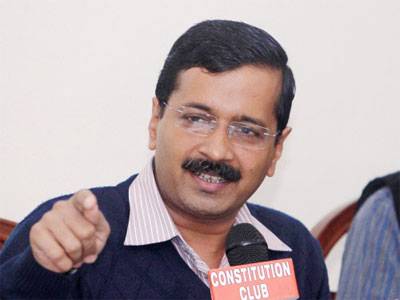
aravind

The AAP leader, who quit the Chief Minister’s post after leading a 49-day-long government, said BJP was afraid of losing elections and that is why it was trying to avoid facing the electorate despite winning all seven seats in Lok Sabha polls in Delhi.

“They are afraid they will lose. All the surveys coming now are showing that AAP will get an overwhelming majority if the elections are held today. It is their government at the Centre, it is their government in MCD. They have seven MPs and they claim it is a wave sweeping across the nation in their favour. Then go for an election. Why they are resorting to these kind of horse trading, buying of MLAs, offering four crore rupees,” he said.

“Perhaps,” Mr. Kejriwal said when asked whether he agreed that Modi was the most popular leader in the country now.

Coming down hard on Lt Governor Najeeb Jung for seeking to invite BJP to form government in the city, Mr. Kejriwal said there was “absolutely no possibility” for the saffron party to take over the reins without indulging in horse-trading.

“The manner in which the LG of Delhi has behaved in the last few weeks clearly shows that he has been batting for BJP,” Mr. Kejriwal said.

Insisting that any invite to BJP to form government will be unconstitutional, he said “I don’t know what arithmetic the Lieutenant Governor has that he has written to the President this letter seeking approval to invite the BJP to form the government.”

Asked whether he regret fighting the elections against Mr. Modi in Varanasi, Mr. Kejriwal said ‘No’.

He said people had very “high hopes” initially that as soon as government was formed as they expected that inflation and prices will come down and corruption will be contained.

But, he said, peoples’ hopes were “betrayed”. “But people still have hopes and everyone says that let give him more time and people are willing to give him time,” Mr. Kejriwal said.

On BJP’s view that strength of the government could be known through secret ballot, he said it was not possible under the Constitution.

“We have consulted very senior advocates. No Article of the Constitution allows secret ballot and in the business rules of Delhi Legislative Assembly it is clearly written that voting can take place only by a show of hands. There is nothing about secret ballot,” he said.

Mr. Kejriwal also rejected criticism that he quit as Delhi Chief Minister to become the Prime Minister.

“I didn’t resign as chief minister to get a major role in the Centre. I resigned from the chief ministership because we actually thought that immediately, there will be Delhi Assembly elections and we will get a clear majority and then we will run government for next five years and make some big systemic changes in Delhi; that was the intention,” he said.

Mr. Kejriwal said he did not have ambition to become Prime Minister. “I have said so many times that I was personally against fighting Lok Sabha elections at that scale.” AAP had contested in around 430 seats in the Lok Sabha polls.

Asked about inner-party democracy, Mr. Kejriwal said AAP has more inner-party democracy than any other party.

“Firstly, let me say with all strength at my command that AAP has more inner-party democracy than any other party in this country. Secondly, it is a new party, we cannot expect everything to be hunky dory in this party. There are a lot of things which may not be in order. We are putting our best efforts to put them in order.

“I may have several weaknesses, I am trying to rectify them. I am a human, not god. There is one thing, our intentions are noble,” he said.

Queried about his style of leadership and whether he takes criticism as constructive, he said, “Of course. I have huge respect for Shanti Bhushan. I greatly admire and respect him. He is a guide for us. He has the right to even slap me. Whatever issues he has raised, we will work on it.”

Mr. Bhushan had last month criticised Mr. Kejriwal’s style of functioning.

Comments

Add new comment

  • Coastaldigest.com reserves the right to delete or block any comments.
  • Coastaldigset.com is not responsible for its readers’ comments.
  • Comments that are abusive, incendiary or irrelevant are strictly prohibited.
  • Please use a genuine email ID and provide your name to avoid reject.
News Network
December 16,2025

jordan.jpg

Prime Minister Narendra Modi on Monday held talks with Jordan’s King Abdullah II in Amman, during which the two leaders discussed ways to further strengthen bilateral relations, with the Prime Minister outlining an eight-point vision covering key areas of cooperation.

Describing the meeting as “productive”, PM Modi said he shared a roadmap focused on trade and economy, fertilisers and agriculture, information technology, healthcare, infrastructure, critical and strategic minerals, civil nuclear cooperation, and people-to-people ties.

In a post on social media platform X, the Prime Minister praised King Abdullah II’s personal commitment to advancing India–Jordan relations, particularly as both countries mark the 75th anniversary of the establishment of diplomatic ties this year.

“Held productive discussions with His Majesty King Abdullah II in Amman. His personal commitment towards vibrant India-Jordan relations is noteworthy. This year, we are celebrating the 75th anniversary of our bilateral diplomatic relations,” PM Modi said.

The meeting took place at the Al Husseiniya Palace, where the two leaders also exchanged views on regional and global issues of mutual interest. According to the Ministry of External Affairs (MEA), both sides agreed to further deepen cooperation in areas including trade and investment, defence and security, counter-terrorism and de-radicalisation, fertilisers and agriculture, infrastructure, renewable energy, tourism, and heritage.

The MEA said both leaders reaffirmed their united stand against terrorism.

PM Modi arrived in Amman earlier on Monday and was received by Jordanian Prime Minister Jafar Hassan, who accorded him a formal welcome. Following the talks, King Abdullah II hosted a banquet dinner in honour of the Prime Minister, reflecting the warmth of bilateral ties.

Jordan is the first leg of PM Modi’s three-nation tour. From Amman, the Prime Minister will travel to Ethiopia at the invitation of Prime Minister Abiy Ahmed Ali, marking his first official visit to the African nation. The tour will conclude with a visit to Oman.

Comments

Add new comment

  • Coastaldigest.com reserves the right to delete or block any comments.
  • Coastaldigset.com is not responsible for its readers’ comments.
  • Comments that are abusive, incendiary or irrelevant are strictly prohibited.
  • Please use a genuine email ID and provide your name to avoid reject.
News Network
December 16,2025

bengal.jpg

The deletion of over 58 lakh names from West Bengal’s draft electoral rolls following a Special Intensive Revision (SIR) has sparked widespread concern and is likely to deepen political tensions in the poll-bound state.

According to the Election Commission, the revision exercise has identified 24 lakh voters as deceased, 19 lakh as relocated, 12 lakh as missing, and 1.3 lakh as duplicate entries. The draft list, published after the completion of the first phase of SIR, aims to remove errors and duplication from the electoral rolls.

However, the scale of deletions has raised fears that a large number of eligible voters may have been wrongly excluded. The Election Commission has said that individuals whose names are missing can file objections and seek corrections. The final voter list is scheduled to be published in February next year, after which the Assembly election announcement is expected. Notably, the last Special Intensive Revision in Bengal was conducted in 2002.

The development has intensified the political row over the SIR process. Chief Minister Mamata Banerjee and her Trinamool Congress have strongly opposed the exercise, accusing the Centre and the Election Commission of attempting to disenfranchise lakhs of voters ahead of the elections.

Addressing a rally in Krishnanagar earlier this month, Banerjee urged people to protest if their names were removed from the voter list, alleging intimidation during elections and warning of serious consequences if voting rights were taken away.

The BJP, meanwhile, has defended the revision and accused the Trinamool Congress of politicising the issue to protect what it claims is an illegal voter base. Leader of the Opposition Suvendu Adhikari alleged that the ruling party fears losing power due to the removal of deceased, fake, and illegal voters.

The controversy comes amid earlier allegations by the Trinamool Congress that excessive work pressure during the SIR led to the deaths by suicide of some Booth Level Officers (BLOs), for which the party blamed the Election Commission. With the draft list now out, another round of political confrontation appears imminent.

As objections begin to be filed, the focus will be on whether the correction mechanism is accessible, transparent, and timely—critical factors in ensuring that no eligible voter is denied their democratic right ahead of a crucial election.

Comments

Add new comment

  • Coastaldigest.com reserves the right to delete or block any comments.
  • Coastaldigset.com is not responsible for its readers’ comments.
  • Comments that are abusive, incendiary or irrelevant are strictly prohibited.
  • Please use a genuine email ID and provide your name to avoid reject.

